If you want to photograph both an entire windmill landscape and a distant detail on the same walk, a bridge camera gives you both focal lengths in one fixed lens. A mirrorless camera with a wide-angle and telephoto lens, on the other hand, means changing lenses. Choose based on the optical wide-angle and telephoto ranges, the full kit you want to carry, and how you’ll frame your subject at high zoom.
Who is this choice for?
Photographer capturing distant windmill details
Wants to frame a distant windmill or a small subject near it from a fixed spot, and is weighing optical telephoto reach against ease of handling. The Dutch Consumers’ Association discusses the importance of zoom range, while Nikon specifies the range of the COOLPIX P1100.
Landscape photographer looking for two compositions
Wants to capture both the windmill and its surroundings in a wide shot, and a distant detail. Nikon describes the Z50II kit as including two separate zoom lenses.
Walker travelling light
Wants to photograph the landscape without carrying a heavy or bulky kit, and is weighing comfort against reach and the need to change lenses. The Dutch Consumers’ Association discusses size and ease of use; Canon gives the weight of the EOS R50 camera with battery and card, not of a complete lens kit.
What should you look for when choosing?
Bridge camera with fixed superzoom
A good fit if: you want to switch quickly between a wide landscape composition and a distant detail while out and about, without changing lenses.
The trade-off: the Dutch Consumers’ Association points out that a very wide zoom range goes hand in hand with a smaller sensor. At extreme telephoto settings, it can also be difficult to keep your subject in the frame.
Mirrorless camera with wide-angle and telephoto zoom lenses
A good fit if: you want the flexibility to use different lenses and are happy to carry a wide-angle and a telephoto lens for your two compositions.
The trade-off: check the mount and everything included in the kit; you may need to change lenses while taking photos.
| What to consider |
What should you check? |
Which consumers is this important for? |
| Optical telephoto reach |
Compare the optical telephoto endpoints in 35mm-equivalent mm, not just the zoom factor. Also consider how you’ll keep your subject in the frame at high zoom. |
If I want to frame a distant windmill detail larger from a single spot, I prioritise optical reach; around 27% of consumers put telephoto reach first. |
| Wide-angle and detail shots |
Check both the wide-angle and telephoto endpoints. With a mirrorless camera, check which lenses are actually included in the kit. |
I want to capture both the windmill and its surroundings, and a distant detail, on the same walk; around 27% of consumers prioritise both compositions. |
| Lens choice and sensor |
Check the sensor and lens mount, as well as which lenses you can use. Don’t judge image quality by megapixels or zoom range alone. |
If I want a choice of focal lengths, I consider the sensor and compatible lenses too; around 20% of consumers prioritise lens choice and image quality. |
| Carrying comfort |
Compare the weight of the complete kit, including the lenses you’ll take, and think about how you’ll carry it on your walk. |
For a longer walk, I want to know the weight of my full kit, not just the camera body; around 13% of consumers put carrying comfort first. |
| Complete kit |
Check that the kit you choose includes both the landscape lens and the telephoto lens you need. |
I want to know in advance whether the camera I’ve chosen and its included lenses will let me create both compositions; around 13% of consumers prioritise a complete wide-angle and telephoto solution. |
Common buying pitfalls
-
Confusing digital magnification with optical zoom
On the Nikon COOLPIX P1100, 3000 mm in 35mm-equivalent terms is the optical telephoto reach; Nikon lists 6000 mm for Dynamic Fine Zoom as digital magnification. These figures don’t describe the same thing.
First compare the optical wide-angle and telephoto endpoints in the same unit, then check whether digital magnification is relevant to how you’ll use the camera.
-
Assuming a camera body or standard kit is a complete telephoto solution
A mirrorless camera kit won’t necessarily include the lens you need for a distant subject. Canon, for example, lists different lenses in different bundles, so check exactly what’s included.
Check whether both the landscape lens and a suitable telephoto lens are included, and whether they fit the camera mount.
If the telephoto lens isn’t included, you’ll need to choose and carry a suitable lens separately.
-
Assuming a fixed superzoom is automatically light or suitable for every landscape
A fixed lens means you don’t have to change lenses, but that alone tells you nothing about the camera’s weight or how wide a view its wide-angle setting offers. With a very narrow field of view, it can also be harder to keep your subject in the frame.
Consider the full range, the weight you’ll carry and the compositions you want to create, not just the maximum zoom factor.
Brands to compare
Panasonic
The LUMIX DC-FZ82D is a bridge camera with a fixed zoom lens for both wide-angle and telephoto shots.
- Panasonic specifies a 20–1200 mm 35mm-equivalent range and 60× optical zoom.
- Check that the exact version you want is available before choosing.
Nikon
The COOLPIX P1100 has a fixed lens with extensive telephoto reach; the Z50II kit with two zoom lenses is a separate mirrorless camera option.
- Nikon specifies an optical range of 24–3000 mm in 35mm-equivalent terms for the P1100. The Z50II kit mentioned includes a 16–50 mm lens and a 50–250 mm lens.
- The 6000 mm figure for Dynamic Fine Zoom is digital magnification, not additional optical reach. With the Z50II kit, you’ll need to change lenses.
Canon
The EOS R50 is an APS-C mirrorless camera with interchangeable lenses; the bundle mentioned includes an RF-S 18–45 mm lens and an RF 75–300 mm lens.
- Canon lists 24.2 megapixels and a weight of around 375 g for the camera with battery and card.
- That weight doesn’t include the complete kit with lenses. Check the bundle: the RF-S 55–210 mm is a different lens from the RF 75–300 mm included in the kit mentioned.
Sony
The α6700 is an APS-C mirrorless camera with an E-mount, allowing you to build a kit with different lenses.
- For its E 70–350 mm lens on APS-C, Sony gives an angle-of-view range equivalent to 105–525 mm.
- This telephoto lens alone won’t give you a wide landscape composition; work out which additional lens you’ll need for that.
Cameras at Joybuy
This Joybuy selection includes cameras with different types of zoom, as well as a Sony mirrorless camera with a 16–50 mm kit lens. For a distant windmill detail, check in particular whether the stated range is optical and whether a telephoto lens is included.
 No image available
Komery W6 12× optical zoom 4K camera
The stated 12× optical zoom may suit you if you want to frame a distant subject; check whether the range works for your shooting position.
The product title also mentions 4K, 64 MP and Wi-Fi.
View product at Joybuy
 No image available
Songdian camera with 8× optical zoom, white
The stated optical zoom may be useful if you want to frame a distant subject; compare the range with the crop you need.
The product title mentions 5K, 64 MP and a dual lens. The description lists electronic image stabilisation, autofocus and manual focus.
View product at Joybuy
 No image available
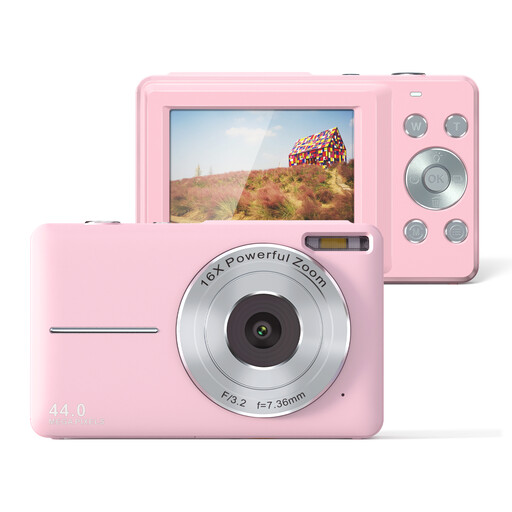
Songdian 4K 44 MP pocket camera, pink
The stated 16× zoom is digital and doesn’t add optical telephoto reach; bear this in mind if you want to frame a distant windmill detail more closely.
The product title mentions 44 MP.
View product at Joybuy
 No image available
Sony ZV-E10 with 16–50 mm zoom lens
The included lens is 16–50 mm; you’ll need another compatible lens for greater telephoto reach.
The description lists an APS-C sensor and Sony E-mount.
View product at Joybuy
Frequently asked questions
Is the highest zoom factor automatically best for a distant windmill?
No. Compare both the wide-angle and optical telephoto endpoints in the same unit. At extreme zoom, it can be harder to keep your subject in the frame; digital magnification doesn’t add optical reach.
Do I need a tripod when zooming in a lot?
It depends on the telephoto range and the conditions. The Dutch Consumers’ Association explains that a very narrow field of view makes it harder to keep your subject in the frame, and says a tripod is essential at 80× zoom. Also check the viewfinder and stabilisation on the specific camera.
What should I check after a trip before putting my camera away?
Check that all the parts you took with you are there and dry, and follow the instructions for your exact model when cleaning and storing it. Don’t assume it’s weather-resistant without model-specific information.
Who should I contact if a camera bought in the Netherlands turns out to be faulty?
According to the Dutch government, you should contact the seller if you have a problem with a faulty product. A manufacturer’s warranty is additional cover; in the Netherlands, there is no fixed statutory warranty period for all products.
Can I publish a windmill landscape online if passers-by are recognisable?
It depends on how you use the image and the circumstances. The Dutch Data Protection Authority distinguishes between photos kept private or shared with a very limited group and wider publication or commercial use. Privacy rules may apply to recognisable people in the latter cases.


