
Floral detail photographer
You photograph petals, bouquets and textures up close, and want to know which zoom setting the macro function works at.


Start with what you photograph most often. For floral details, the focusing distance and the zoom setting at which it applies are both important, while whole stalls call for a wide enough angle. Then weigh the camera’s weight and lens and sensor choices against how far you’ll walk and the lighting conditions. A greater zoom range isn’t automatically the most practical choice for a compact kit.
You photograph petals, bouquets and textures up close, and want to know which zoom setting the macro function works at.
You want to capture whole stalls and their surroundings, as well as details, without changing lenses.
You spend longer walking around and prioritise carrying comfort over the longest possible telephoto reach.
Start with the shots you take most often: close-up details call for attention to the macro setting, while a whole stall needs a wide enough angle. Then factor in the weight you’ll carry and the lighting conditions.
| What to consider | What should you check? | Who is this important for? |
|---|---|---|
| Flowers up close | Check the macro setting, how the focusing distance is measured and the zoom setting at which that distance applies. | If I want to photograph petals up close, I want to know whether the minimum focusing distance suits the framing I’m after. Around 40% of consumers give floral details their highest priority. |
| Stalls and details | Compare the wide-angle and telephoto ends using the same unit, such as 35mm-equivalent focal lengths. | I want to capture a whole stall, then frame a flower further away without changing lenses. Around 30% of consumers prioritise this versatility. |
| Carrying comfort | Compare the weight including the battery and memory card, where available, and consider how you plan to carry the camera. | If I’m walking around the market for a long time, a camera that’s comfortable to carry matters more than maximum telephoto reach. Around 20% of consumers prioritise portability. |
| Changing light | Compare the sensor size and lens aperture at both ends of the zoom range. Look at images taken in conditions similar to those on your market visit. | At a stall in the shade, I want to know which sensor and lens specifications to compare, rather than judging by the zoom factor alone. Around 10% of consumers give low-light photography their highest priority. |
A long telephoto reach doesn’t tell you how much you can fit into the frame at close range. Nikon specifies 125× optical zoom and a weight of approximately 1.4 kg for the COOLPIX P1100. On a busy market route, a wide angle and macro capability may be more useful.
First work out the distances you usually photograph from. Then compare the wide-angle range, macro setting and weight with the battery and memory card fitted.
Kodak lists a macro distance from 1.6 cm at the wide-angle end for the PIXPRO AZ425, while the normal focusing distance at the telephoto end starts at 200 cm.
When checking the focusing distance, also read which zoom setting and conditions it applies to. Don’t just look at the smallest number.
Canon lists the PowerShot SX70 HS in its Dutch shop as discontinued and no longer available.
Before buying, check the seller, the camera’s condition, what’s included and the applicable returns policy.
The condition and included accessories may vary for a second-hand camera.
The LUMIX FZ82D is worth considering if you want to switch between wide framing, floral details and telephoto reach with a single fixed lens.
The PowerShot SX70 HS is worth comparing if an adjustable screen and a wide-angle-to-telephoto range matter to you.
The RX10 IV is an option to consider if you want to weigh a 1.0-type sensor and the stated lens aperture against the telephoto reach.
The AZ425 is a fixed-lens zoom option for anyone comparing wide angle, telephoto and macro at the wide-angle end.
The COOLPIX P1100 is most relevant if subjects at a great distance matter more than a lightweight kit.
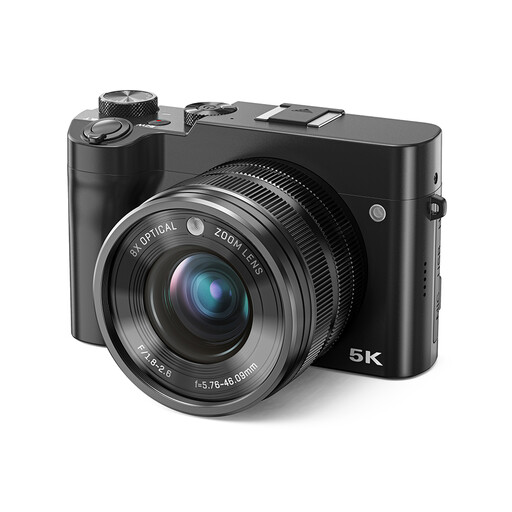
Below is a Joybuy digital camera with 8× optical zoom. Compare its listed features with the framing and handling you need at the flower market.
 No image available
The stated 8× optical zoom lets you adjust your framing for subjects at different distances.
The product name lists 5K, 64MP and a dual lens, along with Full Color Night Vision. The product description mentions electronic image stabilisation, autofocus, manual focusing via the lens ring, a touchscreen and Wi-Fi.
No. That distance alone doesn’t tell you whether you can achieve the composition you want. Check which zoom setting the distance applies to, and whether you can frame the flower, available light and background as you’d like at that setting. Canon lists 0 cm at the wide-angle end for the PowerShot SX70 HS; Kodak also limits the stated macro distance for the AZ425 to the wide-angle end.
Check that the battery is charged, that you have a suitable memory card, and that you’re comfortable using the viewfinder, screen and macro setting. Also compare the included accessories: Canon lists a battery, charger, lens cap and strap among the items supplied with the PowerShot SX70 HS.
According to the Government of the Netherlands, there is no fixed term for the statutory guarantee in the Netherlands. If a product doesn’t meet reasonable expectations, the seller is your point of contact for a solution. For eligible distance purchases, a 14-day cooling-off period applies in many cases. Check whether the specific type of sale is covered by this rule and whether any exception applies.
This depends, among other things, on the purpose and how easily people can be identified in the images. The Dutch Data Protection Authority distinguishes between images that stay private or are shared with a very limited group and wider publication or commercial use. Outside the exception for personal or household use, processing personal data requires a lawful basis under the GDPR. This does not amount to general permission to take and publish any market photo.