
Photographing fine details
You want to capture small lines, embossing or printed details on their own. Look for close focusing and consider how much room you’ll have left for lighting.


Start with a camera that can focus at the zoom setting you want to use and leaves enough room to light the tin evenly. Maximum zoom shouldn’t be your starting point for this tabletop subject. For fine decoration, macro mode and precise focusing matter; a larger sensor and control over lighting and reflections can become more important if you also take photos in changing light. A short focusing distance at the wide-angle end doesn’t automatically mean the camera can focus at the telephoto end or fit the whole tin in the frame.
You want to capture small lines, embossing or printed details on their own. Look for close focusing and consider how much room you’ll have left for lighting.
You want the entire biscuit tin to be clearly recognisable while keeping its decoration visible. Framing, depth of field and lighting all matter, alongside macro features.
If reflections hide the decoration, controlling your lighting set-up is important. You can adjust the positions of the tin, camera and light source in relation to one another.
First, compare the focusing distance at the zoom setting you want to use. Then check whether you can position the light around the tin. The Consumers’ Association considers image sensor size more important for photo quality than the number of megapixels.
| What to consider | What to look for | Who it’s relevant to |
|---|---|---|
| Fine decoration up close | Compare the minimum focusing distance at each zoom setting and check that the subject fits in the frame well at that distance. | If I want to capture small lines or embossing in detail, I look for close focusing and enough room for lighting. Around 33% of consumers prioritise detail. |
| Reflections on the tin | Check whether you can reposition the tin, camera and a diffused light source in relation to one another. | When glare obscures the printed details, I want to be able to adjust the lighting and shooting angle. Around 27% of consumers give controlling reflections top priority. |
| Fitting the whole tin in the frame | Check whether you can frame the tin from the distance you want; don’t compare sensor sizes based on megapixels alone. | For an overall shot, I want the whole tin to remain recognisable without losing sight of the decoration. Around 20% of consumers prioritise this kind of photo. |
| Photographing other subjects too | Compare the zoom range for those other situations with the focusing options for this tabletop subject. | If I want to use one camera for different types of subject, that matters alongside photos of the biscuit tin. Around 20% of consumers prioritise versatility. |
The stated distances may depend on the zoom setting or a specific macro mode. So a distance given for wide-angle doesn’t automatically tell you how close you can focus at the telephoto end.
Check the distance for the zoom setting you’ll use to photograph the decoration or the whole tin.
A shiny surface can show reflections and bright spots that obscure the pattern. More zoom won’t change how the light reflects.
Try diffused light and adjust the position of the light source or the shooting angle. A diffuser or light tent needs extra set-up space and preparation.
The Panasonic DC-FZ82D and DMC-FZ82 have similar names, but the specifications for one model don’t automatically apply to the other.
Compare the full model numbers and their corresponding specifications before making your choice.
Check which items are included with the specific version you’re buying. Nikon states that a charger is not included with the COOLPIX P1100.
Before buying, check the exact version and the accessories included.
If your version doesn’t include a charger, you may need to buy one separately.
The LUMIX DC-FZ82D is worth considering if both close-up details and wider shots are important to you.
The RX10 IV may suit you if you’re looking for a type 1.0 sensor and enough space between the camera and subject.
The PowerShot SX70 HS is worth considering if wide-angle macro and a tilting screen are important to you.
The COOLPIX P1100 is primarily worth comparing if you also want to photograph subjects at a great distance.
The AZ528 is a bridge camera to compare if both wide-angle macro and a general-purpose zoom range matter to you.
This Joybuy selection includes digital cameras with optical zoom. For each model, check whether its focusing distance and the room available for lighting suit photos of the biscuit tin.
 Image unavailable
The stated 12× optical zoom gives you an option for adjusting the framing. Also check whether the focusing distance is suitable for capturing small details on the tin.
The product name lists 64MP, 4K and Wi-Fi.
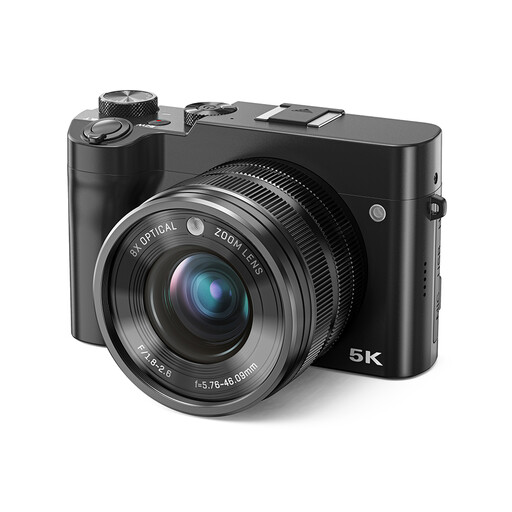 Image unavailable
The stated optical zoom gives you an option for adjusting the framing. Check whether the focusing distance is suitable for the close-up of the decoration you want.
The description mentions manual focusing via a lens ring and an adjustable focus area. The product name lists a dual lens and night vision.
No. For the models mentioned, short focusing distances apply at the wide-angle end or in a specific macro mode. Check separately whether the whole tin fits in the frame from the distance you want and whether there’s enough room for lighting.
Try diffused light and move the light source or adjust the shooting angle if reflections obscure the decoration. Nikon describes using a light tent when photographing jewellery; you can try this approach, but it doesn’t guarantee the same results with every tin.
Check which battery, charger and memory card are included with the version you’ve chosen. Nikon explicitly states that a charger is not included with the COOLPIX P1100.
Not automatically. According to the Dutch government, the seller must resolve problems with a faulty product. An extended warranty is mainly worth considering if its terms clearly offer additional rights.
According to the Dutch government, distance purchases are often covered by a 14-day cooling-off period, and the seller must tell you about it. This doesn’t automatically apply to every transaction or every private sale.