
Families with a strict sugar-free requirement
You’re looking for a product that meets the EU requirement for the ‘sugar-free’ claim. If so, check the ‘of which sugars’ figure per 100 g: for solid foods, the limit is no more than 0.5 g.


For a large family, the choice starts with whether ‘sugar-free’ is a strict requirement or whether you mainly want to avoid added sugar. Under EU rules for nutrition claims, a solid food can only be called ‘sugar-free’ if it contains no more than 0.5 g of sugars per 100 g; ‘no added sugar’ does not mean that it contains no naturally occurring sugars. Then compare the nutritional information per 100 g and per serving, the ingredients and the amount your family actually eats.
You’re looking for a product that meets the EU requirement for the ‘sugar-free’ claim. If so, check the ‘of which sugars’ figure per 100 g: for solid foods, the limit is no more than 0.5 g.
Naturally occurring sugars don’t rule out a product for you. As well as checking the claim on the packaging, compare the ingredients, fibre, salt and nutritional information per serving.
You want to know how many servings a pack provides and whether the ingredients and taste will suit the people who’ll be eating it. Check for allergens and any sweeteners before choosing multiple packs.
First decide whether the total amount of sugars or the addition of sugar matters most. Then compare products using the same quantity, preferably per 100 g, and separately consider the portion you serve at home.
| What to consider | What to check when buying | Who it matters to |
|---|---|---|
| Sugar-free or no added sugar | Check the ‘of which sugars’ figure per 100 g. For solid foods, the EU limit for the ‘sugar-free’ claim is no more than 0.5 g per 100 g; a claim about added sugar does not prove that a product meets this limit. | If sugar-free is a strict requirement for my family, I don’t want to rely on the front of the pack alone. An estimated 36% of consumers put this strict requirement first. |
| Fibre and ingredients | Compare fibre and salt per 100 g, and check the ingredients if you’re looking for a variety with no added sugar. | When choosing a breakfast cereal for regular use, I want to weigh up the rest of the nutritional information as well as the sugar claim. For an estimated 29% of consumers, the overall ingredients and nutrition are their first concern. |
| Pack size and servings | Compare the pack weight with the stated serving size and the amount people at home actually eat. | When shopping for several people, I want to know how long the packs will last without relying on their size alone. This is the main consideration for an estimated 21% of consumers. |
| Taste and ingredients | Check the grains, nuts, allergen information and any sweeteners in the specific variety you’re considering. | Stocking up isn’t much use to me if the people who’ll be eating it don’t like the taste or need to avoid an ingredient. An estimated 14% of consumers put how well a product suits their family first. |
A breakfast cereal can be sold with no added sugar and still contain naturally occurring sugars. For example, Albert Heijn lists 1.9 g of sugars per 100 g for AH Granola noten 0% toegevoegd suiker and 1.1 g per 100 g for Brinta Oergranen.
If sugar-free is a strict requirement, check the total sugars per 100 g against the EU limit of no more than 0.5 g per 100 g for solid foods.
A claim about added sugar alone tells you nothing about the amount of fibre or salt in the same product. That means you’re comparing just one part of its nutritional profile.
Compare the fibre, salt and ingredients for each of the varieties you’re considering, too.
A nut or grain mix may contain ingredients that aren’t suitable for everyone who’ll be eating it. Albert Heijn also notes that AH Krokante muesli noten 0% suiker contains maltitols and carries a warning that excessive consumption may have a laxative effect.
Check the current allergen information and ingredients list; if in doubt, try one pack first.
If your family doesn’t eat a particular variety, a larger stock may go unused.
The weight of a pack doesn’t tell you how many servings your family will get from it: that also depends on how much you put in each bowl.
Before stocking up, compare the pack weight and stated serving size with the amount people at home actually eat.
Albert Heijn describes its own granola and muesli varieties with claims about added sugar.
Quaker has Cruesli varieties labelled ‘zero sugar added’ in its crunchy muesli range.
Brinta Oergranen is a grain mix that Albert Heijn describes as having ‘0% added sugars’.
Kellogg's has several breakfast cereal ranges. A focus on fibre or a familiar product name doesn’t tell you whether a particular variety meets your preferences on sugar.
These granola and Cruesli varieties are worth considering if you’re comparing products with claims about added sugar and weighing up pack sizes for your family. Their names or claims don’t automatically make them sugar-free: check the total sugars and ingredients for the variety you choose.
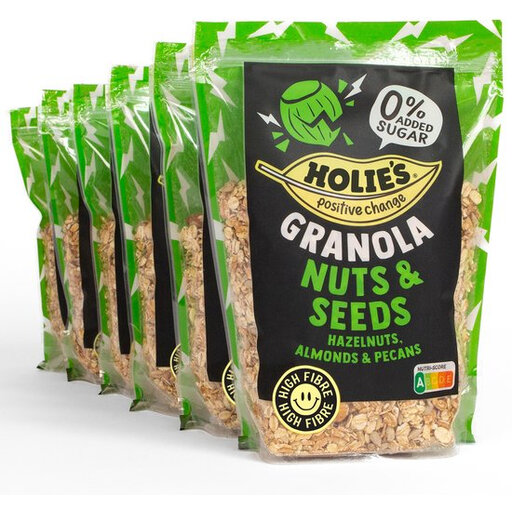 Image unavailable
For a family looking to use several packs of granola with nuts and seeds at once.
The pack contains 6 × 350 g. At 2.1 g of sugars per 100 g, it’s too high for a strict sugar-free requirement; also check that the ingredients suit everyone who’ll be eating it.
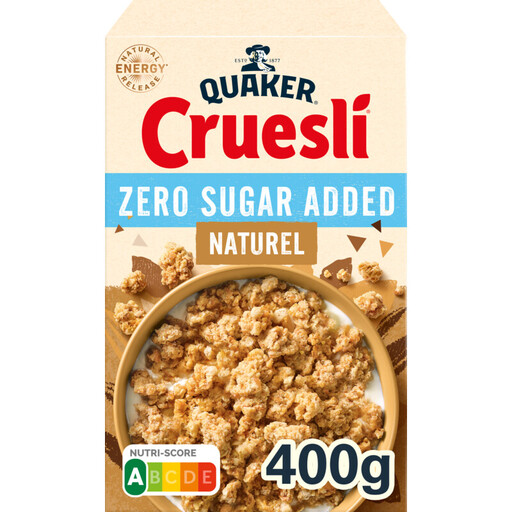 Image unavailable
For families looking to compare a plain variety of crunchy muesli.
The pack contains 400 g. At 3.8 g of sugars per 100 g, it’s above the EU limit for ‘sugar-free’; if you have allergies, check the information on the current packaging.
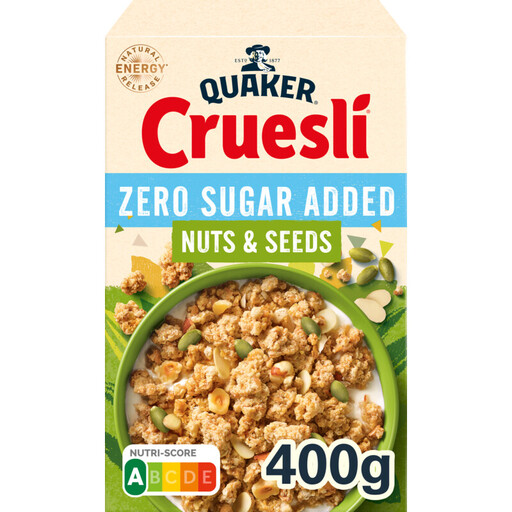 Image unavailable
For a family considering a Cruesli variety with nuts and seeds and wanting to check the ingredients are suitable for everyone first.
The pack contains 400 g. At 3.8 g of sugars per 100 g, it isn’t suitable for anyone who requires the product to meet the EU limit for ‘sugar-free’.
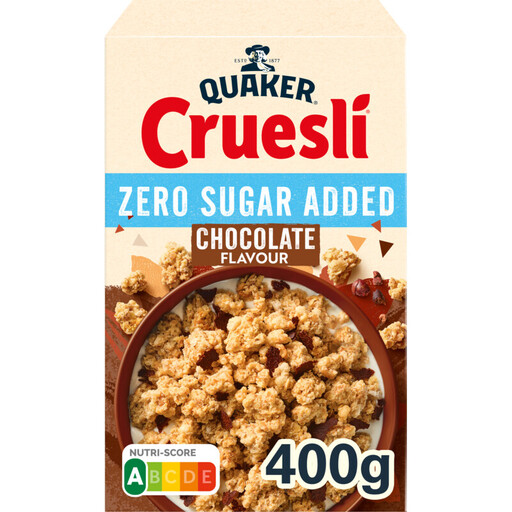 Image unavailable
For families looking to compare a chocolate-flavoured crunchy muesli.
The pack contains 400 g. Despite ‘Zero Sugar’ in the product name, its stated 3.4 g of sugars per 100 g is above the EU limit for ‘sugar-free’; check the allergen information, too.
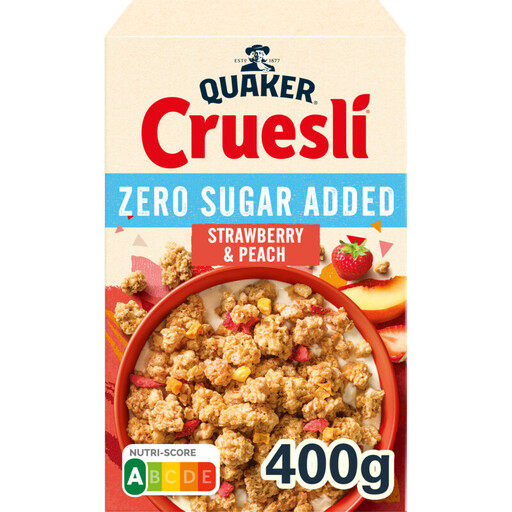 Image unavailable
For families considering a Cruesli variety with strawberry and peach flavour.
The pack contains 400 g. At 4.4 g of sugars per 100 g, it’s above the EU limit for ‘sugar-free’; check the ingredients and allergens on the pack you choose.
No. Under EU rules for nutrition claims, a solid food can be called ‘sugar-free’ if it contains no more than 0.5 g of sugars per 100 g. A product with no added sugar may still contain naturally occurring sugars, so always check the ‘of which sugars’ figure in the nutrition table.
As well as the sugar claim, compare the fibre, salt and ingredients in the specific variety you’re buying. The Netherlands Nutrition Centre assesses products within product groups against several criteria, so a single claim on the front doesn’t tell you how the product as a whole is made up.
A variety with no added sugar may contain sweeteners. For AH Krokante muesli noten 0% suiker, Albert Heijn lists maltitols and warns that excessive consumption may have a laxative effect. Check the ingredients and warnings for the variety you choose.
First check that the ingredients and allergens are suitable for everyone who’ll be eating it and that the flavour matches their preferences. Then compare the pack size with the portions you serve at home; if in doubt, try one pack before buying several.