
Families whose consumption varies
If not everyone eats breakfast loaf every week, a smaller pack can help you match the amount you open to how much you’ll use.


A large pack of breakfast loaf suits a family that eats it regularly; a smaller pack is more practical if only some household members eat it or how much you use varies. Individually wrapped slices or bars keep portions you haven’t used sealed and are convenient to take with you, but they involve more individual packaging. If you’re considering a smaller pack, check the actual weight: ‘half loaf’ doesn’t refer to one standard size.
If not everyone eats breakfast loaf every week, a smaller pack can help you match the amount you open to how much you’ll use.
If several family members eat it, the net weight and number of slices can help you decide whether a larger pack is right for you.
If, for example, you’re looking for a wholemeal variety or a product with no added sugar, compare the ingredients and nutritional information for each product.
First, work out how much breakfast loaf your household usually eats. Then choose the pack format and check the ingredients of each product.
| What to consider | What to check | Who it matters to |
|---|---|---|
| Pack size | Compare the net weight of smaller packs, such as 265–345 g, with larger packs, and check whether the loaf is pre-sliced. | If someone at home only eats breakfast loaf occasionally, I don’t want to open more than we’ll use; a suitable pack size would be the top priority for around 31% of consumers. |
| How much your family eats | For larger packs of around 485–550 g, check the net weight and, where listed, the number of slices. | If several family members regularly have a slice, I want a pack that contains enough for everyone; having enough breakfast loaf for the household would be the top priority for around 31% of consumers. |
| Ingredients | Compare fibre and sugars per 100 g, and read the ingredients and allergen information on the pack. | If family members have different preferences about ingredients, I want to know what’s in each variety; ingredients would be the main consideration for around 25% of consumers. |
| Taking portions with you | Check whether slices or bars are individually wrapped and how many grams there are per portion. | For a packed lunch, I want to take a portion with me without opening the rest; this convenience would be the main reason for choosing a pack for around 13% of consumers. |
A smaller pack of breakfast loaf can come in different weights and shapes. The description doesn’t tell you how many slices you’ll get or whether the loaf is pre-sliced.
Check the net weight and whether the specific product is sliced, and think about how much your household will eat once it’s open.
A 485–550 g pack won’t necessarily suit a household where only one person eats breakfast loaf occasionally.
Choose an amount that suits how much your household eats. Consider a smaller pack or individually wrapped portions if they’re a better fit.
These descriptions don’t tell you everything about a product. Products with no added sugar can still contain sugars, and ingredients and allergens vary between varieties.
Compare the nutritional information per 100 g and read the ingredients and allergen information on the pack.
Peijnenburg offers breakfast loaf in larger loaves, smaller formats and individual portions.
AH offers, among other products, a 485 g pre-sliced plain breakfast loaf.
Jumbo lists plain breakfast loaf in 280 g and 550 g packs.
ALDI lists pre-sliced wholemeal breakfast loaf and a pre-sliced zero-sugar variety from Koek & Bakker, both in 485 g packs.
PLUS offers plain breakfast loaf bars in a 330 g multipack of 6 for anyone who wants pre-portioned servings.
This 550 g unsliced breakfast loaf is worth considering if your household gets through a larger pack. If you’re looking for a smaller pack or pre-portioned servings, choose a different pack format.
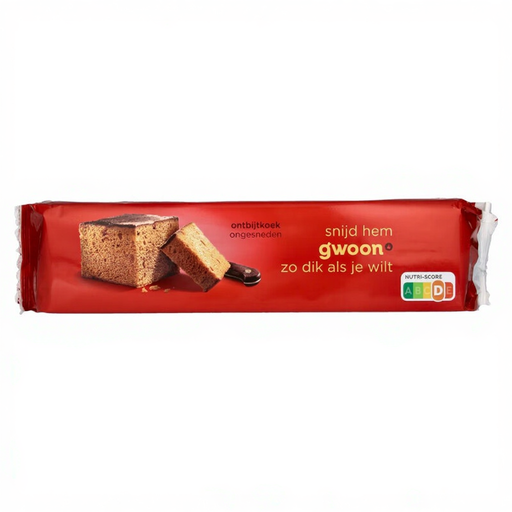 Image unavailable
For households that get through a larger pack of breakfast loaf. This variety weighs 550 g and is unsliced, so you can cut it yourself.
Treat ‘half loaf’ as a description of a smaller pack, not as a fixed pack weight. Albert Heijn, Jumbo and PLUS list smaller breakfast loaf products in a range of weights, including 265 g, 280 g and 345 g, so check the net weight of the product you’re considering.
No. ‘No added sugar’ doesn’t mean a product contains no sugars. Peijnenburg lists 4.9 g of sugars per 100 g for its wholemeal variety with no added sugar, so compare the nutritional information on the specific pack.
Follow the storage instructions on the pack of your breakfast loaf. Albert Heijn and Jumbo product information advises storing it in a cool, dry, dark place; Jumbo also recommends an airtight container or tin to keep the loaf soft.
Yes. Check the allergen information for the specific variety if certain ingredients matter to your household. PLUS product information lists rye flour in its plain bars and also notes the possible presence of allergens including wheat, barley, oats, milk, almonds and hazelnuts.