
People keeping an eye on sugar
You want breakfast cake as part of a sweet breakfast, but you compare how much sugar each slice contains. If you choose a variant with no added sugar, check which sweeteners it contains too.


When choosing breakfast cake, don’t rely on the word ‘wholegrain’ alone: compare the sugar and fibre content per 100 g and per slice. Peijnenburg lists 4.9 g of sugars and 17 g of fibre per 100 g for its wholegrain variant with no added sugar. The standard wholegrain variants mentioned by Albert Heijn, Jumbo and PLUS list 34 to 35.5 g of sugars per 100 g. Check the ingredients and allergen information too, as a variant with no added sugar may contain sweeteners.
You want breakfast cake as part of a sweet breakfast, but you compare how much sugar each slice contains. If you choose a variant with no added sugar, check which sweeteners it contains too.
You’re looking for breakfast cake made with wholegrain rye. The proportion of wholemeal rye flour, along with the sugar and fibre content, helps you compare specific variants.
You eat breakfast cake at different times and want to know how much a pack contains and whether the slices are already cut.
Start with the nutrition information per 100 g, then check the ingredients and finally compare what’s in a slice of the product you’ve chosen.
| What to consider | What to check before buying | Who it matters to |
|---|---|---|
| Sugars and fibre | Compare the sugar and fibre content per 100 g and per slice. For a variant with no added sugar, check the ingredients list too. | If I want a sweet breakfast but am mainly keeping an eye on the sugar and fibre in the cake, this is my first point of comparison. Around 46% of consumers prioritise this combination. |
| Wholegrain rye | Check the stated proportion of wholemeal rye flour and whether you’re choosing a sliced or unsliced variant. | For my familiar breakfast cake, I mainly want to know which wholegrain rye variant I’m buying; I compare the other label details afterwards. Around 27% of consumers prioritise this grain base. |
| Packaging and convenience | Check the net weight, slice size and whether the cake is pre-sliced. | When I eat breakfast cake at different times, I mainly want a pack that suits the way I use it. Convenient packaging is the top priority for around 27% of consumers. |
Wholegrain describes the type of grain, not the amount of sugar. Product information from Albert Heijn, Jumbo and PLUS lists 34 to 35.5 g of sugars per 100 g for the standard wholegrain breakfast cakes mentioned here.
Compare the sugar and fibre content of the specific pack, both per 100 g and for the slice you plan to eat.
Peijnenburg lists xylitol as an ingredient in its wholegrain variant with no added sugar. The product information also warns that excessive consumption may have a laxative effect and that the product is not suitable for animals to ingest.
As well as checking the nutrition table, read the ingredients and warnings for the variant you’ve chosen.
The Netherlands Nutrition Centre states that a 30 g slice of breakfast cake contains 11.2 g of sugars. A slice of a different weight will contain a different amount per serving.
Check the weight of a slice and use the nutrition information for the breakfast cake you’re buying.
The figures listed relate to specific breakfast cakes from these brands, so compare the variant shown on the pack.
Offers, among other products, a wholegrain breakfast cake with no added sugar.
Offers a 485 g pack of sliced wholegrain breakfast cake.
Offers wholegrain breakfast cake in a 280 g pack.
Offers a 485 g pack of sliced wholegrain breakfast cake.
ALDI lists a sliced wholegrain breakfast cake and a separate Zero variant.
If you’re looking for individually wrapped portions of breakfast cake, this Snelle Jelle variant is worth a look. Don’t use the variant name as an indication of its sugar content: check the nutrition information on the pack instead.
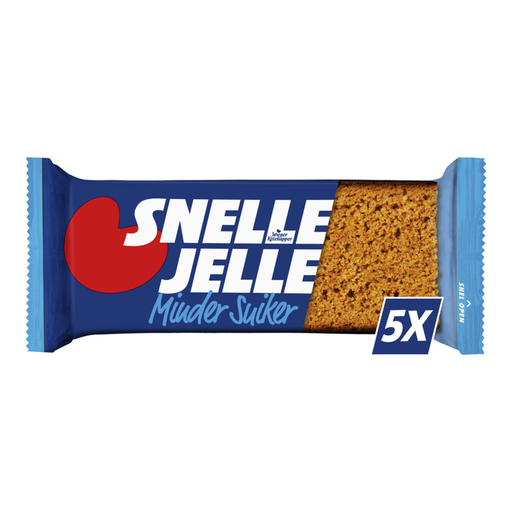 Image unavailable
The five individually wrapped 50 g portions are handy if you want to take breakfast cake with you. The product description mentions rye and gluten, with possible traces of nuts and milk. To compare sugar and fibre, check the current values per 100 g and per portion on the pack; don’t infer them from the variant name.
No. For the standard wholegrain variants mentioned here, Albert Heijn, Jumbo and PLUS list 34 to 35.5 g of sugars per 100 g. Peijnenburg lists 4.9 g per 100 g for its wholegrain variant with no added sugar. Compare the nutrition information for the specific products.
Read the nutrition information, ingredients and warnings. The Peijnenburg variant mentioned contains xylitol; according to the product information, excessive consumption may have a laxative effect, and the product is not suitable for animals to ingest.
Rye is a gluten-containing grain. The product information for the Peijnenburg, Albert Heijn, Jumbo and PLUS variants mentioned lists rye and/or gluten-containing cereals. If you have an allergy or dietary restriction, check the allergen information on the specific pack.
Follow the storage instructions on the pack you buy. For the variants mentioned, Albert Heijn and Jumbo recommend storing them in a cool, dry place. Peijnenburg recommends keeping its variant somewhere dry and dark, preferably in a sealed tin or container.