
A canteen buyer working to a tight budget
Buys breakfast cake regularly for lunch and can arrange for a large cake to be sliced and prepared in-house.


For a staff canteen working to a tight budget, a large unsliced own-brand breakfast cake is a practical starting point if employees can cut it themselves. A sliced option is better suited to quick service. If you serve slices without their packaging, information about allergens present must be available, according to the Netherlands Food and Consumer Product Safety Authority.
Buys breakfast cake regularly for lunch and can arrange for a large cake to be sliced and prepared in-house.
Benefits most from slices that are ready to serve quickly, or individual portions when slicing during the lunchtime rush is impractical.
Wants to check the nutritional information and ingredients for the exact product. If you serve it without its packaging, information about allergens present must be available, according to the Netherlands Food and Consumer Product Safety Authority.
First, decide whether the canteen can slice the cake itself and use an opened pack in line with its procedures. Then compare the type you want with the information guests need when food is served.
| What to consider | What should you check? | Who is this most important for? |
|---|---|---|
| Regular purchasing | Check the pack weight and whether an opened pack suits the quantity the canteen serves. | I buy breakfast cake often and can have a large cake sliced in-house. Around 36% of consumers prioritise keeping to a tight purchasing budget. |
| Nutritional information and type | For the exact product, read the ingredients and nutritional information per 100 g, including sugars, fibre and salt. | If guests ask for a specific type, I want to know what it actually contains. For around 29% of consumers, product choice is the main concern. |
| Speed of service | Check whether the cake is sliced and, if you need individual portions, whether each slice is wrapped separately. | During the lunchtime rush, I want to be able to serve slices without having to cut the cake first. Ease of serving is the priority for around 21% of consumers. |
| Allergens in unwrapped slices | Check the latest allergen information and make it available where the food is served. | If I serve slices without their original packaging, I need to be able to tell guests about allergens present. For around 14% of consumers, this is their top purchasing priority. |
A label such as wholemeal or Zero does not tell you all the nutritional values of the exact product.
Compare the ingredients and nutritional information per 100 g on the packaging, and take the size of the slice you serve into account.
Guests must be able to get information about allergens present when food is served without its packaging. For cereals containing gluten, the Netherlands Food and Consumer Product Safety Authority also requires the specific cereal to be named.
Keep the current packaging or product sheet available where the food is served, and update the information if the product changes.
This requires extra care when employees prepare slices from different packs.
The National Institute for Public Health and the Environment (RIVM) describes bread as a source of iodine because it contains iodised baker’s salt. This does not mean the breakfast cake you choose has the same property.
For breakfast cake, use the information for the specific product. Do not treat iodine as a selection criterion unless you have product-specific evidence.
The differences below relate to the specific types and packs mentioned, not every product from each brand.
PLUS offers a 550 g plain breakfast cake, sold unsliced.
Jumbo lists, among other options, a 550 g plain cake and a pack of six.
Albert Heijn lists a 600 g own-brand breakfast cake and sliced options, including wholemeal and Zero.
ALDI lists sliced Koek & Bakker options in 485 g packs, including wholemeal and Zero.
Lidl lists a 485 g sliced plain Tastino breakfast cake, sold in store.
Peijnenburg offers, among other options, a 550 g plain sliced breakfast cake and other types.
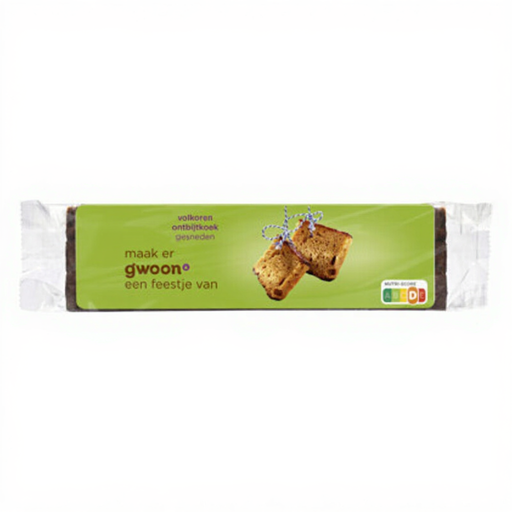
This sliced breakfast cake suits a canteen that wants to get slices ready to serve quickly. If serving it without its packaging, check the product’s current allergen information.
 No image available
For a canteen that wants to get slices ready to serve without cutting the cake; the pack contains 485 g.
The ingredients list rye, while the allergen statement excludes the main allergens. Check the current packaging or product sheet before giving guests allergen information.
Check whether the slices are individually wrapped if this is needed for serving.
Yes. According to the Netherlands Food and Consumer Product Safety Authority, consumers must be able to get information about allergens present at the place where unwrapped food is offered. For cereals containing gluten, it must be clear which cereal is involved. Information can be provided in writing, electronically or, under certain conditions, verbally.
No. The nutritional value of one slice does not describe the whole lunch offering. The Netherlands Nutrition Centre gives the following values for an average 30 g slice of breakfast cake: 92 kcal, 11.2 g sugars and 1.1 g fibre, among others. Check the packaging for the nutritional information for the type you choose.
No, not without information about the specific product. The National Institute for Public Health and the Environment (RIVM) describes iodised baker’s salt in bread, but that does not confirm that the same applies to the breakfast cake you choose.
No. In 2025, the Netherlands Food and Consumer Product Safety Authority published research findings on sampled breakfast cake and gingerbread products, but it did not link those findings to the supermarket products discussed here. So you cannot draw a conclusion about a specific brand from them.