
Canteen manager providing takeaway lunches
Looking for individually wrapped portions that employees can take with them straight away, without anyone having to slice the breakfast cake.


For employees taking breakfast cake with them or serving themselves, individually wrapped portions are practical: there’s no need to slice or hand them out. A sliced loaf works well at a lunch counter, provided the canteen has a plan for storing it after opening and sharing allergen information when serving it unwrapped. If you’re catering for a particular dietary preference, compare the ingredients and nutritional values per portion; ‘no added sugar’ doesn’t mean sugar-free.
Looking for individually wrapped portions that employees can take with them straight away, without anyone having to slice the breakfast cake.
Looking for a larger, sliced loaf to serve at a lunch counter. The number of portions, storage and allergen information are all important.
Comparing wholegrain options, fibre and sugars in breakfast cake, for example. The ingredients list and nutritional values per portion are a more useful guide than the wording on the front of the pack alone.
Best for: self-service, lunchboxes and serving without slicing.
Consider: the portions are pre-set, but each one has its own wrapper.
Best for: a lunch counter where the canteen serves the slices.
Consider: once opened, serving, storage and allergen information need attention.
| What to consider | What to check when buying | Who it matters to |
|---|---|---|
| Portions to take away | Check the number of portions, the weight per portion and whether they’re individually wrapped. | When employees help themselves to lunch, I want to put out portions they can take away straight away. Around 40% of consumers put convenience for taking food away first. |
| Nutritional information | Compare sugars, fibre and salt per portion, and read the ingredients list too. | For a range that caters for different dietary preferences, I want to know what a slice or bar actually contains. Around 30% of consumers give this nutritional profile top priority. |
| Shared serving | Check the total weight, number of slices and storage instructions after opening. | At a staffed lunch counter, I want to serve several guests from one loaf without making serving awkward. For around 30% of consumers, shared serving matters most. |
These statements don’t mean the same thing. Peijnenburg states that its individually wrapped 5-pack with no added sugar still contains 1.3 g of sugars per 27 g bar.
Compare the ‘of which sugars’ figure per portion, and check the ingredients and any warnings on the packaging too.
A large loaf and a multipack of individual portions suit different ways of serving. Weight alone doesn’t tell you how many portions are ready to serve.
Check the number of slices or bars, and decide whether employees will help themselves or the canteen will serve the cake.
A loaf for slicing may also mean extra work when serving and managing stock.
When serving food unwrapped, guests must be able to get information about any allergens present. The ingredients and warnings that apply depend on the variant supplied.
Keep the label or product specification available. According to the Netherlands Food and Consumer Product Safety Authority, information about unpackaged products can, for example, be provided on a card. If the information is given verbally, it must be clear that guests can ask for it.
Offers both individually wrapped portions and sliced breakfast cake.
Worth considering when comparing sliced loaves and packs containing several portions.
Offers a plain 6-pack of breakfast cake bars, each wrapped individually for serving in advance.
ALDI lists pre-sliced breakfast cake for serving at a lunch counter.
Lidl lists Tastino breakfast cake in larger pack sizes.
This sliced breakfast cake is suited to a lunch counter where the canteen serves the slices. Check how many slices are in the pack to make sure it meets your serving needs.
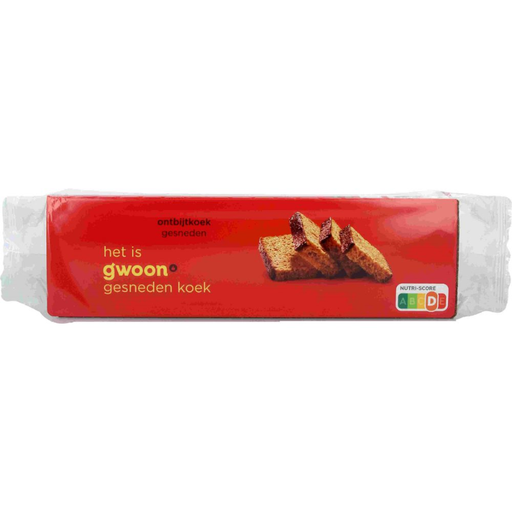 No image available
For serving at a lunch counter, you can hand out slices from the pre-sliced loaf. Check the number of slices on the pack and keep allergen information available when serving it unwrapped.
No. According to the Netherlands Food and Consumer Product Safety Authority, information about any allergens present must be available before unwrapped food is purchased or eaten. This can be provided in writing or verbally; if it’s given verbally, it must be clear that guests can ask for it.
No. Peijnenburg states that its 5-pack with no added sugar still contains 1.3 g of sugars per 27 g bar. Check the nutrition table per portion for the variant you choose.
Check the label on the variant actually supplied, as ingredients and warnings can vary. For example, PLUS lists rye flour in its plain breakfast cake bars and also notes the possible presence of other allergens.
No, that conclusion doesn’t follow from the Dutch rules on baker’s salt. According to the Netherlands Food and Consumer Product Safety Authority, iodine compounds may be present in bread, bread substitutes and other bakery products as a result of adding baker’s salt containing no more than 65 mg of iodine per kg of salt. If iodine is one of your selection criteria, check the label or ask the supplier for the product specification.