What should you look for when choosing?
First choose an amount that suits how often you eat it, then compare the nutritional information and ingredients of the variants you’re considering.
| What to consider |
What should you check? |
Who is this most important for? |
| Packaging and waste |
Compare the weight in grams and the storage instructions once opened. Jumbo lists small sizes of 265–280 g alongside larger loaves. |
If I only eat a slice occasionally, I don’t want the rest of a large pack to be left sitting around. That’s why around 46% of shoppers prioritise a pack size that suits their needs. |
| Sugars, fibre and portions |
Check the sugars and fibre per 100 g, and see how much a slice weighs. Compare the values for the exact product. |
For a snack, I want to know what’s in one slice, not just what the front of the pack promises. Nutritional values are a priority for around 36% of shoppers. |
| Allergens and gluten |
Check the ingredients, allergen information and, if needed, the gluten-free claim on the pack. |
A small size is no use to me if the ingredients don’t meet my dietary requirements. Allergens are the first thing around 18% of shoppers check. |
Breakfast cake on Joybuy
This 250 g pack is worth considering if you’re looking for breakfast cake as a snack. Check how many portions you can open individually if that matters to your choice.
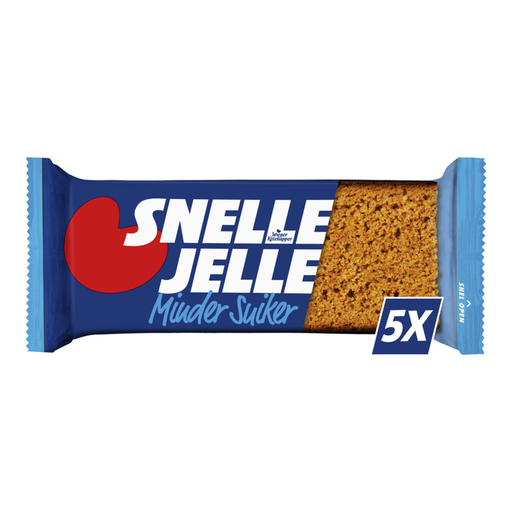 Image unavailable
Snelle Jelle Breakfast Cake Less Sugar-Free, 250 g
The 250 g pack may suit anyone who enjoys breakfast cake as an occasional snack. Don’t rely on the variant name instead of the nutritional information: check the sugars per 100 g and read the ingredients and allergen information on the pack.
View on Joybuy
Frequently asked questions
Is ‘half loaf’ a standard size for breakfast cake?
It’s better to go by the stated weight than by that English term. For example, Jumbo’s range includes smaller 265 g and 280 g packs. Also consider the number of slices and how often you eat breakfast cake.
Does breakfast cake with no added sugars contain no sugar at all?
No. ‘No added sugars’ doesn’t mean the product contains no sugars. For the exact variant, check the ‘of which sugars’ value in the nutrition table, ideally per 100 g and for the portion you plan to eat.
How should I store breakfast cake once opened?
Follow the storage instructions on the pack of your breakfast cake. Jumbo recommends storing its 280 g plain variant in a cool, dry place; instructions may vary by product.
What should I look for if I need to avoid gluten?
Check for a gluten-free claim and read the ingredients and allergen information on every pack. A small size doesn’t make a product suitable for a gluten-free diet: Jumbo lists rye and wheat in its 280 g plain breakfast cake.
Does every breakfast cake contain iodised baker’s salt?
You can’t assume this is the case for every breakfast cake. The Dutch Commodities Act Decree defines baker’s salt as iodised table salt for bread and other baked goods. Check the ingredients list to see what’s stated for a specific product.


