What should you look for when choosing?
Start with the slices you want to serve. Then check that the pack suits the number of people, and read the ingredients and nutritional information for the variety you choose.
| What to consider |
What to check when buying |
Who is this most important for? |
| Slices and serving |
Check whether the cake is pre-sliced and how many slices are in the pack, if this is stated. Look at the slices themselves if thickness matters. |
I want to serve slices straight away to several people on Sunday, without finding they’re different from what I expected. For around 42% of consumers, convenience at the table comes first. |
| Label and nutritional information |
Read the ingredients and allergen information for the exact variety. Compare sugars, fibre and salt per 100 g and, if stated, per serving. |
When choosing between plain, wholegrain and other varieties, I want to know what’s in that particular pack. This is the first consideration for around 33% of consumers. |
| Pack size |
Compare the pack weight with the number of people eating, and think about how many slices you want to keep after breakfast. |
For one Sunday breakfast, I want to serve enough without buying more than I’m likely to use. Around 25% of consumers prioritise a suitable pack size. |
Brands to consider
These examples can help you spot differences in packaging and product descriptions. Always check the specific variety you’re choosing.
Peijnenburg
Peijnenburg lists its sliced plain variety as a 550 g pack containing 18 slices. This is useful information when you’re planning for several people.
- The number of slices is stated for this specific variety.
- Knowing that it’s sliced and contains 18 slices still doesn’t tell you how thick each slice is.
Albert Heijn
Albert Heijn lists an AH sliced breakfast cake weighing 350 g. The smaller pack size may suit you if you’re buying for one breakfast.
- The product description confirms that this variety is sliced.
- Check the current pack for ingredients, nutritional values and allergens. Albert Heijn notes that this information can change.
Jumbo
Jumbo lists, among other products, its own 475 g sliced plain breakfast cake, alongside other breakfast cake varieties.
- You can distinguish between plain and other product descriptions in the range shown.
- The variety or pack weight doesn’t tell you how thick the individual slices are.
PLUS
PLUS lists its own 485 g sliced plain breakfast cake, as well as a 550 g Peijnenburg variety.
- The pack weights give you a useful starting point for working out how much you need.
- PLUS says that product composition can change. If you’re choosing based on ingredients or allergens, read the current label.
Koek & Bakker
Aldi lists a 485 g sliced wholegrain breakfast cake under Koek & Bakker, as well as a separate sliced Zero variety.
- Both varieties shown are described as sliced.
- Don’t assume the varieties are interchangeable: check the ingredients and nutritional information on each pack. The product descriptions don’t indicate slice thickness.
Lidl
Lidl lists a 485 g sliced wholegrain breakfast cake as a supermarket own-brand product.
- The product description and pack weight help you make an initial comparison of size and serving convenience.
- Check the packaging of the product you choose for ingredients, allergens and the slices themselves.
Sliced breakfast cake on Joybuy
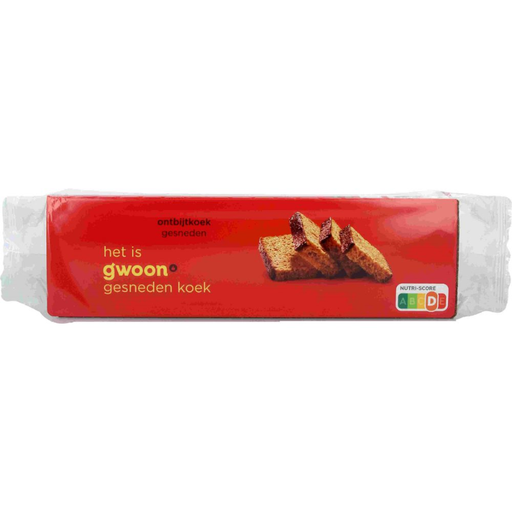
This sliced breakfast cake is an option if you want to serve slices without having to cut them yourself. Check the packaging if the number or thickness of the slices matters for your Sunday breakfast.
 No image available
g'woon sliced breakfast cake 485 g
Pre-sliced, so you can serve it straight from the pack at breakfast.
485 g pack. Check the current label for ingredients and allergens, and look at the slices themselves if their size is important.
View on Joybuy
Frequently asked questions
Does ‘sliced’ mean breakfast cake has thick slices?
No, ‘sliced’ doesn’t tell you how thick the slices are. Peijnenburg lists 18 slices in a 550 g pack of one plain variety, but that doesn’t indicate their thickness. Look at the slices if you’re after a particular size.
What should I look for in the allergen information for breakfast cake?
Read the allergen information for the exact variety on the current label. For its plain breakfast cake, PLUS lists rye and cereals containing gluten, and also notes that it may contain wheat, barley and oats. Don’t assume another pack has the same ingredients.
Does breakfast cake automatically contain iodine because of baker’s salt?
No, you can’t tell from the product category. The Netherlands Nutrition Centre says that bakers aren’t required to use baker’s salt, so check the information for the product you’ve chosen rather than assuming it contains iodine.
How should I store opened sliced breakfast cake?
Follow the storage instructions on the pack you’ve chosen. For its sliced plain variety, Peijnenburg says to store it in a cool, dry place, such as in a sealed container or tin.
Can I rely on the ingredients listed on an online product page?
When buying, use the information on the current packaging. PLUS and Albert Heijn say that product information can change. This is especially important if you’re choosing based on ingredients, allergens or nutritional values.


