
Households that don’t eat much breakfast cake
If you only occasionally pack a slice for a school lunch, compare the net weight of a compact loaf with that of a larger pack.


Choose a compact loaf if breakfast cake is only eaten occasionally at home and a larger pack is unlikely to be finished. Choose individually wrapped slices or bars if a ready-to-pack portion for the school bag matters more. For wholemeal and reduced-sugar varieties, compare the nutritional information per 100 g and per portion. If allergies are a concern, always check the label on the exact pack.
If you only occasionally pack a slice for a school lunch, compare the net weight of a compact loaf with that of a larger pack.
An individually wrapped slice or bar is a different option from a small loaf: the portion is already wrapped separately for the school bag.
If you’re keeping an eye on fibre, sugars or allergens, check the exact variety. Wholemeal or reduced sugar doesn’t, in itself, mean a product is suitable for someone avoiding gluten.
First decide whether a smaller loaf will be finished at home, or whether individually wrapped portions are more convenient for school. Then check the allergens and, if nutritional value matters, compare the same figures per 100 g and per portion.
| What to consider | What to check when buying | Who it matters to |
|---|---|---|
| Smaller pack | Compare the net weight, number of slices and storage instructions. Jumbo lists 280 g packs of both plain and wholemeal breakfast cake. | If I only eat breakfast cake occasionally at home, I don’t want to open more than I’m likely to finish; around 25% of shoppers place most importance on a smaller pack. |
| Ready-to-pack portion | Check how many individually wrapped slices or bars there are and the weight of each one. Peijnenburg lists ten separately wrapped 28 g slices. | For a school bag, I want to be able to grab one portion without taking a loaf; around 25% of shoppers prioritise this convenience. |
| Allergens | Read the ingredients and warnings on the exact pack, and agree any necessary arrangements with the school and the pupil’s parent or carer. | If a pupil needs to avoid certain ingredients, I want to know what’s in this variety before packing it; around 31% of shoppers put checking allergens first. |
| Nutritional value | Compare fibre and sugars per 100 g and per portion; assess any reduced-sugar claim against the comparison stated on the product. | When choosing between plain, wholemeal and reduced-sugar varieties, I want to compare the nutritional information on a like-for-like basis; for around 19% of shoppers, this comparison is the main consideration. |
A 280 g loaf is compact, but its slices aren’t individually wrapped. A pack of separate slices or bars offers a different way to take breakfast cake with you.
Decide which type of packaging you need first, then compare the total weight and number of portions.
The regular Jumbo varieties discussed here list rye and wheat. A wholemeal or reduced-sugar claim is no substitute for checking for cereals containing gluten.
Read the current ingredients and warnings every time you buy. If gluten needs to be avoided, also check that the exact pack is labelled gluten-free.
A claim such as ‘less sugar’ refers to a specific product comparison; portion sizes and other nutritional values can vary between varieties.
Compare the nutritional information per 100 g, and also check what’s in one slice or bar.
Jumbo lists 280 g packs of plain and wholemeal breakfast cake for anyone looking for a compact loaf.
Peijnenburg has a plain variety with ten individually wrapped 28 g slices.
PLUS lists breakfast cake bars, individually wrapped, in both a plain variety and one called Less Sugar.
Albert Heijn’s range page shows 485 g packs of AH breakfast cake and 345 g Peijnenburg varieties.
Lidl lists biscuit bars in packs of six, including a variety called Breakfast Cake Less Sugar.
If you’d rather take a portion with you than slice it from a loaf, here’s a compact pack of breakfast cake. Check the current packaging if the sugar claim or allergens are important to your choice.
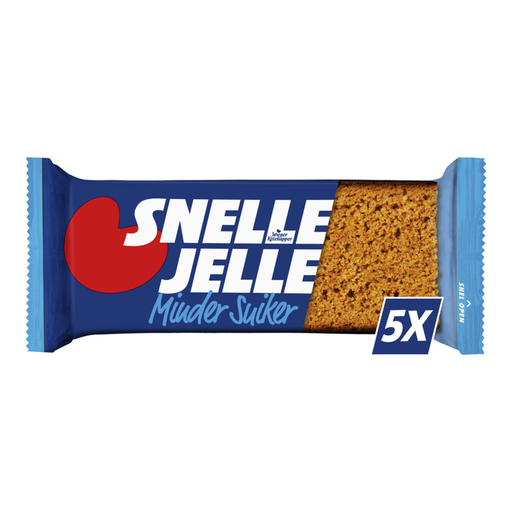 Image unavailable
An option for taking a portion of breakfast cake to school; the pack lists a total weight of 250 g.
Check the current nutritional information to assess the sugar claim. If allergies are a concern, check the ingredients and warnings on the pack.
Don’t assume that a product is suitable based on its category: the Jumbo plain and wholemeal varieties discussed here list rye and wheat. If a gluten-free option is essential, check the label on the exact pack, the ingredients and any cross-contamination warnings, and take the pupil’s school arrangements into account.
It’s better to compare net weight than to rely on the term ‘half a loaf’. The Jumbo varieties discussed here, at 280 g, are compact loaves; also check the number of slices and whether they’re individually wrapped.
Individual slices are handy if you need to put one wrapped portion in the school bag at a time. Peijnenburg, for example, lists ten individually wrapped 28 g slices; with a compact loaf, you take out the slices you need yourself.
Follow the storage instructions on the exact pack. The Jumbo breakfast cakes discussed here say to store in a cool, dry place; if a loaf takes a while to finish at home, the type of packaging may also be worth considering.