If you only eat breakfast cake occasionally on night shifts, a small pack is probably a better fit for your cupboard than a large loaf. Individually wrapped portions are handy to take with you, but whichever option you choose, compare the ingredients, nutritional values and the amount you actually eat. A smaller pack isn’t automatically the better choice on all these counts.
Who might find a smaller pack useful?
A small pack mainly solves a storage problem: once you’ve opened it, there’s less breakfast cake to get through. Whether individually wrapped portions are more convenient depends on what you want to take with you to work.
People who only eat breakfast cake occasionally
If you only fancy a slice on some night shifts and share the pack with just a few people at home, the total contents matter more than the shape of an individual slice. Compare the net weight with the amount you usually get through.
People who pack a portion in advance
An individually wrapped portion can go in your work bag or locker without you having to take a whole opened loaf with you. Check how many portions are in the pack and what the packaging says about storage.
People who compare ingredients
If ingredients, sugars, fibre or allergens influence your choice, pack size alone tells you little. The Netherlands Nutrition Centre advises you to read the ingredients list and nutrition table rather than relying solely on the front of the pack.
What should you look for when choosing?
If you only take breakfast cake with you on night shifts occasionally, one particular need may determine your choice: keeping less in the cupboard at home, the ingredients or a portion that’s easy to take with you. Use your main priority to compare packs.
| What to consider |
What to check |
Who it matters most to |
| Pack size |
Compare the net weight and number of slices with how often you eat breakfast cake. Treat 265–300 g as a practical size for a smaller pack, not as a fixed size for half a loaf. |
If I only eat a slice occasionally, I don’t want to be left with lots of opened product. A small amount to keep in the cupboard would therefore be the main priority for around 42% of consumers. |
| Ingredients |
Read the ingredients, allergen information and nutritional details, including sugars, fibre and salt per 100 g. Check the values per portion if they’re listed and you want to compare portions. |
I want to know what’s in the breakfast cake I choose, even if the front of the pack focuses mainly on a product claim. Ingredients would be the first consideration for around 33% of consumers. |
| Convenience for taking with you |
Check whether the slices are simply pre-cut or individually wrapped too, and how much each portion weighs. |
I want to be able to pack one portion for my break without having to cut it at work. Convenience for taking it with you would come first for around 25% of consumers. |
Common mistakes
-
Assuming ‘half a loaf’ is a standard size for breakfast cake
A search term doesn’t tell you how much breakfast cake you’ll get. Jumbo, for example, lists packs of 265 g, 280 g and 300 g, with different numbers of slices or portions.
Compare the net weight and pack type of the exact product: a small pack of sliced cake and a box of individually wrapped portions don’t meet the same practical need.
-
Treating a claim on the front as complete nutritional information
‘Zero’, ‘wholemeal’ and a claim about sugar don’t mean the same thing. None of these terms tells you on its own how much sugar, fibre or salt a portion contains.
Read the nutrition table and ingredients list on the pack you’re buying. The Netherlands Nutrition Centre advises against relying only on the front of a label.
-
Assuming all breakfast cake contains the same baker’s salt
The ingredients in one breakfast cake don’t tell you which ingredients have been used in another variety.
If the type of salt matters to your choice, check the ingredients on the specific pack or ask the manufacturer.
Brands compared
These brands offer examples of different sizes and pack types. Always compare the specific variety: information about one breakfast cake doesn’t necessarily apply to the rest of the brand’s range.
Peijnenburg
Jumbo lists a 265 g pack of sliced cake with nine slices; PLUS also lists a 280 g pack of individually wrapped Naturel portions, with ten portions.
- You can compare a smaller pack of sliced cake with a pack of individual portions.
- According to PLUS product information, the Naturel portion pack contains rye and cereals containing gluten, and lists 38 g of sugars per 100 g. Check the details for the variety you choose.
Jumbo
The Jumbo category includes own-brand breakfast cake packs of 280 g and 300 g.
- These sizes let you choose an amount that suits occasional use.
- Check the label on the exact variety for ingredients, allergens and nutritional values.
Koek & Bakker
ALDI describes a 485 g pack of pre-sliced Koek & Bakker Ontbijtkoek Zero.
- Pre-sliced portions can be handy if you like to pack one at home before you go.
- At 485 g, this isn’t a small pack by the comparison used here. Check the label for the ingredients rather than relying on the name ‘Zero’ alone.
PLUS
PLUS lists a 485 g pack of its sliced naturel breakfast cake and advises: ‘store in a cool, dry and dark place’.
- PLUS product information lists 36 g of sugars, 3.3 g of fibre and 0.52 g of salt per 100 g for this variety.
- If you only eat breakfast cake occasionally, a 485 g pack calls for different cupboard planning from a smaller pack.
Lidl
Lidl lists a 485 g Ontbijtkoek zero on its product page.
- The stated weight makes it possible to compare this with smaller packs.
- A name such as ‘zero’ is no substitute for an ingredients list or nutrition table; check these on the pack.
Breakfast cake at Joybuy
This smaller pack of breakfast cake is a good fit if you want to keep less in the cupboard and only take something with you on night shifts occasionally. Check the pack to see how the portions are arranged and what nutritional information applies to this variety.
 No image available
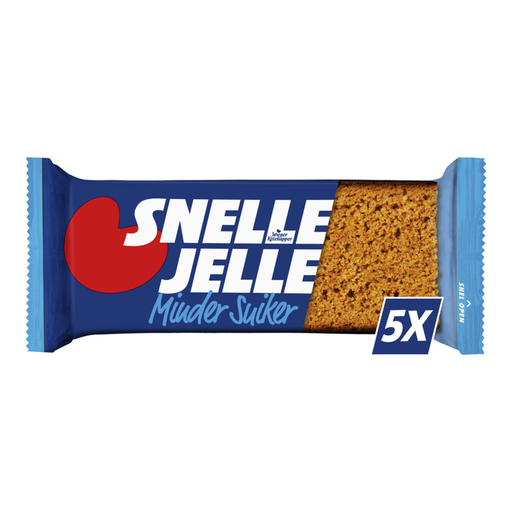
Snelle Jelle Breakfast Cake Less Sugar-Free 250 g
The 250 g pack could suit you if you only take breakfast cake with you on night shifts occasionally and don’t want to keep a large pack at home. Check the label for portion sizes, ingredients and nutritional values; don’t assume from the product name that the cake is sugar-free.
View at Joybuy
Frequently asked questions
How can I identify a smaller pack of breakfast cake?
Check the net weight and type of pack, rather than relying only on the search term ‘half a loaf’. Jumbo, for example, lists breakfast cake in 265 g, 280 g and 300 g packs; also check whether you’re buying a pack of sliced cake or individual portions.
Are individually wrapped portions more convenient than a pack of sliced cake?
Individual portions are particularly handy if you want to put one in your work bag before you leave. A pack of sliced cake may be enough if you pack a portion at home and can store the rest appropriately; compare the number of portions and the total contents.
How can I compare sugars and fibre between varieties?
Read the nutritional values per 100 g on the exact pack and consider the portion you plan to eat too. The Netherlands Nutrition Centre advises checking the ingredients list and nutrition table as well as any claims on the front of the pack.
Can I tell which allergens breakfast cake contains from the product name?
No, check the allergen information for the specific variety. PLUS lists rye and cereals containing gluten for the Peijnenburg Naturel portion pack; you can’t automatically apply that information to another breakfast cake.
Does all breakfast cake contain iodised baker’s salt?
Don’t assume it does just because of the product category. If the type of salt used matters to your choice, check the ingredients for that particular breakfast cake or ask the manufacturer for product information.


