What should you look for when choosing?
Start with the quantity you actually want to use. Then compare the nutritional information, how the product is divided into portions and any ingredients that matter to your household.
| What to consider |
What to check |
Who it matters to |
| Pack size |
Check the net weight and number of slices, then decide how much you want to use after New Year. |
If just one or two of us eat the cake, I don't want to have a large loaf left over. For roughly 42% of shoppers, a smaller quantity is the top priority. |
| Sugars, fibre and sweeteners |
Compare sugars and fibre per 100 g and, if available, per portion. Check the ingredients list too. |
With a variant that has no added sugars, I want to know what the label says it does contain. Around 25% of shoppers prioritise this nutritional information. |
| Individual portions |
Check whether the portions are individually wrapped and whether their size suits the way you plan to use them. |
I don't eat breakfast cake every day and want to be able to take one portion at a time. For around 17% of shoppers, this convenience is the most important factor. |
| Ingredients and allergens |
Read the ingredients list and allergen information on the current packaging, even if you've bought the product before. |
If someone in my household needs to avoid certain ingredients, I want to know what's in this variant first. For around 16% of shoppers, checking this is the most important step. |
Brands and ranges compared
A brand name tells you little about the size or packaging format of a specific breakfast cake. Compare the individual variants instead.
Peijnenburg
Peijnenburg offers both a 265 g sliced variant, listed by Albert Heijn, and a 280 g pack of ten portions, listed by PLUS.
- You can compare a small sliced loaf with individually wrapped portions.
- The “no added sugars” claim on the 265 g variant doesn't replace the need to read the ingredients and nutritional information.
Jumbo
Jumbo lists a 280 g plain breakfast cake, as well as larger packs of breakfast cake.
- The 280 g variant comes in the form of a compact loaf.
- It isn't a pack of individually wrapped portions, so check whether you'll use up the opened loaf within a time frame that works for you.
Albert Heijn
Albert Heijn lists the 265 g Peijnenburg variant and its own 485 g breakfast cake variant.
- The listed range lets you compare a smaller and a larger size.
- Check the ingredients and allergens on the current packaging; product information can change.
PLUS
PLUS lists a 280 g pack of Peijnenburg portions and a larger 550 g own-brand loaf.
- The listed pack contains ten individually wrapped portions.
- First consider whether you need individual portions if what you're really looking for is one compact loaf.
Koek & Bakker
ALDI Nederland lists Koek & Bakker breakfast cake in a 485 g sliced pack.
- This larger size gives you a useful point of comparison if you expect to use more cake.
- At 485 g, it doesn't meet the same need for a small pack as the 265–280 g options listed here.
A Joybuy product for enjoying over time
This product suits a smaller quantity for a small household. Check the portion format if you're specifically looking for either a compact whole loaf or individual portions.
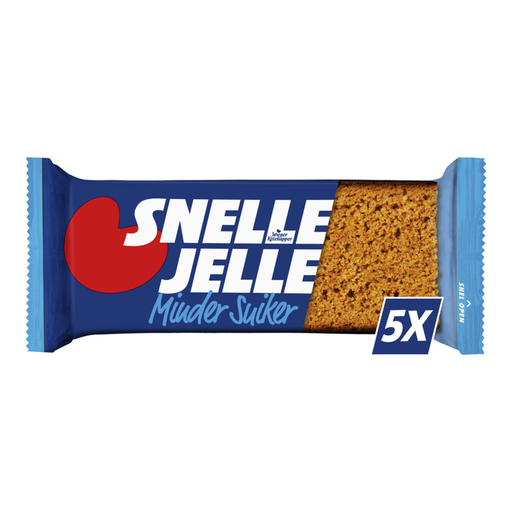 Image unavailable
Snelle Jelle Breakfast Cake, 250 g
A 250 g pack is an option if you're looking for a smaller quantity for your household. Check that the portion format suits the way you plan to use it, and refer to the current packaging for ingredients, allergens and nutritional information.
View at Joybuy
Frequently asked questions
What counts as a small loaf of breakfast cake?
For this comparison, the 265 g pack listed by Albert Heijn and the 280 g pack listed by Jumbo are examples of compact loaves. Focus on the net weight and the number of slices you expect to use around New Year; the term “half loaf” doesn't refer to a fixed weight.
Does “no added sugars” mean that breakfast cake is sugar-free?
No, this claim doesn't mean that a product contains no sugars. For the variant you've chosen, check the sugar value in the nutritional information and read which ingredients and any sweeteners it contains.
How should I store a small breakfast cake once opened?
Follow the storage advice on the packaging of the product you've bought. Before buying, consider whether you'll use the contents in time once opened, or whether you'd prefer individually wrapped portions.
Where can I check the allergens in breakfast cake?
Read the ingredients list and allergen information on the current packaging for the specific variant. Don't rely on the brand name, a different pack size or information from a previous purchase.
Can I assume that every breakfast cake contains iodine?
No, the name breakfast cake doesn't confirm which salt has been used in a specific product. If this matters to your choice, check the product-specific information or ask the manufacturer.


