What should you look for when choosing?
Start with what matters most to your family: the balance of sugars and fibre, a familiar taste or serving it with a meal. Then compare the labels of the options that fit your needs.
| What to consider |
What to check before buying |
Who is this important for? |
| Sugars and fibre |
Compare sugars and fibre per 100 g and per slice; check which sweetener has been used too. |
If I serve breakfast cake regularly, I want to weigh up sugars and fibre together without choosing an ingredient that isn’t right for our household. This combination is a top priority for around 50% of consumers. |
| Familiar taste |
Check the proportion of wholemeal rye flour and the sugars; check the allergens in your chosen version. |
With fussy eaters, I want to be able to choose a sweet version while knowing what’s in it. For around 33% of consumers, that familiar quality comes first. |
| Serving and cooking |
Check whether the cake is pre-sliced and whether the pack size suits the number of slices you need or the recipe. |
When I’m serving slices or using breakfast cake in a savoury dish, I mainly want the right amount and shape. For around 17% of consumers, that’s the most important consideration. |
Brands to consider
The details below apply to the breakfast cakes mentioned, not to each brand’s full range. Always check the current packaging when you buy.
Peijnenburg
With its standard breakfast cake and Wholemeal with No Added Sugars version, Peijnenburg offers two different recipes to compare.
- Peijnenburg describes the no-added-sugar version as 100% wholemeal; Jumbo lists 17 g of fibre and 4.9 g of sugars per 100 g.
- This version contains xylitol and may contain nuts and milk. Check the label and keep the cake out of pets’ reach.
AH
AH Wholemeal Sliced Breakfast Cake comes in a 485 g pack, for anyone who wants pre-sliced portions.
- Albert Heijn lists 41% wholemeal rye flour and 5.7 g of fibre per 100 g for this version.
- The same product information lists 34 g of sugars per 100 g, rye and the possible presence of other cereals.
Jumbo
Jumbo Wholemeal Breakfast Cake comes in a 280 g pack, a different size from the 485 g packs mentioned here.
- Jumbo lists 35.9% wholemeal rye flour and 8.2 g of fibre per 100 g.
- The product information also lists 35.5 g of sugars and 0.62 g of salt per 100 g, as well as gluten, rye and wheat.
Lidl
Lidl lists a 485 g pack of sliced wholemeal breakfast cake as a store product.
- The pre-sliced format and pack size can help you decide whether it suits the family occasion you have planned.
- For a comparison of ingredients, sugars, fibre and allergens, check the label on the specific product.
G'woon
G'woon Wholemeal Sliced Breakfast Cake, 485 g, is a standard wholemeal option to assess for its ingredients and pack format.
- Joybuy lists 5.9 g of fibre per 100 g for this product, which comes pre-sliced.
- Joybuy also lists 34 g of sugars per 100 g. Check the current allergen information on the packaging.
Breakfast cake on Joybuy
This G'woon breakfast cake comes pre-sliced and suits anyone looking for a standard wholemeal option to serve at a family occasion. In particular, compare its sugar and fibre levels with the other options that matter to your household.
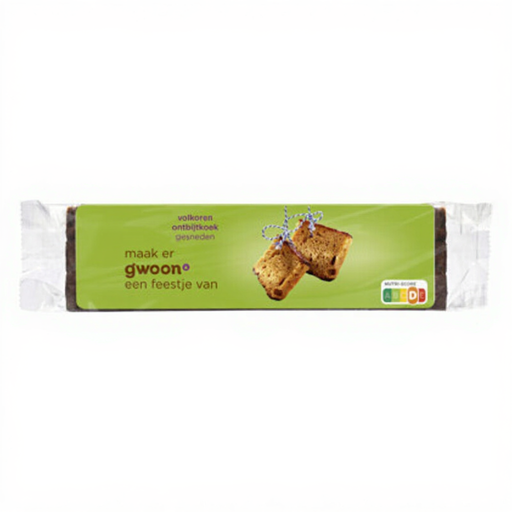 Image unavailable
G'woon wholemeal breakfast cake, sliced, 485 g
A pre-sliced option for serving up portions at a family occasion.
Joybuy lists 5.9 g of fibre and 34 g of sugars per 100 g. Compare the current nutritional information per portion and check the allergen details on the packaging, particularly as rye is listed among the ingredients.
View on Joybuy
Frequently asked questions
Is wholemeal breakfast cake naturally low in sugars?
No. Albert Heijn lists 34 g of sugars per 100 g for AH Wholemeal Sliced Breakfast Cake, while Jumbo lists 35.5 g per 100 g for its Wholemeal Breakfast Cake, 280 g. So compare both sugars and fibre in the specific products, ideally using the same measure of per 100 g.
What does the wholemeal label tell you about a breakfast cake?
The label alone doesn’t give you a complete picture of the ingredients or nutritional value. Albert Heijn lists 41% wholemeal rye flour in its sliced wholemeal version; Jumbo lists 35.9% for its 280 g version. Also check the sugars and fibre figures on the label.
How can I tell whether breakfast cake contains iodised salt?
Check the ingredients list for the specific breakfast cake or ask the manufacturer. In its 2008 agreement on bakers’ salt, the Ministry of Health, Welfare and Sport described measures to encourage the use of iodised salt in bread and bread substitutes. That doesn’t tell you which ingredients are in your breakfast cake.
How should I store breakfast cake for a family occasion?
Follow the storage instructions on the packaging of your chosen version. For the wholemeal breakfast cake discussed here, Jumbo recommends storing it in a cool, dry place. For Peijnenburg Wholemeal with No Added Sugars, it recommends a dry, dark place, preferably in a sealed tin or container. If the version contains xylitol, keep it out of pets’ reach too.


