If several people are having coffee at the same time, a large, pre-sliced breakfast cake is practical: you can hand out slices without having to cut it. If people are leaving at different times, individually wrapped slices are more convenient; an unsliced cake needs a knife and a suitable surface. Whichever option you choose, check the current label if ingredients, allergens or nutritional values are important to your decision.
Which format works best for you?
Sharing coffee without serving utensils
If everyone is having coffee at the same time and there’s no knife to hand, a pre-sliced cake means you can serve the slices straight away. For example, Peijnenburg says its 550 g sliced cake contains 18 slices.
Commuters taking something with them
If people are leaving at different times, everyone can take a sealed portion with them. Jumbo lists a Peijnenburg pack containing ten individually wrapped 28 g slices.
Comparing labels for a group
If you’re buying for a group where ingredients or allergens matter, compare the exact products. Check the nutritional information too if sugar, salt or sweeteners are part of your decision.
What should you look for when choosing?
First decide whether you’ll be sharing the breakfast cake there and then, or taking it away in individual portions. Then compare the size and label of the product you want to buy.
| What to consider |
What to check when buying |
Who is this important for? |
| Sharing straight away |
Check whether the cake is sliced and how many slices are in the pack. |
If everyone is having coffee at the same time, I want to hand out slices without having to find a knife first. Sharing straight away is the priority for around 42% of consumers. |
| Taking individual portions |
Check whether the slices are individually wrapped, and look at the number of slices and the weight of each one. |
Anyone leaving earlier may want to take a sealed portion rather than share an opened cake. Around 33% of consumers prioritise taking individual portions. |
| Ingredients and nutritional information |
Check the ingredients, allergens and nutritional values per 100 g or per serving on the exact pack. |
If I’m buying for people with different dietary requirements, I want to be able to identify the right product. For around 25% of consumers, this label information matters most. |
Common mistakes
-
Assuming a cake to share comes in individual portions
A large, sliced breakfast cake is ready to serve, but that doesn’t mean the slices are individually wrapped for people leaving later.
Check the pack for the difference between ‘sliced’ and ‘individually wrapped’, and see how many slices it contains.
-
Taking ‘no added sugars’ to mean ‘sugar-free’
According to Peijnenburg, its no-added-sugar variant still contains 4.9 g of sugars per 100 g and includes xylitol. The wording on the front of the pack is no substitute for checking the full nutritional information.
Compare the ingredients and nutritional values per 100 g of the exact products you’re considering.
-
Assuming the product contains iodine based on its type
Not every breakfast cake has to contain baker’s salt: according to the Netherlands Nutrition Centre, bakers aren’t required to use it.
Don’t assume what’s in a breakfast cake based on its name. Check the label or ask the manufacturer if iodine is relevant to your choice.
-
Assuming allergens are the same across different variants
Ingredients and allergens can vary between breakfast cakes. Choosing a pack for the whole group based only on the brand name could therefore hide important differences.
Check the current allergen information on the exact pack before serving the cake.
Brands to consider
Peijnenburg
Peijnenburg offers, among other products, large sliced cakes and individually wrapped slices.
- According to Peijnenburg, its 550 g sliced plain cake contains 18 slices. Jumbo also lists a pack of ten individually wrapped 28 g slices.
- Standard variants and no-added-sugar variants differ in their ingredients and nutritional values. Compare the exact packs.
Jumbo
Jumbo’s range includes breakfast cake in various formats, including sliced cakes and packs with multiple portions.
- The different pack formats make it possible to find an option for sharing straight away or taking individual portions with you.
- Ingredients and nutritional values apply to each individual product, not to the range as a whole.
PLUS
PLUS sells, among other products, its own-brand 550 g breakfast cake, which is sold unsliced.
- An unsliced cake is an option if you can cut it into slices before your coffee break.
- You’ll need a knife and a suitable surface for this variant. Check the current ingredients and allergen information too.
Koek & Bakker
ALDI lists, among other products from Koek & Bakker, pre-sliced 485 g breakfast cakes in wholegrain and Zero variants.
- With the pre-sliced wholegrain variant, you won’t need to cut it before serving.
- Check the pack of your chosen variant for up-to-date ingredients and nutritional information.
Breakfast cake to share straight away
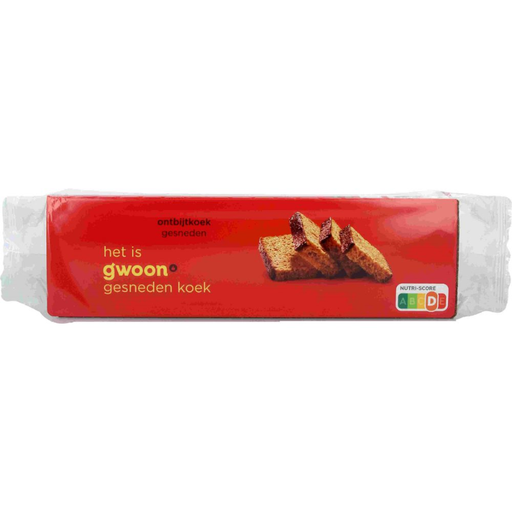
This sliced breakfast cake is a good fit for a coffee break when you want to offer several people a slice at the same time, without having to cut it there and then.
 No image available
g'woon sliced breakfast cake 485 g
This sliced cake is a handy option when you want to serve slices at a group coffee break without cutting it yourself. The pack contains 485 g; check how many slices it includes if you need a portion for everyone.
If ingredients, allergens or nutritional values matter to the group, check the current label on this pack.
View on Joybuy
Frequently asked questions
When should I choose a large sliced breakfast cake instead of individual portions?
Choose a large sliced cake if you want to serve several people a slice at the same time without cutting it. If they’re leaving at different times, individually wrapped slices are more convenient to take with you.
Is breakfast cake with no added sugars also sugar-free?
No, those two descriptions don’t mean the same thing. Peijnenburg lists 4.9 g of sugars per 100 g for its sliced no-added-sugar variant. Check the other ingredients and nutritional values of the product you’re buying too.
Which allergens should I check when buying breakfast cake for a group?
Check the allergen information on each exact pack. The Peijnenburg 10-pack described contains rye and lists milk and nuts as possible allergens; don’t assume this information also applies to other variants.
Does every breakfast cake contain iodine from baker’s salt?
You can’t tell from the type of product alone. The Netherlands Nutrition Centre says that bakers aren’t required to use baker’s salt. Check the label or ask the manufacturer about the ingredients in a specific cake.
How should I store breakfast cake until coffee time?
Follow the storage instructions on the pack you choose. PLUS says to store its unsliced breakfast cake in a cool, dry place away from light; don’t assume the same instructions apply to another variant.


