
Managing a small lunch supply
If you only need breakfast cake for a few lunches, a compact pack helps you match the amount you buy to how much you use. Also consider how many slices you expect to hand out once the pack is open.


For a small lunch supply, choose a sliced pack of around 265–350 g if you need a few portions without keeping a larger pack open for long. Individually wrapped portions are better for handing out or taking with you, while a larger pack makes more sense if the breakfast cake will be eaten quickly. Check the net weight, number of portions and current label for each option.
If you only need breakfast cake for a few lunches, a compact pack helps you match the amount you buy to how much you use. Also consider how many slices you expect to hand out once the pack is open.
For a canteen lunch or food on the go, individually wrapped pieces can make handing them out and taking them with you easier. A sliced pack is an alternative if you don't need individual wrappers.
If you’re keeping an eye on sugars, fibre or allergens, check the exact variety. The Peijnenburg individually wrapped portions described by PLUS contain rye and may contain milk and nuts; this information does not automatically apply to other breakfast cakes.
When to choose it: If you want slices for a few lunches without opening a large pack.
Consider: A lower net weight doesn't tell you how many portions the pack will provide for your needs.
When to choose them: If you want to hand out or pack breakfast cake as individual portions.
Consider: This also means choosing individual wrappers; decide whether that format suits how you’ll use them.
When to choose it: If several people or back-to-back lunches will get through the pack quickly.
Consider: If demand is low, more breakfast cake will be left once the pack is open.
| What to consider | What to check before buying | Who it matters to |
|---|---|---|
| Quantity | Compare the net weight, the number of lunch portions you need and the best-before date. | If I only have a few lunches planned, I don't want to open more breakfast cake than I’m likely to use. Around 46% of consumers prioritise having a small amount that suits their needs. |
| Portion format | Check the number of slices or individually wrapped pieces, and the weight per piece. | When handing out portions or taking them with me, I want to know in advance how many pieces I can give out. Set portions are the top priority for around 27% of consumers. |
| Label | Compare sugars and fibre per 100 g, and check the ingredients and allergens for the exact variety. | If sugars, fibre or allergens affect my choice, I need to be able to assess each variety using its own label. Around 27% of consumers prioritise these checks. |
Compact breakfast cakes don't all weigh the same: the small packs reviewed range from 265 g to 350 g. Even a pack that looks small may contain more slices than you need for lunch.
First decide how many portions you need, then compare the net weight, number of pieces and best-before date.
This wording doesn't tell you how much sugar a portion contains in total. Nutritional values also vary between varieties.
Check the ‘of which sugars’ value per 100 g on the current label, and take portion size into account when comparing products.
According to the Netherlands Nutrition Centre, bakers are not required to use baker’s salt. Ingredients and allergens can also vary between breakfast cake varieties.
Check the label on the exact pack; don't rely on the name ‘breakfast cake’ alone.
Jumbo lists a 265 g sliced Peijnenburg variety, among other options; PLUS describes a pack of 10 individual portions weighing 280 g in total.
Jumbo lists a 280 g Ontbijtkoek Naturel as a compact own-brand pack.
According to Albert Heijn, AH Ontbijtkoek gesneden weighs 350 g, making it a sliced alternative for a small lunch supply.
ALDI lists Koek & Bakker varieties weighing 465 g, as well as a 485 g sliced zero variety.
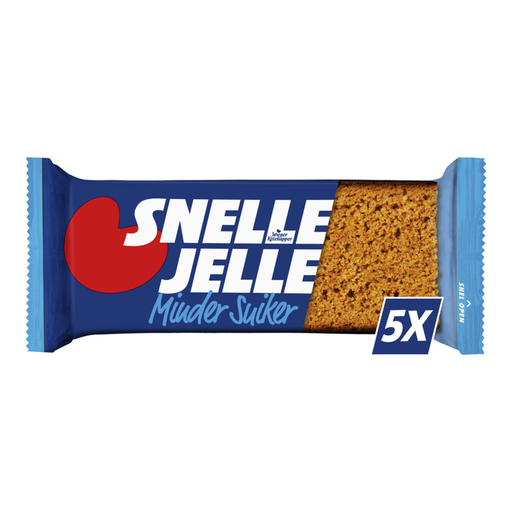
This pack of individually wrapped bars suits anyone who wants to take breakfast cake along or hand it out as individual portions for a small lunch supply. If you’d rather have slices from a single pack, compare that format too.
 No image available
For anyone who wants to take breakfast cake along or hand it out as individual portions. The product description lists five individually wrapped 50 g bars, 250 g in total; these aren't slices from a single sliced pack.
The name includes ‘Sugar-Free’, while the description refers to less added sugar. Don't treat these claims as equivalent: check the claim and nutritional information on the current pack before choosing based on sugar content.
Don't treat ‘half loaf’ as a standard weight. The compact packs reviewed weigh 265 g, 280 g, 345 g or 350 g; choose based on the net weight and the number of lunch portions you need.
No, those terms don't mean the same thing. For the exact variety, check the ‘of which sugars’ value per 100 g and see how many grams you’ll have per portion.
Start with the net weight, the number of slices or pieces, and the best-before date. To compare what’s in the product, check the ingredients, allergens and nutritional value per 100 g; also check the storage instructions for the pack you choose.
No, you can't tell from the product category alone. According to the Netherlands Nutrition Centre, bakers are not required to use baker’s salt; ask for product information if the ingredients matter to your choice.