If you want to serve the traditional new-baby treat, choose rusks with sugar-coated aniseeds; a bread roll offers a different take. If you simply want rolls for one or a few people, buying them individually lets you match the quantity to your gathering. A pack of part-baked rolls is a good option if you need several or know in advance how you’ll store any leftovers. Check the preparation instructions, ingredients and allergens for each product.
Who is this choice for?
Small household or a small gathering to meet the new baby
You’re expecting only a few people and don’t want to end up with several rolls by default. Albert Heijn, ALDI and Dirk list bread rolls individually; if you buy a pack of part-baked rolls, you’ll need a plan for storing the rest.
Anyone planning how to serve a new-baby treat
You’re choosing between the familiar rusk topped with sugar-coated aniseeds and a bread roll served with aniseeds. Stichting Ambachtelijke Bakkerij describes rusks with sugar-coated aniseeds as a new-baby tradition; using a bread roll changes the base of the treat.
Anyone who reads labels carefully
You want to know which grains, allergens, fibre and types of salt are in the bread roll you buy. Check the current packaging: the ingredients in a white roll and a multigrain version aren’t interchangeable.
What should you look for when buying?
For a small gathering to meet the new baby, first decide whether you want to serve rusks or bread rolls. Then compare the number you’re buying with how many you expect to use, and read the label for the product you choose.
| What to consider |
What to check when buying |
Who this matters to |
| Quantity and leftovers |
Count the guests and compare individually sold rolls with the pack size. Albert Heijn, ALDI and Dirk list rolls individually; Jumbo and Dirk also offer packs of four. |
If only a few people are eating, I want to buy only what we’ll use. An estimated 33% of consumers prioritise buying the right amount. |
| Type of treat |
Choose between dry rusks for a traditional presentation and a bread roll served as part of the treat. |
For a familiar new-baby treat, I want to serve the aniseeds on rusks, not on a roll. Around 27% of consumers prioritise this presentation. |
| Ingredients and nutrition information |
Check the ingredients, allergens and nutritional values for each product, including fibre per 100 g and whether iodised salt is listed. |
When ingredients or allergens determine my choice, I don’t want to rely on the colour of the bread or the product name. An estimated 20% of consumers prioritise checking the label. |
| Preparation and availability |
Check whether the rolls are ready to serve or need baking, and whether your chosen shop stocks them. |
If I have little time to prepare, I want to know whether I can serve the rolls straight away. Around 20% of consumers prioritise convenience. |
Common mistakes
-
Using ‘half a loaf’ as a measure for bread rolls
Voedingscentrum classifies bread rolls as small bread. For this purchase, the number of individual rolls or the number in a pack tells you more than the term ‘half a loaf’.
Compare the pack size and weight of the products you’re considering. Before buying, decide what you’ll do with any leftover rolls.
-
Treating a bread roll as the same thing as a rusk with sugar-coated aniseeds
Stichting Ambachtelijke Bakkerij describes a rusk as a dry, twice-baked form of bread that’s part of the new-baby tradition. A bread roll is a different base, even if you serve it with sugar-coated aniseeds.
First decide which treat you want to serve, then work out how many rusks or rolls you’ll need.
-
Judging the label by the colour of the bread or the shop name
Albert Heijn and PLUS list iodised salt for specific bread rolls included in the research. The PLUS multigrain roll lists 34% wholemeal wheat flour and 5.8 g of fibre per 100 g; those details don’t automatically apply to other rolls.
Read the current ingredients, allergen warnings and nutrition information for the exact variety you’re buying.
-
Buying a pack without a plan for the rest
A pack of four is only the right amount if you’ll use the rolls or can store them according to the instructions. Freezing may be an option, but always follow the product’s storage guidance.
Plan your portions in advance and check the storage and freezing instructions on the packaging before opening it.
Brands to consider
Among the supermarket products reviewed, the main difference is whether you can buy a bread roll individually or part-baked rolls in a pack. Always check the variety and the information on the current packaging.
Albert Heijn
Albert Heijn lists a 70 g white bread roll sold individually, which is a handy option if you only want to buy a few.
- The product information lists wheat and iodised salt.
- Check the current packaging if ingredients or allergens affect your choice.
Jumbo
Jumbo lists white part-baked rolls in a pack of four, weighing 300 g in total.
- The product information gives oven instructions of 10–12 minutes at 200 °C for this variety.
- If there are only one or two of you, you’ll need a plan for the other rolls in a pack of four.
Lidl
Lidl lists a white bread roll among its fresh-from-the-oven in-store bakery range.
- An in-store roll is an option if you’re looking to buy rolls individually.
- Lidl says its fresh bread range can vary by store. Check the label in store, too.
ALDI
ALDI lists a white bread roll sold individually, for anyone looking to buy a small quantity.
- Buying rolls individually lets you match the quantity to your gathering.
- Check the current ingredients, allergen and nutrition information before using it to make your choice.
PLUS
PLUS lists white and multigrain part-baked rolls in 300 g bags.
- The multigrain variety reviewed lists 34% wholemeal wheat flour and 5.8 g of fibre per 100 g.
- Preparation instructions and ingredients vary by variety; follow the directions on the bag you buy.
Dirk
Dirk lists both an 80 g white bread roll sold individually and a pack of four white part-baked rolls.
- You can compare the pack size with the number of rolls you want to serve.
- Check the current ingredients and allergens on the packaging for the variety you choose.
Bread rolls at Joybuy
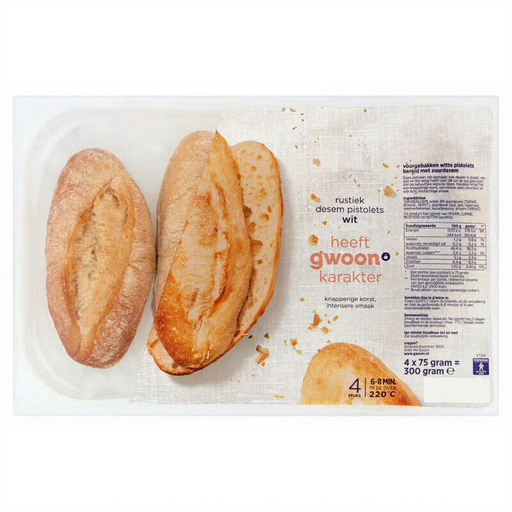
This pack of four rolls is most useful if you’re planning to serve several. If you’re buying for one or two people, decide in advance what you’ll do with the remaining rolls.
 No image available
g'woon White Rustic Pistolet, 4 pack
A pack for anyone planning to use four rolls; if you’re catering for a smaller group, you may have some left over.
Before buying, check whether the rolls need baking, and read the current ingredients, allergens and storage instructions on the packaging.
View at Joybuy
Frequently asked questions
Is a bread roll the same as half a loaf?
No. Voedingscentrum classifies bread rolls as small bread. For a small gathering, compare the actual number of rolls and their weight rather than relying on the term ‘half a loaf’.
Do I need bread rolls to serve rusks with sugar-coated aniseeds?
No, the traditional treat is made with rusks. Stichting Ambachtelijke Bakkerij describes a rusk as a dry, twice-baked form of bread; choose a bread roll if you deliberately want to serve a roll instead of this classic option.
How should I store part-baked rolls after opening?
Follow the storage instructions on the packaging for your product. Voedingscentrum recommends keeping an opened pack of part-baked rolls in the fridge for 2–4 days or in the freezer for 1–3 months; their quality may deteriorate during freezing.
Does every bread roll contain iodised salt?
Don’t assume so. Albert Heijn and PLUS list iodised salt in specific bread rolls, but check the current ingredients list for the roll you’re buying.
What should I look for if allergens are important?
Read the ingredients list and any warnings about the possible presence of allergens for the exact bread roll you’re buying. The products reviewed vary in their grains and allergen information; ‘multigrain’ or ‘sourdough’ won’t tell you which allergens a product contains.


