
Planners catering for guests with different bread preferences
You want guests to be able to tell white and wholemeal bread apart at a glance, without having to guess from the colour or appearance.


If you want to give guests at a wedding buffet a choice between familiar white bread and wholemeal bread, make sure the options are clearly labelled and displayed separately. A dark or multigrain loaf does not automatically offer both choices. Check the ingredients and allergens for each bread, plan when to defrost it, and ask specifically about baker’s salt if you have questions about iodine; according to the Netherlands Nutrition Centre, its use is not compulsory.
You want guests to be able to tell white and wholemeal bread apart at a glance, without having to guess from the colour or appearance.
You want to give wholemeal bread a clearly identified place and compare the fibre content per 100 g, while still offering guests another type of bread.
You are serving several types of unpackaged bread and want to be able to provide the ingredients and allergen information for each one separately. The Netherlands Food and Consumer Product Safety Authority explains the allergen information requirements for professional suppliers of unpackaged food.
First decide which types of bread guests should be able to identify separately. Then compare the nutritional information and arrange the information needed for serving each type.
| What to consider | What to check when buying | Who is this most important for? |
|---|---|---|
| Clearly identified bread choices | Check that white and wholemeal bread are labelled and displayed separately. | I want guests looking for familiar white bread to find it straight away; this clear choice is the top priority for around 37% of consumers choosing bread for a buffet. |
| Wholemeal bread and fibre | Look for the product description ‘wholemeal’ and, if needed, compare the fibre content per 100 g. | If I want to offer wholemeal bread, I want to know which loaf is actually labelled as such. This matters most to around 36% of these consumers. |
| Allergens and buffet arrangements | Keep a record of the ingredients and allergens for each type of bread, and check the storage instructions. | When I serve several types of unpackaged bread, I want to be able to give guests accurate information about each one; this is the top priority for around 27% of these consumers. |
A dark colour or a mix of grains does not, by itself, tell you whether a loaf is wholemeal. This can leave guests unsure which option is wholemeal.
Check the product description and nutritional information for the specific bread. Offer white bread separately if guests should have that choice too.
According to the Netherlands Nutrition Centre, bakers do not have to use baker’s salt. You cannot tell whether it is present just from the type of bread.
Check the label or ask the baker or caterer about baker’s salt if it is relevant to your choice of bread.
Ingredients and allergens can vary from one type of bread to another. A single notice does not make clear which information applies to which option.
Keep the packaging or product specification for each type and make sure the information for unpackaged bread can be matched to the right product. The Netherlands Food and Consumer Product Safety Authority says professional suppliers must make allergen information available.
Bread left out for too long can dry out, and you may not need all the bread you have bought at the same time.
The Netherlands Nutrition Centre recommends freezing bread in portions after you buy it. Defrost what you need and top up the bread baskets during the buffet.
These brands offer a starting point for comparing different types of bread. Check each product individually before putting together your buffet.
Albert Heijn lists products including AH Bakkersbrood swirl volkoren half.
Jumbo is one of the supermarkets you can compare when shopping for your buffet.
Lidl lists wholemeal and multigrain options among its freshly baked bread.
ALDI Nederland lists white bread and fine wholemeal bread among its fresh daily bread.
PLUS lists half loaves in fine wholemeal, wholemeal and other varieties.
Dirk describes bread varieties ranging from white and wholemeal to multigrain and sourdough.
These products include a wholemeal loaf and multigrain rolls or baguettes for your buffet. If you also want to serve white bread, choose and check it as a separate option.
 Image unavailable
A clearly identified wholemeal option for your bread table. The pack contains two 550 g loaves; check the latest allergen information and whether baker’s salt is listed before serving.
 Image unavailable
A wholemeal option in flatbread form if you want to offer a different shape alongside standard bread. The pack contains six pieces; check the current packaging for ingredients, allergens and baker’s salt.
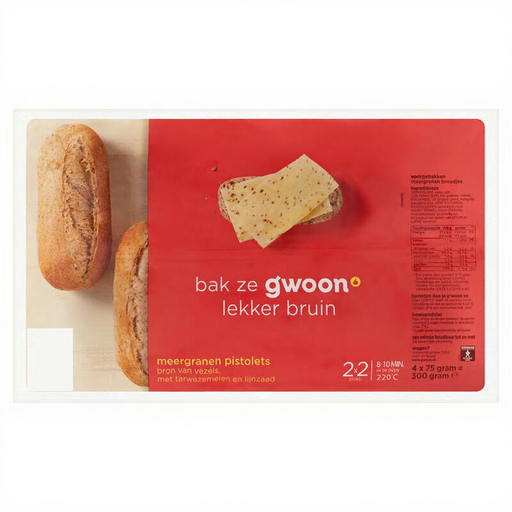 Image unavailable
Four rolls as an additional multigrain option. Multigrain does not automatically mean wholemeal; check the product description and consult the current packaging for accurate sesame and other allergen information before serving.
 Image unavailable
Four individual baguettes, each weighing 135 g, to add another type of bread to the buffet. Check that the product description matches the type of bread you want, and consult the current packaging for full allergen information.
No. A dark colour or the description ‘multigrain’ does not confirm that the bread is wholemeal, and it does not offer a separate white option either. Check the product description and display white and wholemeal bread separately and clearly if you want to offer both.
No. According to the Netherlands Nutrition Centre, using baker’s salt is not compulsory. If its presence matters to your choice, check the label or ask the baker or caterer.
Keep information available for each type of bread so guests can see which allergens apply to which product. The Netherlands Food and Consumer Product Safety Authority explains that professional suppliers of unpackaged food must provide information about the 14 allergens.
Yes, you can freeze bread in advance. The Netherlands Nutrition Centre recommends freezing it in portions after you buy it. Then take out only as much as you need, and follow the instructions for your chosen product.