
Vandaag of morgen in huis

Kwaliteit gegarandeerd

Welkomstaanbiedingen ontgrendelen: GRATIS bezorging | Tot 80% korting | Gratis 30 dagen JoyPlus-proefperiode
Download de app
A bread slicer can be useful for freshly baked bread, cheese, cold meats and vegetables. Even so, many households buy a model that is barely used after a few weeks. This is often due to a limited cutting range, difficult maintenance or a size that does not suit the kitchen.
An electric slicer is not automatically suitable for every type of food. If you mainly slice bread, your requirements will differ from those of someone who also prepares meat, cheese or vegetables. Checking the right points beforehand can help you avoid an unsuitable purchase.
A higher wattage does not necessarily make a machine easier to use. The drive system, blade, guide and stability also determine how evenly you can slice. A compact 100 W machine may be sufficient for bread and light kitchen tasks, while intensive use calls for a more robust construction.
Some models offer only a few settings. Always check the actual slice thickness. A range of 0-15 mm is suitable for thin slices of bread as well as thicker slices of bread, cheese or cold meats. For larger pieces or specific preparations, a range of up to 20 or 23 mm may be more practical.
A sharp blade, crumbs and food residue require regular cleaning. A removable blade and detachable carriage make this easier. Also look for a food pusher, non-slip feet, a safety switch and a way to store the appliance out of children’s reach.
A foldable slicer takes up less space in a Dutch kitchen. When folded, the blade is also less accessible, but the appliance must still be stored safely and in a dry place.
For bread, a serrated stainless steel blade is practical. The teeth grip the crust without requiring you to press each loaf down by hand. A smooth blade may be more suitable for meat and cheese. Some electric meat slicers or multifunctional models come with multiple blades.
Check the following points:
Measure the available space beforehand. A machine measuring 375 mm long and 230 mm deep requires more worktop space than a manual bread slicer. Also consider the weight: a heavier appliance may stand more securely, but is less easy to move.
A foldable design is particularly useful if you do not use the bread slicer every day. Make sure the hinge feels sturdy and that the machine locks securely and remains stable when unfolded.
A safety switch does not automatically eliminate every risk, but it can help prevent accidental activation. Always use the supplied pusher and unplug the appliance before removing a blade or carriage.
Look for:
A kitchen grater, vegetable slicer, potato slicer or food pump has different functions from a bread slicer. So do not choose solely because a product is described as “multifunctional”. First decide which foods you want to prepare most often.
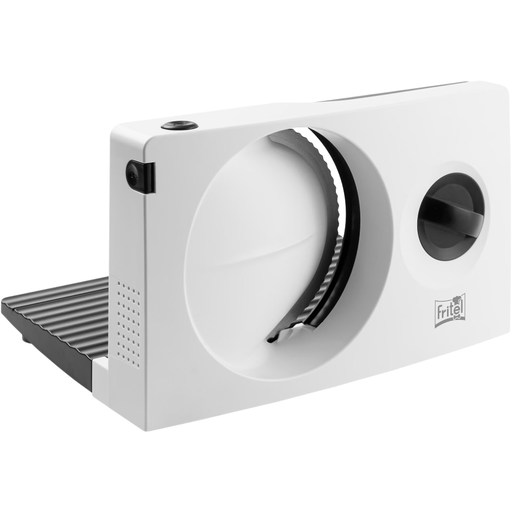
Why it suits this profile: This compact model is designed for home bakers who mainly slice bread and do not need extensive meat-processing capabilities. The adjustable thickness of 0-15 mm accommodates both thin and thicker slices of bread.
The product information lists a serrated stainless steel blade, a child-safe on/off switch and a foldable design. This means the key purchasing criteria can be checked in advance.
100 W motor, 170 mm blade diameter, removable crumb tray and a stated warranty period of 2 years.
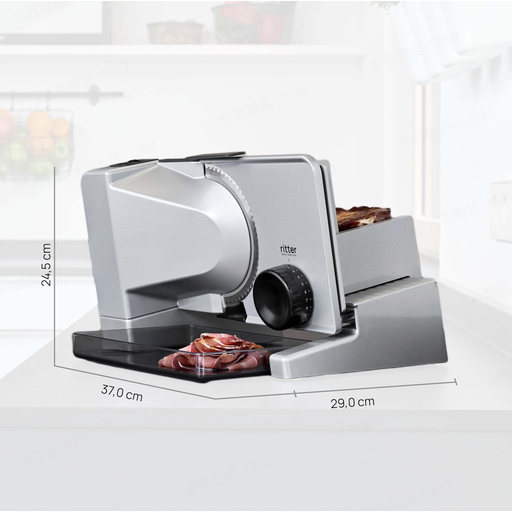
Why it suits this profile: Suitable for households that regularly slice bread, cheese and cold meats, and value adjustable controls and a metal housing.
According to the product description, the model has a metal construction, a removable carriage and electronic speed control. The listed specifications state that the slice thickness can be adjusted up to 23 mm.
Serrated blade for bread, smooth blade for meat and cheese, plus a 24 cm cutting path according to the product description.
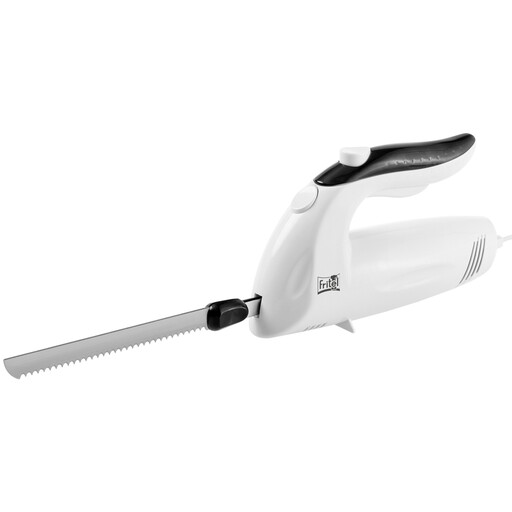
Why it suits this profile: This electric knife is suitable for users who mainly want to slice roasts, baguettes, frozen foods or cabbage. It is not a traditional bread slicer with a carriage.
The product information mentions a double safety switch and two blades: a meat blade and a blade for frozen foods. Before buying, check whether this way of working suits your kitchen routine.
150 W power according to the product listing, a handle for left- and right-handed use, and a 1-metre cord.
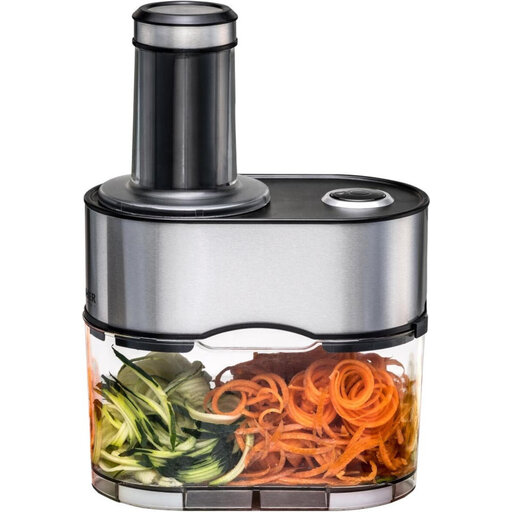
Why it suits this profile: This appliance is designed for making vegetable and fruit spirals, so it complements rather than replaces a bread slicer or meat slicer.
The product information describes five blades, a 2.5-litre collection bowl, safety switches and dishwasher-safe parts. This makes the appliance’s use and cleaning requirements clearer.
Stainless steel housing, stated BPA-free construction, and space-saving storage for the blades and cord.
We have compiled a complete, up-to-date list of products that fully meet these strict selection criteria and the applicable European safety regulations.
Yes, but allow the bread to cool sufficiently first. Very warm bread can be soft and delicate, making it harder to produce even slices. Use the carriage and food pusher as instructed in the manual, and do not force the bread through the blade.
Switch off the appliance, unplug it and follow the product manual. On models with a removable blade or detachable carriage, you can remove crumbs and residue more easily. Do not wash motor components under the tap. Check whether each part is dishwasher-safe.
The electricity costs depend on the power rating and how long the appliance is used. A 100 W appliance theoretically uses 0.1 kWh when running continuously for one hour. In practice, a bread slicer usually runs for less time. The purchase price, maintenance and availability of replacement parts are therefore at least as important as the wattage.
