
Small household looking to avoid leftovers
You can match the number of rolls or slices to the number of people eating. An individual roll, a four-pack of rolls and half a loaf each give you a different amount to use or store.


Choose individual rolls if you want to hand them out at a street festival; bake-at-home rolls need time and equipment before you set off. Half a loaf is a better choice if you’re making filled slices at home or want to freeze any leftover bread. If you only need one or two rolls, compare individual rolls with a four-pack too.
You can match the number of rolls or slices to the number of people eating. An individual roll, a four-pack of rolls and half a loaf each give you a different amount to use or store.
You want to prepare rolls at home and take them with you. Check the packaging of each bake-at-home product for the equipment needed, temperature and cooking time.
You look at fibre per 100 g, ingredients, allergens and whether iodised salt is listed. Compare the labels on the exact products rather than relying on the names of the types of bread.
For a small group, first decide whether you want to take individual rolls or filled slices with you. Then choose a quantity and preparation method that suit what you can do before setting off.
Best for: you want to hand out four individual rolls and can bake them at home.
Consider: you may have rolls left over if there are only one or two of you; baking them takes time before you set off.
Best for: you’re making filled slices at home or want to store any unused bread.
Consider: slices aren’t individual rolls to hand out. Albert Heijn says you can freeze AH Rond volkoren half at home on the day of purchase.
Best for: you need one roll and don’t want to take a four-pack.
Consider: check what’s available in store; Lidl says its fresh bakery range may vary by branch.
| What to consider | What to check when buying | Who it matters to |
|---|---|---|
| Portions and leftovers | Count the people eating and compare individual rolls, the number in each pack and the storage instructions for half a loaf. | If I’m taking bread for one or two people, I don’t want to be left with an unused four-pack; around 37% of consumers prioritise portions and leftovers. |
| Preparation and serving | Check the equipment and cooking time for bake-at-home rolls, and decide whether you can bake them before setting off. | I want to prepare rolls at home and hand them out individually later, without slicing bread on site. Around 27% of consumers prioritise this convenience when serving. |
| Fibre and type of grain | Compare the fibre per 100 g and check which grains have been used; ‘multiseed’ doesn’t automatically mean ‘wholemeal’. | Whether I choose white, multiseed or wholemeal, I want to see what I’m choosing on the label rather than judging by the shape of the bread; around 18% of consumers prioritise fibre and type of grain. |
| Ingredients and allergens | Read the current ingredients and allergen information for the exact product; check for ‘iodised salt’ if it’s relevant to your choice. | If I have a relevant allergy, I want to check the ingredients before taking bread with me. Around 18% of consumers prioritise ingredients, allergens and salt. |
A roll is an individual item; half a loaf gives you slices for making filled sandwiches. This difference affects how you prepare and serve the bread.
Decide how many individual rolls or filled slices you want to serve before choosing a pack.
A four-pack may be handy for four people, but you could have rolls left over if you’re catering for a smaller group. How you store half a loaf depends on the instructions for that product.
Plan for the number of people eating and check whether you can store or freeze any leftover bread according to the label.
The Netherlands Food and Consumer Product Safety Authority explains that iodine can be added to bread through bakers’ salt. That doesn’t mean iodised salt is listed on the label of every roll or half loaf.
Check the ingredients list for your chosen product if iodised salt is important to your purchase.
The Jumbo rolls reviewed contain wheat and gluten; some of the other rolls examined also list additional potential allergens. A name such as ‘white’ or ‘multiseed’ doesn’t give you complete allergen information.
Read the current allergen statement for the exact variety before buying it for someone with a relevant allergy.
AH Rond volkoren half is an option if you want to make filled slices rather than take individual rolls.
The Jumbo product information reviewed includes white and multiseed rolls in 300 g four-packs.
Lidl lists a white roll in its fresh bakery range in store.
ALDI lists individual rolls, giving you a different quantity option from a four-pack of bake-at-home rolls.
PLUS lists both white bake-at-home rolls in a 300 g bag and an individual white sourdough roll.
The white and multigrain bake-at-home rolls from Dirk that were reviewed are sold in packs of four, weighing 300 g.
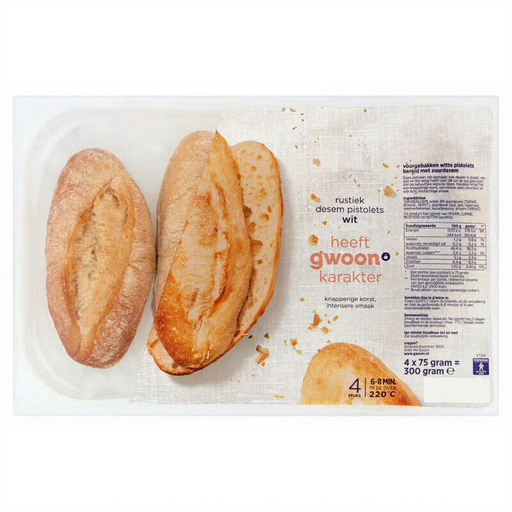
This four-pack is a good fit if you want to take four individual white rolls to a street festival. Check the pack for preparation instructions before you buy.
 No image available
This four-pack is a good choice if you want to hand out four individual rolls.
Before you buy, check the preparation instructions and current allergen information on the pack.
Rolls are more convenient if you want to hand out individual portions; half a loaf is a good fit if you’re making filled slices at home. If you’re choosing bake-at-home rolls, check whether you can bake them before setting off. To store slices, follow the instructions for that particular loaf; Albert Heijn says AH Rond volkoren half can be frozen at home on the day of purchase.
Yes, if the instructions for your product include air fryer cooking. For the white bake-at-home rolls reviewed, PLUS recommends 4 minutes at 200 °C in a preheated air fryer; for other varieties, follow the instructions on the pack.
No, you can’t assume that every roll does. The Netherlands Food and Consumer Product Safety Authority explains how iodine can be added to bread through bakers’ salt; check the ingredients list for your roll to see whether it contains ‘iodised salt’.
Read the current allergen statement for the exact roll you’re buying, rather than relying on the name of the bread. The Jumbo rolls reviewed contain wheat and gluten; some of the varieties examined also list additional potential allergens.
No, the name ‘multiseed’ doesn’t in itself mean that a roll is wholemeal. Check the product description and ingredients to see which grains have been used; compare the fibre per 100 g if that distinction matters to your choice.