
Canteens that make wholemeal the default
For buyers who want to offer a roll with a verifiable wholemeal flour content and can compare the ingredients and nutritional information of the varieties they choose.


If wholemeal is a priority for your lunch menu, choose a roll with a verifiable wholemeal flour content, and offer a white roll as a separate option. A variety made with both wholemeal flour and white wheat flour can be a middle ground for fussy eaters. But the word ‘multigrain’ doesn’t confirm what it contains, so check the ingredients of the exact product.
For buyers who want to offer a roll with a verifiable wholemeal flour content and can compare the ingredients and nutritional information of the varieties they choose.
For teams looking to offer more than just white and fully wholemeal rolls, and seeking a variety made with both wholemeal flour and white wheat flour.
For sites that bake rolls in batches and therefore need to match their storage method, preparation time and equipment capacity to their service schedule.
For a university lunch menu, wholemeal, a verifiable mix of wholemeal flour and wheat flour, and white rolls are distinct choices. How the rolls are prepared also determines whether they suit the lunchtime rush.
When: choose a roll clearly labelled as wholemeal when wholemeal flour content is the starting point for your lunch menu.
Consider: some customers may prefer a white roll, and you should confirm that your supplier stocks the exact variety you want.
When: this middle-ground option suits a menu that goes beyond just white and fully wholemeal rolls. PLUS lists its Korenlanders multigrain sourdough rolls as containing 34% wholemeal wheat flour and 21% wheat flour.
Consider: a partially wholemeal roll is not the same product as a fully wholemeal roll.
When: offer a white roll as a separate option for customers who prefer this type of bread.
Consider: don’t treat a white variety as proof that your menu also includes the desired white-and-wholemeal mix.
| What to consider | What to check before buying | Who it matters to |
|---|---|---|
| Wholemeal content and fibre | Read the product name and ingredients. Compare the stated wholemeal flour content and fibre per 100 g for the exact varieties. | I want to be able to check how much wholemeal flour is in a roll before choosing it as the basis for my lunch menu. This composition is the top priority for around 42% of consumers. |
| Choice for fussy eaters | Check that a potential middle-ground variety really does contain both wholemeal flour and wheat flour; don’t rely on the name ‘multigrain’ alone. | I want to give customers who choose different types of bread more than one option, without presenting a partially wholemeal roll as fully wholemeal. This choice matters most to around 33% of consumers. |
| Preparation during the lunch rush | Match the storage method, baking time and pack size of the roll you choose to your available equipment and number of service periods. | During a short lunch rush, I want to bake rolls as they’re needed. For around 25% of consumers, preparation and service planning is the deciding factor. |
The name alone doesn’t tell you how much wholemeal flour a roll contains. For example, the composition listed by PLUS differs between its multigrain rolls and its Korenlanders sourdough variety.
Compare the product name, ingredients and nutritional information for the exact varieties. Choose a partially wholemeal roll as a deliberate middle-ground option, not as an automatic substitute for a fully wholemeal one.
When rolls are filled and served unpackaged, customers must still be able to find out which allergens they contain. The Netherlands Food and Consumer Product Safety Authority says that businesses serving unpackaged food must inform customers about allergens.
Keep up-to-date allergen information for each roll and filling combination available at the serving point, and update it whenever an ingredient changes.
Seeing iodised salt listed for one product tells you nothing about the ingredients of another roll.
Check the ingredients of the exact variety before mentioning iodised salt in the product information.
These ranges give you an idea of the types of rolls you can compare. For a canteen order, always check the variety you’ve chosen and the retailer in question.
Albert Heijn’s fresh bread range includes individual white and wholemeal rolls.
Jumbo has a range of bake-at-home rolls in different varieties and storage formats.
Lidl includes white rolls in its fresh-from-the-oven bread range.
Aldi describes an individual white roll and also shows white and wholemeal rolls in its wider bakery range.
PLUS lists white, multigrain and partially wholemeal bake-at-home rolls, each with its own ingredients.
Dirk lists multigrain bake-at-home rolls under the 1 de Beste brand.
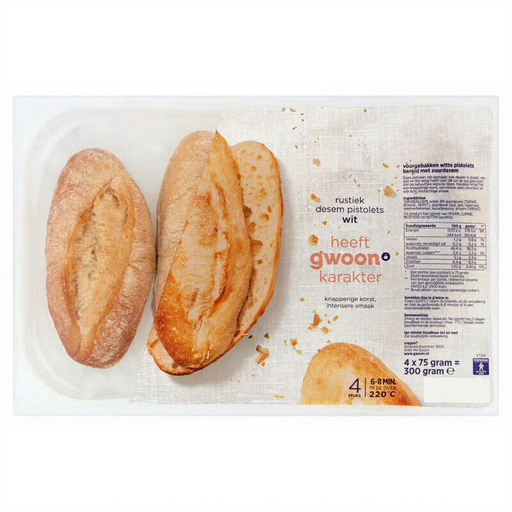
This white roll works as a separate option alongside a roll with a confirmed wholemeal flour content. Don’t judge it by its name as a white-and-wholemeal mix.
 No image available
A white option for a lunch menu that gives customers a choice of different types of rolls.
Check the ingredients and allergens on the packaging. Only plan preparation around the lunch rush once you’ve checked the product instructions.
No. Check the product name and ingredients to see how much wholemeal flour the roll you’ve chosen contains. For example, PLUS lists 34% wholemeal wheat flour and 21% wheat flour for its Korenlanders multigrain sourdough rolls. This describes a mix, not a fully wholemeal roll.
The canteen must be able to inform customers about allergens in unpackaged rolls, as the Netherlands Food and Consumer Product Safety Authority explains. Check both the exact roll and the filling, and keep the information up to date if either changes.
Don’t assume a roll is suitable based on its type of bread or product name. The PLUS varieties described contain wheat. Check the exact ingredients and allergen information for every roll you offer, and don’t make blanket assurances about an entire product category.
Use the storage and preparation instructions for the exact roll you’ve bought to work out how many you can bake at once. Check that the baking time and equipment fit the times when your canteen plans to serve the rolls.
You can’t assume that every roll does. Check the ingredients of the exact variety to see whether iodised salt is listed for that product.