
Families keeping an eye on lunch costs
You’re looking for an option you can pack regularly on school days without wasting bread. So, compare the number of rolls and their weight before comparing packs.


For a school lunch, first compare the number of rolls and their weight, then choose what suits how often you plan to pack them. If rolls are a regular part of your lunch routine, it’s worth considering one clearly labelled as wholemeal: the Netherlands Nutrition Centre advises replacing white bread with brown or wholemeal bread as much as possible. If your child has coeliac disease or a relevant allergy, check the current label, take steps to prevent cross-contamination and follow the school’s arrangements before choosing an ordinary roll.
You’re looking for an option you can pack regularly on school days without wasting bread. So, compare the number of rolls and their weight before comparing packs.
If a roll is often the main part of lunch, it’s worth considering whether it’s wholemeal, its nutritional information and whether your child can eat it easily at school. The Netherlands Nutrition Centre recommends brown or wholemeal bread for a school lunch.
If your child has a relevant medical dietary restriction, first decide which product is suitable according to their dietary plan. Check the current label, prevent cross-contamination where necessary and ask about the school’s arrangements.
When choosing rolls for a school lunch, decide what matters most: cost per roll, a wholemeal option, your morning routine or allergens.
| What to consider | What to check | Who is this important to? |
|---|---|---|
| Cost per lunch | Compare the number of rolls and their weight, then work out the cost per comparable roll or per 100 g. | I pack a roll on many school days and want to know how many lunches I’ll get from a pack. For around 36% of consumers, cost per lunch comes first. |
| Wholemeal as a lunch staple | Look for an explicit wholemeal label and check the nutritional information per 100 g; the term ‘multigrain’ isn’t enough. | If rolls often replace sliced bread at lunch, I want to make a conscious choice about what I pack. For around 29% of consumers, this everyday bread choice is the main consideration. |
| Baking and storage | Check the preparation method and storage instructions for the specific product. | I don’t have much time before school and want to avoid unused rolls going stale. For around 21% of consumers, a quick morning routine and having enough in stock are the main concerns. |
| Gluten and allergens | Read the current label. If your child has a medical dietary restriction, make sure the product choice and any steps to prevent cross-contamination suit their needs. | If my child needs to avoid gluten or wheat, I need to know what I can safely pack and what arrangements the school has in place. For around 14% of consumers, this is a priority. |
A pack with fewer or smaller rolls isn’t a like-for-like basis for comparing the cost per lunch.
First check the type of bread, the number of rolls and the weight. Only then compare the cost per roll or per 100 g.
According to the Netherlands Nutrition Centre, ‘multigrain’ means that at least three types of grain have been used. The term doesn’t confirm that a roll is wholemeal.
Look for an explicit wholemeal label and check the ingredients and nutritional information if that’s why you’re buying it.
PLUS product information lists wheat and gluten-containing cereals in its white rolls. The Netherlands Nutrition Centre notes that even crumbs from cross-contamination can be relevant for people with coeliac disease.
Read the current label, follow your child’s dietary plan and, if needed, check with the school how food should be packed and shared.
Bake-at-home rolls need time to prepare, and storage instructions can vary by product. For example, Albert Heijn says its white bake-at-home rolls aren’t suitable for freezing at home.
Before buying, check when you can bake the rolls and how to store that particular pack. Choose an amount you’ll be able to use.
Albert Heijn offers white bake-at-home rolls, an individual wholemeal roll and an option labelled gluten-free.
ALDI offers an individual white roll, which is handy if you want to buy them one at a time.
PLUS lists 300 g packs of white bake-at-home rolls, with preparation and allergen information.
Dirk offers white and multigrain bake-at-home rolls in packs of four, weighing 300 g.
Lidl offers 700 g packs of white rolls to bake at home.
This pack of four white rolls could suit anyone looking for rolls for several school lunches. Compare the weight, cost per roll and preparation method before deciding whether they fit your routine.
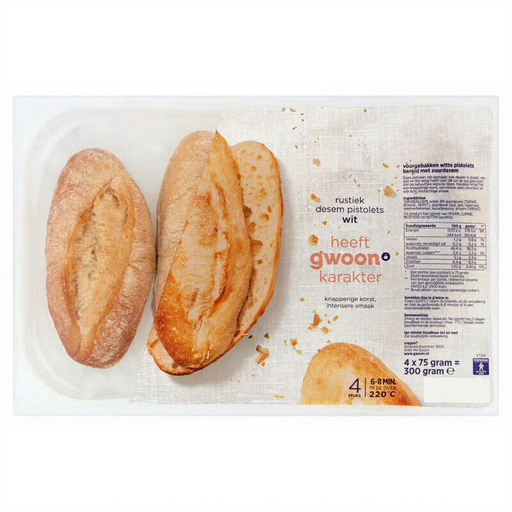 Image unavailable
A pack of white rolls for anyone who wants to spread four rolls across planned lunch breaks.
Before buying, check the weight and preparation method if you’re comparing packs or want to get the rolls ready before school. If you need to avoid gluten or other allergens, read the current label.
You can, if they suit your child’s needs and any arrangements in place. However, for a regular bread-based lunch, the Netherlands Nutrition Centre advises replacing white bread with brown or wholemeal bread as much as possible. So, look for rolls clearly labelled as wholemeal too.
Not necessarily. According to the Netherlands Nutrition Centre, ‘multigrain’ refers to at least three different types of grain. Check separately for a wholemeal label and read the ingredients.
Buy an amount that matches the lunches you’ve planned and follow the product’s storage instructions. If you want to freeze the rolls in portions, first check whether those particular rolls are suitable for freezing.
Not for every child. If your child has coeliac disease or another relevant medical dietary requirement, the product must meet their needs. Check the current label and prevent cross-contamination where necessary. Also ask what arrangements the school has for packing and sharing food.
You can’t assume that every roll does. The Netherlands Food and Consumer Product Safety Authority describes iodine compounds in bread and bakery products as a possibility; check the ingredients list for the roll you’re buying.