
Small household looking to avoid leftovers
If you’re buying for one or two meals, it helps to match the number of rolls to what you plan to eat. Buying them loose, choosing a split pack or opting for frozen rolls are all ways to do this.


As an alternative to half a loaf, individual bread rolls give you just enough for one meal, with no leftovers. If you’re buying for several meals, a pack of part-baked rolls that you can split may be a good option. Frozen rolls let you prepare only what you need for each meal. For both packaged options, check how many rolls you need to use at once and follow the storage and defrosting instructions for the product you choose.
If you’re buying for one or two meals, it helps to match the number of rolls to what you plan to eat. Buying them loose, choosing a split pack or opting for frozen rolls are all ways to do this.
If you want to pick up rolls on a quick shopping trip and bake them at home, check which appliance you’ll need and how long they take to prepare. PLUS says its white part-baked rolls take 8–10 minutes in the oven and can also be cooked in an air fryer.
Compare the nutritional information per 100 g and check the ingredients for the exact variety. PLUS’s multigrain rolls contain 7 g of fibre per 100 g and include wheat, rye, barley and oats.
Choose this when: you need one or a few rolls for today; Albert Heijn sells a white roll individually.
The trade-off: you won’t have an opened four-pack left over, but you also won’t have any rolls in stock for your next meal.
Choose this when: you’re planning several meals and want to bake the rolls at home.
The trade-off: you’ll often be buying four at once. Albert Heijn’s brown part-baked rolls come in a split pack of two, but Albert Heijn says they aren’t suitable for freezing at home.
Choose this when: you have freezer space and want to prepare rolls only when you need them.
The trade-off: you’ll need to allow time for defrosting. Jumbo says its frozen rolls should not be refrozen once defrosted, and must be prepared and eaten within 24 hours.
| What to consider | What to check before buying | Who it matters to |
|---|---|---|
| Portions and storage | Check the number of rolls, whether the pack can be split and the storage instructions once opened. | If I only need one or two rolls, I want to avoid having the rest left over. For around 42% of consumers, reducing leftovers would be the top priority. |
| Preparation | Check whether the rolls are ready to eat or need baking, and which equipment and preparation time are required. | If I want to eat straight away or make warm rolls at home, when they need preparing will determine my choice. For around 33% of consumers, this would come first. |
| Nutritional information and allergens | Compare fibre per 100 g and check the ingredients, allergens and any ‘may contain’ statement for the exact variety. | If I need to compare grains, fibre or allergens, the product name alone isn’t enough. For around 25% of consumers, this label information would be the main consideration. |
If you’re buying for one meal for one or two people, you may have rolls left over, even if the pack looks small.
Choose individual rolls if you’re only buying for that meal. If you pick up four, decide in advance when you’ll eat the rest and how to store them according to the packaging.
This may go against the instructions for the frozen product you’ve chosen.
Only take the number you need out of the freezer. Jumbo says its frozen rolls should not be refrozen once defrosted, and must be prepared and eaten within 24 hours.
PLUS’s multigrain rolls include wheat, rye, barley and oats. The colour or product name is no substitute for checking the allergen information.
Read the ingredients, allergens and any ‘may contain’ statement on the exact pack.
Ingredients vary from product to product. Albert Heijn and PLUS list iodised salt in the varieties checked, while Jumbo’s long-life white rolls list ‘salt’.
Check the current ingredients list if the type of salt matters to your choice.
Sells both individual white rolls and brown part-baked rolls in a split pack.
Sells rolls in four-packs, including long-life part-baked and frozen varieties.
Sells white and multigrain part-baked rolls, so you can compare their nutritional information, ingredients and preparation instructions.
Sells a four-pack of white part-baked rolls from 1 de Beste.
This four-pack is an option if you’re buying rolls for several meals. Check the packaging for preparation instructions and how to store the rolls once opened.
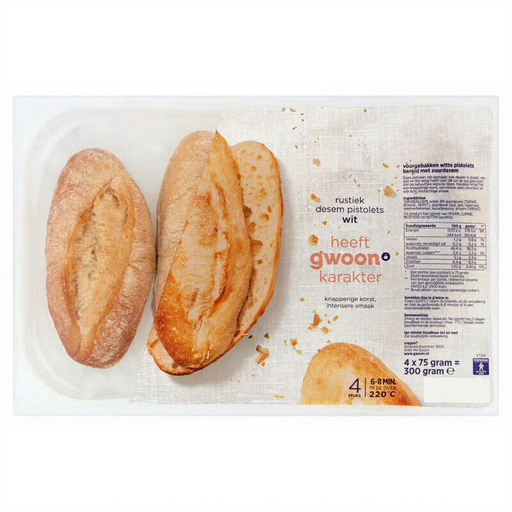 Image unavailable
This pack is a good fit if you want to buy rolls for several meals.
Pack size: 4 rolls.
Check the preparation method and storage instructions for after opening on the packaging; don’t assume the rolls are suitable for freezing at home.
Yes, if you want to match the amount to one meal: an individual roll may be enough. With a four-pack, you’ll also need to decide when to eat the remaining rolls and how to store them.
It depends on the exact product, so follow the instructions on the packaging. For example, Albert Heijn says its brown part-baked rolls aren’t suitable for freezing at home. For rolls that can be frozen, the Netherlands Nutrition Centre recommends storing them for 1–3 months.
Don’t assume so. Albert Heijn and PLUS list iodised salt in the varieties checked, while Jumbo’s long-life white rolls list ‘salt’ in the ingredients. Check the current label on the product you’re buying.
You can’t tell from the name ‘multigrain’. PLUS’s multigrain rolls contain wheat, rye, barley and oats. If you need to avoid gluten, check the allergen information on the exact pack.