When choosing bread rolls for a large family lunch, don’t rely on the term ‘thick cut’: it doesn’t give you a useful measure of a roll’s thickness or how much filling it can hold. Check the number of rolls and the pack weight, and look at their shape if you want to add generous fillings. Compare the ingredients, fibre, allergens and cooking instructions too; frozen rolls also need enough freezer space.
Who are these choices relevant to?
Families who like to add generous fillings to their rolls
If you’re looking for bread rolls for a lunch or snack with plenty of filling, you’ll want to know how many you need and whether their shape suits the filling. The number of rolls, their weight and the cooking instructions can help you plan, but they don’t prove how sturdy a roll is.
Families who keep an eye on fibre
If you want to compare the grain content of bread rolls, check the ingredients and nutritional information per 100 g. According to the Netherlands Nutrition Centre, wholegrain cereal products contain more fibre than white cereal products; the term ‘multigrain’ doesn’t tell you how much wholemeal flour a particular roll contains.
Households looking for a gluten-free roll
A gluten-free label matters when making this choice, but it doesn’t replace checking for other allergens. PLUS’s gluten-free bread roll example lists sesame.
What should you look for when choosing?
For a large family lunch, first work out how many rolls you’ll need for each meal. Then check the product’s shape, nutritional information, allergens and cooking instructions on the pack you’re planning to buy.
| What to consider |
What to check when buying |
Who is this most important for? |
| Generous fillings |
Look at the shape of the roll and compare the number of rolls and the pack weight. Don’t assume it will be sturdy based on ‘thick cut’ or ‘rustic’ alone. |
If I want to add plenty of filling to one roll, I want to be able to judge its shape before I buy it. Around 34% of consumers prioritise suitability for generous fillings. |
| Portions and storage |
Count the rolls in the pack and read the baking instructions. For frozen rolls, check the storage instructions and make sure you have enough freezer space. |
For a lunch with lots of people, I want to be able to prepare enough rolls without losing track of what I have in stock. Portions and planning are the main concern for around 33% of consumers. |
| Fibre and grain type |
Check which flour is listed in the ingredients and compare the fibre per 100 g for the specific products. |
I want to make an informed choice about the grain content of the rolls I buy for my family, rather than relying on the term ‘multigrain’. Fibre and grain type are the top priority for around 25% of consumers. |
| Gluten and allergens |
Read the ingredients, allergen information and any ‘may contain’ statements on the label. Even with a gluten-free product, check for other allergens. |
If someone at the table needs to avoid a specific allergen, the roll needs to suit their requirements. Around 8% of consumers give this check top priority. |
Common mistakes
-
Assuming ‘multigrain’ means a set amount of fibre
The name doesn’t tell you how much wholemeal flour or fibre a particular roll contains. PLUS lists 56% wholemeal wheat flour and 7 g of fibre per 100 g for its multigrain rolls; these figures apply to this product, not all multigrain rolls.
Compare the ingredients list and fibre per 100 g on the packs you’re considering.
-
Buying frozen rolls without planning how to store them
A frozen pack needs freezer space, and you’ll need to follow the product instructions. Jumbo says to store its brown frozen rolls at −18 °C and not to refreeze them after thawing.
Check you have enough freezer space and read the instructions on the pack you’ve chosen before defrosting the rolls.
-
Assuming gluten-free means allergen-free
PLUS’s gluten-free multiseed rolls list sesame. So a gluten-free label doesn’t answer every question about allergens.
Check the full allergen information on every pack, even if you already know the product name.
Brands with relevant examples of bread rolls
These examples show the product information you can compare across different bread rolls; a brand name alone doesn’t tell you about the characteristics of its entire range.
Jumbo
Jumbo has examples of white and brown frozen rolls, as well as other varieties such as multiseed and spelt.
- The ingredients and allergens are listed for the white rolls, while the brown frozen rolls also have storage instructions.
- The instructions for one frozen variety don’t necessarily apply to another Jumbo roll.
PLUS
PLUS’s multigrain and gluten-free roll examples meet two different shopping needs.
- The multigrain rolls list 56% wholemeal wheat flour and 7 g of fibre per 100 g.
- The gluten-free multiseed rolls list sesame; if you have allergies, read the label for the specific product.
Dirk
The white and rustic multigrain rolls from 1 de Beste are examples for anyone comparing pack sizes and product types.
- The rustic multigrain variety is described as a pack of four rolls weighing 300 g in total.
- The term ‘rustic multigrain’ doesn’t guarantee a particular thickness, firmness or amount of wholemeal flour.
Albert Heijn
The AH Sourdough brown multigrain roll is an example where the ingredients tell you more than the product name alone.
- The product information lists 27% wholemeal wheat flour and iodised salt.
- Assess other sourdough or multigrain rolls individually, based on their own ingredients and nutritional information.
Bread rolls on Joybuy
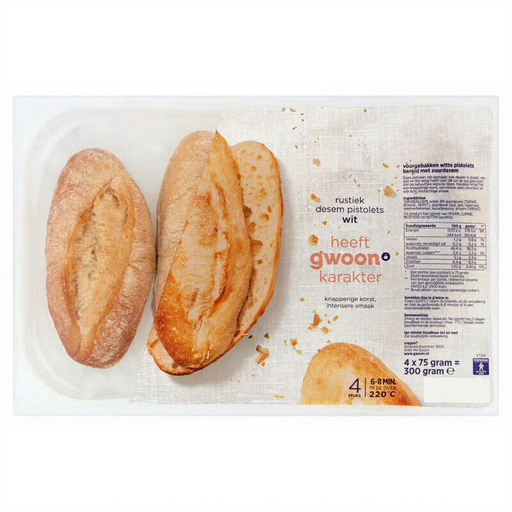
This pack of four rolls is one option for planning how many rolls you’ll need for a family lunch. If you want to add generous fillings, assess their shape separately.
 No image available
g'woon White Rustic Pistolet, pack of 4
Four rolls in a pack give you a starting point for planning family portions.
Check their shape if you want to add generous fillings: the number of rolls doesn’t confirm how sturdy they are. Also read the cooking instructions and allergen information on the pack.
View on Joybuy
Frequently asked questions
Can I tell from ‘thick cut’ whether a roll is suitable for lots of filling?
No. For these rolls, the term doesn’t indicate a specific thickness or proven ability to hold a filling. Look at the product’s shape, and use the number of rolls and their weight to plan portions—not as proof that the rolls are sturdy.
How do I plan how many rolls to bake for a large group?
First count how many rolls you need for each meal, then read the instructions for the product you’ve chosen. PLUS says to bake its multigrain rolls for 8–10 minutes in an oven at 220 °C. If you choose Jumbo’s brown frozen rolls, follow the storage instructions and keep them at −18 °C; don’t refreeze them after thawing.
Are multigrain rolls always wholemeal?
No. The term ‘multigrain’ doesn’t tell you how much wholemeal flour a roll contains. Check the ingredients and fibre per 100 g for the specific product; for example, PLUS lists 56% wholemeal wheat flour in its multigrain rolls.
What should I check if someone needs to avoid an allergen?
Read the ingredients, allergen information and any ‘may contain’ warnings on the pack you’re buying. Jumbo’s white rolls list wheat and gluten and may contain milk and sesame; PLUS’s gluten-free multiseed rolls list sesame.


