
Small households
If you’re shopping for one or a few people, you’ll want to match the number of rolls or slices of bread to the meals you have planned. Individual rolls and half a loaf meet different needs.


Buy individual bread rolls if you want to take exactly the number you need for one or a few people. A pack of rolls works well for a planned meal if you’ll use or store all of them; choose half a loaf if you’d rather have sandwiches on several occasions. For packaged bread, check the ingredients and allergen information. If the rolls may need baking, check the preparation instructions too.
If you’re shopping for one or a few people, you’ll want to match the number of rolls or slices of bread to the meals you have planned. Individual rolls and half a loaf meet different needs.
A pack of rolls can work well for breakfast or lunch with a small group, as long as it contains the right number. If you want to bake them just before serving, check the instructions on the pack you choose.
If you prefer wholemeal bread or have questions about ingredients, allergens or iodised baker’s salt, check the packaging of the exact product. According to the Voedingscentrum, bakers aren’t required to use baker’s salt.
First, decide whether you want individual rolls for one meal or bread for sandwiches over several meals. Then match the quantity and, where necessary, the preparation to your plans.
Choose these if: you want to get the number of rolls just right for one or a few people.
Bear in mind: availability of individual rolls can vary by shop and time.
Choose these if: the pack size suits your group or a meal you have planned for later.
Bear in mind: bake-at-home rolls need oven space and preparation time, so don’t rely on the product name alone.
Choose this if: you’re a small group and want sandwiches on several occasions.
Bear in mind: slices of bread are a different kind of portion from individual rolls for guests.
| What to consider | What to check when buying | Who is this most important for? |
|---|---|---|
| Getting the quantity right | Count the people and meals; compare individual rolls, the contents of a pack and half a loaf. | If I only need a few portions, I don’t want to be left with uneaten bread. Around 33% of consumers put finding the right quantity first. |
| When you plan to serve it | For bake-at-home rolls, check the preparation instructions and make sure your oven will be available in time. | For a planned lunch, I want to serve the rolls at the right time. This is the main consideration for around 27% of consumers. |
| Ingredients and labelling | Read the ingredients and allergen information. If you have a question about iodine, check for baker’s salt or ask the baker. | If a particular type of bread or ingredient matters to me, I want to know what’s in the product I choose. Around 20% of consumers prioritise these checks. |
| Shop range | Check whether your chosen shop stocks the individual roll, pack or half loaf you want. | I want to do all my shopping in one shop and find a type of bread that suits my plans. The range is the deciding factor for around 20% of consumers. |
A pack with more rolls than you need may leave you with some left over after the meal. For example, Jumbo and Dirk list packs of four rolls, while ALDI and Dirk also list individual rolls.
First, count how many people you expect. Choose a pack only if you’ll use or store any rolls left over.
The term ‘multigrain’ doesn’t by itself mean that a roll is wholemeal.
If you want wholemeal bread, look for an explicit wholemeal description on the product you choose and read the ingredients information.
According to the Voedingscentrum, bakers aren’t required to use iodised baker’s salt; organic bread usually doesn’t contain it.
If this matters to you, check the ingredients list or ask the baker.
PLUS’s multigrain rolls come with instructions to bake in a preheated oven at 220 °C for 8–10 minutes. Other products may have different instructions.
Before buying, read the preparation instructions for the exact variety and plan your oven space around mealtime.
Preheating the oven and baking the rolls takes time just before serving.
A good place to start if you want to browse rolls and half loaves in the same online bread range.
Worth considering if you want to compare packaged rolls with half loaves.
An option if you want to choose fresh rolls while doing your shopping.
Worth considering if you want to buy the exact number of rolls you need individually.
A good place to start if you want to compare packaged varieties of rolls and how to prepare them.
Worth considering if you want to compare individual rolls with a pack of bake-at-home rolls.
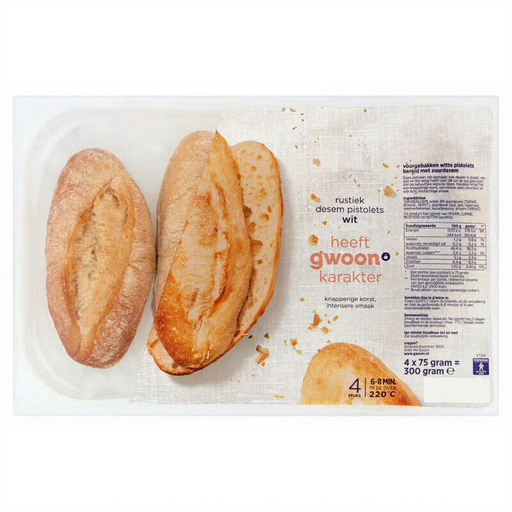
This is a pack of four rolls, suited to anyone who can use four. Check the packaging before deciding whether and when they need to be prepared.
 No image available
An option if you want to use four rolls for your planned meal or a later occasion.
Check the packaging to see whether the rolls need preparing, and read the ingredients and allergen information for everyone who’ll be eating.
Choose individual rolls if you want separate rolls for one meal and want to match the quantity to the number of people. Half a loaf is a better fit if you want sandwiches on several occasions.
Follow the instructions for the rolls you buy. PLUS recommends baking its multigrain rolls in a preheated oven at 220 °C for 8–10 minutes; these instructions don’t automatically apply to other varieties.
No. According to the Voedingscentrum, bakers aren’t required to use baker’s salt. For packaged bread, check the ingredients list or ask the baker if you want to know whether your chosen bread contains it.
Read the descriptions, ingredients and allergen information for the exact product. According to the Voedingscentrum, organic bread usually doesn’t contain baker’s salt. The Voedingscentrum also recommends checking whether gluten-free bread contains iodine.