
If you’re buying bread for a group
You want enough rolls for your guests without unnecessary leftovers. So compare the price per roll and check whether you need individual rolls or a whole pack.


Work out your bread budget for an Italian evening by considering the price per roll and how many you want to serve, not just the pack price. Fresh rolls sold individually are convenient if you’re serving them straight away and want to buy an exact quantity. Part-baked rolls need time and suitable equipment, but you can bake them just before the meal. Compare the labels on individual products for ingredients, fibre and allergens.
You want enough rolls for your guests without unnecessary leftovers. So compare the price per roll and check whether you need individual rolls or a whole pack.
Whether you’re serving antipasti, soup or pasta, you’ll want the bread on the table at the right time. With part-baked rolls, you’ll need to allow time and space in the oven or air fryer; fresh rolls don’t need baking.
If ingredients, fibre or allergens matter to your guests, look beyond the colour or the name ‘multigrain’. The ingredients list and nutritional information tell you about the specific roll.
When choosing rolls for an Italian evening, first work out how many you need, when you want to serve them and which ingredients matter to your guests.
| What to consider | What to check when buying | Who it matters to |
|---|---|---|
| Total cost of the bread | Compare the price per roll with the pack size and the number you plan to serve. | When I’m buying for a group, I don’t want to be left with rolls I didn’t need. The total cost of the bread is the main consideration for an estimated 50% of consumers. |
| When you’ll serve them | Check whether the rolls are ready to serve or need baking, and what equipment and preparation time they require. | When the rest of the meal is nearly ready, I want to be able to serve the rolls without delay. For around 30% of consumers, serving time is the most important factor. |
| Ingredients and allergens | Read the ingredients and allergen lists; compare the fibre per 100 g in the nutritional information. | If a guest needs to watch their ingredients or allergens, I want to be able to check the label on the roll I’ve chosen. The ingredients are the first consideration for an estimated 20% of consumers. |
A pack may look like good value, but if you’re catering for a small group, any leftover rolls count too.
Calculate the price per roll, then choose a quantity that suits the number of people eating.
Part-baked rolls need space in the oven or air fryer. Serving may be delayed if you’re using the same appliance for other dishes at the same time.
Check the preparation instructions and plan when to bake the rolls, or choose fresh rolls if you want to serve them without baking.
The product name or dark colour doesn’t tell you how much wholemeal flour or fibre a roll contains.
Check the ingredients list and compare the stated fibre per 100 g if these details matter to your choice.
According to the Voedingscentrum, bakers aren’t required to use iodised baker’s salt. Whether a roll contains this type of salt depends on the product.
Check the ingredients list if the type of salt used is important to your purchase.
Albert Heijn sells individual white rolls baked in store, as well as a separate gluten-free part-baked option.
Jumbo sells white part-baked rolls and brown frozen rolls, among other options.
Lidl offers white rolls in a 700 g pack for baking at home.
ALDI lists an individual white roll for purchase in store.
PLUS sells white part-baked rolls and a multigrain sourdough option, with product information on preparation and ingredients.
Dirk sells white part-baked rolls under its 1 de Beste own brand in a pack of four.
This product selection features a pack of four white rolls to serve with a meal. Check the current price per roll and the preparation method if you’re planning to serve them at an Italian evening.
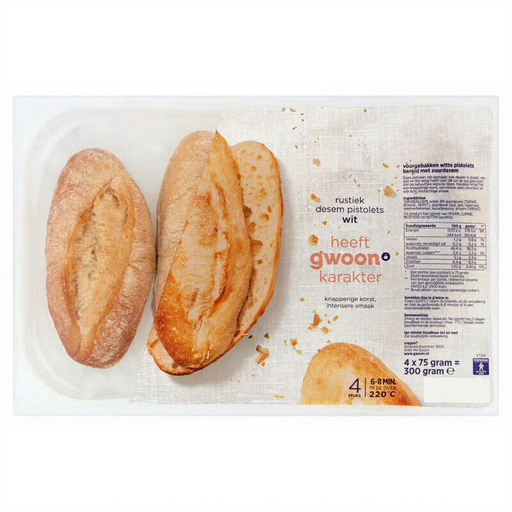 No image available
If you want to serve four rolls with your meal, this pack size matches the quantity you need.
Before buying, check the preparation method and allergen information for cereals containing gluten, lupin, mustard, nuts and sesame.
Multiply the number of rolls you want to serve by the current price per roll. Then compare individual rolls with packs and allow for any rolls that might otherwise be left over.
Follow the instructions for the product you’ve chosen and plan to bake the rolls just before serving if you want a freshly baked crust. PLUS recommends baking its white part-baked rolls in an oven at 220 °C for 8–10 minutes, or in a preheated air fryer at 200 °C for 4 minutes; other products may have different instructions.
No, the name alone doesn’t tell you how much wholemeal flour it contains. Check the ingredients list: for example, PLUS Korenlanders multigrain rolls list 34% wholemeal wheat flour and 5,8 g of fibre per 100 g, but those figures apply to that specific option.
No, you can’t tell from the type of bread. According to the Voedingscentrum, bakers aren’t required to use iodised baker’s salt, so check the ingredients list on the roll you’re buying.