
Hosts catering for different tastes
You want to offer familiar white rolls, as well as a separate wholemeal option for guests who prefer it.


For a sharing board with a mix of guests, you can pair white rolls with rolls explicitly labelled ‘wholemeal’. That way, guests don’t all have to choose the same bread. According to the Netherlands Nutrition Centre, wholegrain products contain more fibre than white-grain products; the word ‘multigrain’ alone doesn’t prove that a roll is wholemeal. For bake-at-home rolls, check the instructions for the exact variety, and ask for allergen information if you’re buying unwrapped rolls.
You want to offer familiar white rolls, as well as a separate wholemeal option for guests who prefer it.
You’re looking for a roll that really is wholemeal, rather than relying on the word ‘multigrain’. The Netherlands Nutrition Centre distinguishes between wholegrain and white-grain products.
You want to time the baking around when you’ll be serving, so you’ll need to factor in the instructions for your chosen rolls and the oven space available.
First decide which types of bread you want to offer. Then check that the pack size and any baking instructions suit your group and serving time.
| What to consider | What should you check? | Who is it important for? |
|---|---|---|
| Choosing between white and wholemeal | Check that the wholemeal option is explicitly labelled ‘wholemeal’; ‘multigrain’ isn’t enough. | If my guests have different preferences when it comes to bread, I want to offer a familiar wholemeal option alongside white. Around 29% of consumers prioritise this combination. |
| Familiar taste and presentation | Choose a type of bread that goes well with your fillings, and check whether the rolls need baking. | For guests who mainly want a neutral base for their fillings, I’d also choose white rolls. Around 29% of consumers prioritise this. |
| Timing | Read the baking time and temperature on the exact pack, and work out how many rolls will fit in the oven at once. | If I’m baking the rolls just before the get-together, I need to know whether they’ll all be ready on time. This is the biggest consideration for around 21% of consumers. |
| Getting the quantity right | Count the rolls in each pack and tailor your purchase to your group, taking any leftovers into account. | If I’m catering for a small group, I don’t want to be left with lots of one type of roll. Around 21% of consumers pay most attention to getting the quantity right. |
A roll containing several types of grain isn’t necessarily made with wholegrain flour. So a multigrain roll may not be what you had in mind.
If you want a wholemeal option, look for the word ‘wholemeal’ and check the ingredients and nutritional information on the exact pack.
Bake-at-home rolls need time and oven space just before serving. For example, PLUS gives a baking time of 8–10 minutes at 220 °C for its multigrain rolls; these instructions don’t automatically apply to other varieties.
Check the packaging and work out in advance how many batches you’ll need to bake.
You can’t tell which allergens a specific roll contains just from the words ‘white’ or ‘wholemeal’.
Before buying unwrapped rolls, ask for the latest allergen information. According to the Netherlands Food and Consumer Product Safety Authority, sellers must inform consumers about allergens present in their products.
A multipack can leave you with leftovers, especially if you’re also offering other types of bread.
Count the rolls of each type and follow the storage advice on the packaging for any leftovers. The Netherlands Nutrition Centre’s storage guide recommends keeping opened brown rolls in a kitchen cupboard for 2–4 days or in the freezer for 1–3 months.
Albert Heijn’s online range includes brown and multigrain rolls, among other options.
Jumbo’s online range includes white, wholemeal and multiseed rolls.
Lidl offers freshly baked bread and provides information about the ingredients and allergens in its range.
ALDI lists an individual white roll, as well as white and wholemeal bake-at-home rolls.
PLUS lists white and multigrain rolls, with baking instructions for specific varieties.
Dirk lists white and multigrain rolls, including four-packs.
These white rolls are a familiar choice for your sharing board. If you’d also like to offer wholemeal rolls, choose a separate product that is labelled as such.
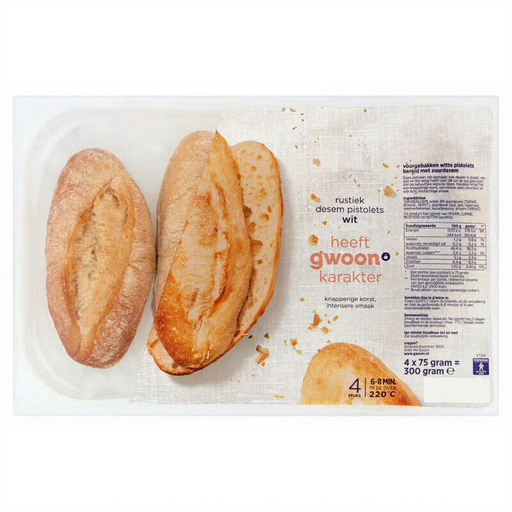 Image unavailable
A white roll for anyone who wants a familiar bread option on their sharing board. The pack contains 4 rolls; this product isn’t labelled as wholemeal. Before serving, check the preparation instructions and, if you have allergies, refer to the latest packaging.
No, you can’t tell from the word ‘multigrain’. If you want to choose a wholemeal roll, look for the explicit ‘wholemeal’ label on the packaging. The Netherlands Nutrition Centre distinguishes wholegrain products from products made with white flour.
If your guests have different preferences, you can offer both. White rolls make a neutral base for fillings; according to the Netherlands Nutrition Centre, wholegrain products contain more fibre than white-grain products. Check the packaging to make sure the wholemeal option is labelled as such.
Follow the baking time and temperature on the packaging for your rolls. PLUS gives a baking time of 8–10 minutes at 220 °C for its multigrain rolls, but these instructions don’t automatically apply to other products.
Ask the seller for the latest information about the specific roll. According to the Netherlands Food and Consumer Product Safety Authority, businesses must inform consumers about allergens in non-prepacked foods. Don’t try to work out what a roll contains from its name alone.
Don’t assume that a specific roll does. A historical publication in the Government Gazette describes an agreement encouraging participating producers to use baker’s salt with iodine; it doesn’t guarantee that every roll contains it. Check the ingredients of a packaged product, or ask the seller about the ingredients in an unwrapped roll.