
If you want to serve lunch at short notice
You want to serve rolls with lunch or at a herring get-together. A fresh bread roll from the shop needs no baking at home, while a bake-at-home option requires you to plan for the time and equipment.


For a Flag Day lunch, a fresh bread roll is ideal if you want to serve it straight away; a bake-at-home option lets you time the baking for just before you eat. If you’re looking for a higher-fibre choice, compare the ingredients and fibre per 100 g. If you want rolls sliced down the middle, check each product to make sure they really are pre-sliced.
You want to serve rolls with lunch or at a herring get-together. A fresh bread roll from the shop needs no baking at home, while a bake-at-home option requires you to plan for the time and equipment.
You want to know which type of grain has been used and how much fibre your chosen bread roll contains per 100 g. A multigrain name alone doesn’t tell you whether the roll is made entirely from wholemeal flour.
Read the allergen information for the specific variety, even if it’s labelled gluten-free. For unpackaged rolls, ask for allergen information before you buy.
Start with how you want to serve the rolls: a bread roll isn’t automatically pre-sliced. Then check how it needs to be prepared and which ingredients matter for your lunch.
| What to consider | What to check when buying | Who it matters to |
|---|---|---|
| Slicing | Check whether the rolls are pre-sliced and whether a slice thickness is specified. | If I want to fill rolls quickly, I need to know whether I’ll have to slice them myself. For around 25% of consumers, how the rolls are sliced is a top priority. |
| Wholemeal flour and fibre | Read the ingredients list and compare the stated fibre per 100 g. | A brown colour or a multigrain name isn’t enough for me: I want to be able to compare the ingredients. Around 25% of consumers prioritise this. |
| Serving and preparation | Check whether the roll is fresh, part-baked or frozen, and follow the product-specific preparation and storage instructions. | I want to choose between serving the rolls straight away and baking them at home just before lunch. For around 25% of consumers, planning is the main consideration. |
| Allergens and salt | Read the allergen information, including for gluten-free varieties; if you wish, check whether iodised salt or baker’s salt is listed in the ingredients. | If ingredients determine my choice, I need to be able to check the information for the specific roll. An estimated 25% of consumers prioritise this check. |
The name of a bread roll doesn’t tell you how much wholemeal flour it contains. PLUS’s product information states that its multigrain rolls contain 56% wholemeal wheat flour and 7 g of fibre per 100 g.
Compare the ingredients list and fibre per 100 g for the varieties you’re considering.
According to Albert Heijn’s product information, its gluten-free white rolls may also contain egg, milk, soya, almond and hazelnut.
Read the full allergen information and, for unpackaged rolls, ask for allergen details before you buy.
Baker’s salt contains iodine, but according to the Voedingscentrum, bakers aren’t required to use it.
For packaged rolls, check the ingredients list for iodised salt or baker’s salt; for unpackaged rolls, ask the shop.
Bake-at-home rolls take time to prepare. Jumbo also states that its part-baked brown frozen rolls should be stored at −18 °C and not refrozen after defrosting.
Choose between fresh, bake-at-home and frozen rolls once you know when you want to serve them and what preparation and storage options are available.
Albert Heijn lists a fresh white roll, a wholemeal roll and a separate gluten-free bake-at-home option.
Jumbo lists a pack of four part-baked brown rolls from its frozen range.
PLUS lists several part-baked rolls, including white and multigrain varieties.
Dirk lists white and rustic multigrain bake-at-home rolls in packs of four.
ALDI lists individual white rolls.
Lidl lists white rolls for baking at home.
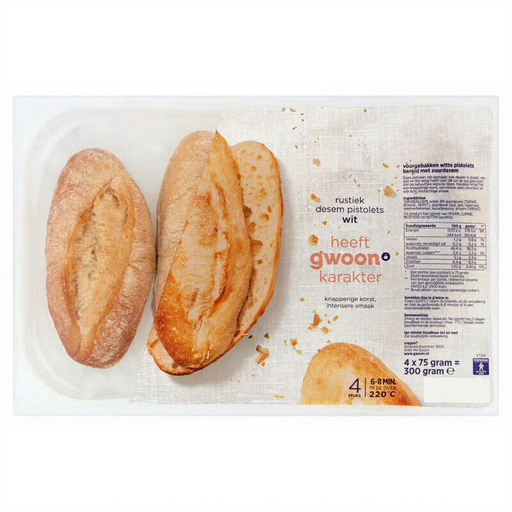
You could consider these rolls in a pack of four for lunch. Before buying, check whether they need to be baked and whether they’re pre-sliced if that matters for your serving plans.
 No image available
For a lunch where you want to serve several bread rolls. Check the packaging to see whether you need to bake them and whether they’re pre-sliced; also read the allergen information if it matters for your choice.
Compare varieties by their ingredients and fibre per 100 g, rather than just by whether they’re called white or multigrain. Albert Heijn states that its wholemeal roll contains 100% wholemeal flour and 7.1 g of fibre per 100 g; PLUS states that its multigrain rolls contain 7 g per 100 g. These figures apply to the products mentioned.
Follow the instructions for the rolls you buy. PLUS states that its white and multigrain bake-at-home rolls take 8–10 minutes in a preheated oven at 220 °C, or 4 minutes in a preheated air fryer at 200 °C; don’t automatically use these timings for other varieties.
Ask about the allergens in the specific roll before you buy. The Netherlands Food and Consumer Product Safety Authority states that sellers must provide customers with information about 14 allergens.
No, don’t assume that every roll is made with baker’s salt. According to the Voedingscentrum, baker’s salt has iodine added to it, but its use isn’t compulsory. Check the ingredients list or ask about unpackaged bread.