
Small groups looking to avoid leftovers
If not everyone eats a whole roll, the number in a pack will determine whether it suits your dinner. Buying them individually or storing any unused rolls according to the instructions are practical options.


Choose individual rolls if you want to buy exactly the number you need. A pack of bake-at-home rolls works well when several people want one and you have a plan for any leftovers. If by ‘half loaf’ you mean a smaller loaf to share, look for a demi-baguette: rolls are individual portions, not half a loaf. Whatever you choose, check the ingredients, allergen information, preparation and storage instructions for that specific product.
If not everyone eats a whole roll, the number in a pack will determine whether it suits your dinner. Buying them individually or storing any unused rolls according to the instructions are practical options.
If fibre matters to you, compare the ingredients and nutritional information per 100 g for the rolls you’re considering. The term ‘multigrain’ alone doesn’t tell you how much wholemeal flour they contain.
If you want the bread on the table shortly before dinner, preparation time and the appliance needed are important. Check the instructions on the pack you choose.
First decide whether you want to serve individual rolls or a smaller loaf to share. Then match the quantity to the number of people eating, and only then compare the nutritional information and preparation instructions.
When: several people each want a roll and you can bake the number you need.
Consider: a pack takes time to prepare, and you’ll need a plan for storing any that are left over.
When: you only need one or a few rolls and want to buy by the number.
Consider: the options available vary by shop; if you’re buying unpackaged bread, ask for allergen information.
When: you want to slice and share a smaller loaf rather than handing out individual rolls.
Consider: the quantity still needs to suit the number of people you’re serving.
| What to consider | What to check when buying | Who should pay particular attention? |
|---|---|---|
| Portions and leftovers | Compare the number of rolls with the number of people eating, and read the storage advice in case you have any left over. | If we’re only eating a few rolls, I don’t want to bake a whole pack without a plan. Getting the quantity right matters most to around 50% of consumers. |
| Fibre and type of grain | Check the ingredients for wholemeal flour and compare the fibre content per 100 g. | When I choose rolls for their fibre content, I want to look beyond their colour or the name ‘multigrain’. Around 30% of consumers prioritise this nutritional choice. |
| Preparation and serving time | Check which appliance you need, along with the time and temperature on the pack. | Just before dinner, I want to know whether baking the rolls fits into my schedule. Serving time is the top priority for around 20% of consumers. |
The Netherlands Nutrition Centre classifies rolls as small bread rolls. So a pack of individual rolls is a different way to serve bread from a smaller loaf to share.
Choose how you want to serve the bread first, then compare the number of rolls with what your group is likely to eat.
The product name alone doesn’t tell you how much wholemeal flour a roll contains or how much fibre it provides.
Read the ingredients list and compare the fibre content per 100 g for the specific products.
If you need fewer rolls than the pack contains, you’ll have bread left over to store.
Check the storage and freezing instructions before you buy, and bake only the number you want to serve if the product instructions allow it.
Ingredients and allergens vary between roll varieties. If you have an allergy, information for another product is no substitute for the details of the rolls you’ve chosen.
Read the pack label or, if you’re buying unpackaged bread, ask for allergen information before you buy.
Albert Heijn sells rolls as well as AH Robuust white demi-baguettes in packs of two.
Jumbo lists white rolls among its options, in a pack of four.
PLUS lists packaged white and multigrain rolls, as well as an individual sourdough roll.
Dirk lists 1 de Beste white bake-at-home rolls in a pack of four, weighing 300 g in total.
ALDI lists a white roll sold individually.
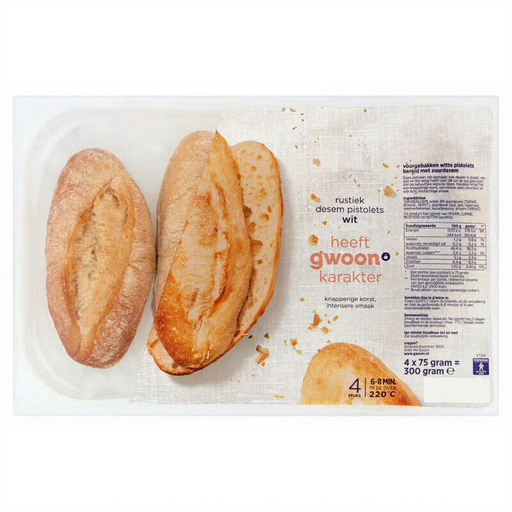
This pack of four rolls is one option when several people want a roll. Compare the quantity with your dinner plans, and check the product packaging for preparation and storage instructions.
 No image available
A pack for a dinner where several people want a roll; check whether four will be enough for your group.
Pack size: 4 rolls. Check the current packaging for ingredients, allergens, preparation instructions and advice on storing any unused rolls.
No. The Netherlands Nutrition Centre classifies rolls as small bread rolls. If you’re looking for one smaller loaf to share at dinner, a demi-baguette is a better fit; make sure you check how much you’ll need.
Follow the storage advice for the product you’ve chosen, and freeze any unused rolls promptly if the instructions allow it. The Netherlands Nutrition Centre recommends keeping an opened bake-at-home roll in the freezer for 1 to 3 months; compare this general guidance with the instructions on your pack.
No. The name ‘multigrain’ doesn’t by itself confirm that a product is made with wholemeal flour. Check the proportion of wholemeal flour in the ingredients and compare the fibre content per 100 g: PLUS lists 56% wholemeal wheat flour and 7 g of fibre per 100 g for its multigrain rolls.
For packaged rolls, read the allergen information for the specific variety. If you’re buying unpackaged bread, ask about allergens before you buy; don’t assume it has the same ingredients as another roll.
Don’t assume that it does. PLUS lists iodised salt in the ingredients for the rolls discussed here, but check the ingredients list for the specific product you want to buy.