
Families with different bread preferences
If one person wants a white roll and another would rather have a wholemeal or multigrain option, you can serve both without choosing the same bread for everyone.


For a fakeaway night with different bread preferences, serve white rolls alongside a separate multigrain or wholemeal option rather than choosing one type for everyone. If a wholemeal base is essential, don’t rely on the brown colour or the word ‘multigrain’: check the product name and ingredients list. For each pack you choose, also compare the fibre per 100 g, allergens and preparation instructions.
If one person wants a white roll and another would rather have a wholemeal or multigrain option, you can serve both without choosing the same bread for everyone.
If you specifically want wholemeal, look beyond the colour, seeds or the word ‘multigrain’. According to the Netherlands Nutrition Centre, wholemeal bread is made from 100% wholemeal flour.
For a fakeaway meal with burgers, kebab or a vegetarian filling, for example, it’s useful to check in advance whether the rolls you choose can be prepared in your oven or air fryer.
First, decide which types of bread your guests want to eat, then compare the labels on the individual rolls. ‘Multigrain’ and ‘wholemeal’ are not interchangeable: according to the Netherlands Nutrition Centre, multigrain means that at least three types of grain are used.
| What to consider | What to check | Who is this important for? |
|---|---|---|
| Wholemeal and fibre | Check for the word ‘wholemeal’, the ingredients and the fibre per 100 g. A brown colour or the word ‘multigrain’ alone isn’t enough to call a roll wholemeal. | If I mainly want a clearly labelled wholemeal option, I don’t want to judge a roll by its colour. For around 44% of consumers, this is said to be the most important factor when choosing. |
| Different preferences | Choose clearly identifiable white and wholemeal or multigrain rolls, and check how many rolls are in each pack. | If not everyone likes the same type of bread, I want to let guests choose between white and another option. For around 33% of consumers, having that choice is said to come first. |
| Preparation and packaging | Check the number of rolls and the instructions for the appliance you plan to use; don’t assume every variety has the same baking time. | I want to serve the rolls warm without holding up the rest of the meal. For around 23% of consumers, practical preparation is said to matter most. |
A dark crust or layer of seeds doesn’t tell you whether all the flour used is wholemeal. According to the Netherlands Nutrition Centre, ‘multigrain’ refers to the number of types of grain, while wholemeal bread is made from 100% wholemeal flour.
For a wholemeal roll, look for the specific word ‘wholemeal’, then check the ingredients and fibre per 100 g.
According to the Netherlands Nutrition Centre, bakers aren’t required to use baker’s salt. So the information on one product doesn’t tell you anything about another roll.
Check the packaging of the variety you choose to see whether ‘iodised salt’ or ‘baker’s salt’, for example, is listed in the ingredients.
The product information for the PLUS and Jumbo rolls mentioned here lists wheat. The ingredients of another variety may differ, even if the roll looks similar.
If you have a relevant allergy, read the ingredients and allergen information on the exact pack you’re buying.
These brands offer examples of products whose labels you can compare, including white, brown and multigrain rolls. The characteristics mentioned apply to the specific varieties, not to a brand’s entire range.
The AH brown multigrain sourdough roll is an example of a brown roll whose wholemeal percentage is listed in the ingredients.
Jumbo’s brown frozen rolls are an example to compare if you’re looking for a part-baked option.
PLUS’s white and multigrain rolls show why it’s useful to compare products per 100 g.
Dirk’s range of rolls includes both white and brown options.
Lidl lists a white roll in its fresh-from-the-oven range.
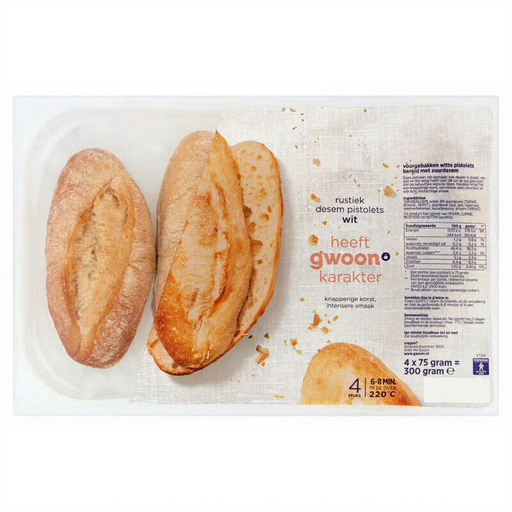
This white roll is a good fit for anyone who wants a familiar white bread roll on fakeaway night. If you also want to serve a wholemeal or multigrain option, choose it separately and compare its label.
 No image available
A white option for a table where people have different bread preferences. Check the packaging for ingredients, allergens and preparation instructions if these matter to you.
No, not necessarily. According to the Netherlands Nutrition Centre, ‘multigrain’ means that bread contains at least three types of grain; wholemeal bread is made from 100% wholemeal flour. So check the product name and ingredients list for the roll you choose.
You can’t assume that. According to the Netherlands Nutrition Centre, bakers aren’t required to use baker’s salt. Check the label on the roll you choose to see whether iodised salt or baker’s salt is listed in the ingredients.
Yes, if the instructions for the rolls you’ve chosen say they can be cooked in an air fryer. Check the specified temperature and cooking time too; don’t automatically use the instructions for another variety.
Read the ingredients and allergen information for the specific roll before serving it. The PLUS and Jumbo products mentioned list wheat; the colour or name of another roll won’t tell you exactly what it contains.