For a special Easter lunch, you could choose a rustic or sourdough roll if the type of bread and its appearance are your priorities. A white roll is a classic base for your fillings. If you prefer wholemeal or want more fibre, check the ingredients and nutritional information. For guests with dietary requirements or allergies, always check the current label and take care when preparing and serving the rolls.
Who might find these options useful?
If you’re putting together a special lunch with fillings
You’re looking for a roll whose type and appearance complement your fillings. A rustic option or a roll labelled as sourdough could be just the thing. Also check whether you’re buying white, multigrain or wholemeal rolls.
If you’re looking for wholemeal options and fibre
You want to compare the type of grain and the amount of fibre. Check the ingredients and nutritional information per 100 g: terms such as multigrain and rustic don’t, by themselves, tell you how much wholemeal flour a roll contains.
If you’re catering for dietary requirements or allergies
You’re choosing rolls for guests who need to avoid certain ingredients. Check the latest product information for both the bread and the fillings. If a guest needs gluten-free rolls, keep them separate while preparing and serving them.
What should you look for when choosing?
First, decide which feature matters most for your Easter lunch. Then compare the packaging and preparation instructions of the rolls that meet your needs.
| What to consider |
What to check when buying |
Who is this most important for? |
| Appearance and flavour |
Check the type of bread and the ingredients. If you’re choosing a sourdough option, check that sourdough is specifically mentioned. |
For a special lunch with fillings, I want to choose a roll whose type and appearance complement them. Around 36% of consumers say appearance and flavour are their top priorities. |
| Wholemeal and fibre |
Compare the types of flour listed and the fibre content per 100 g. Multigrain doesn’t automatically mean wholemeal. |
If I’m looking for wholemeal options and fibre, I want to know what flour the roll contains. Wholemeal ingredients and fibre are top priorities for around 29% of consumers. |
| Preparation and serving time |
Check the baking time, temperature and number of rolls. For in-store bakery rolls, check what your local branch stocks. |
When serving several dishes for lunch, I want to be able to serve the rolls on time. Preparation and serving time are the main concern for around 21% of consumers. |
| Ingredients for guests |
Read the latest allergen information. If it matters for your choice, check whether iodised salt is listed. |
If a guest has a dietary requirement or allergy, I need to be able to check that both the bread and fillings are suitable. Around 14% of consumers prioritise gluten, other allergens or the information about iodine. |
Common mistakes
-
Assuming rustic or sourdough means wholemeal
A white sourdough roll may have wheat flour as its main ingredient. By contrast, PLUS lists 34% wholemeal wheat flour in its Korenlanders multigrain sourdough roll. The descriptions don’t mean the products have the same ingredients.
Compare the ingredients and, if fibre matters to you, the nutritional information per 100 g.
-
Assuming every roll contains iodised salt
Whether iodised salt is listed varies by product. For packaged rolls, the ingredients list helps you make an informed choice about the product you’re buying.
If iodised salt matters to you, check the packaging for iodised salt or baker’s salt. For an unpackaged roll, ask which ingredients have been used.
-
Leaving preparation details until just before lunch
Part-baked rolls have product-specific instructions and need time and space in the oven or air fryer. If you’d rather buy fresh rolls in store, don’t assume every branch stocks the same range: Lidl says its range may vary by branch.
Read the preparation instructions before planning lunch, and check what your local store stocks shortly before you buy.
-
Only checking for gluten when serving
Other allergens may also matter to your guests. The Netherlands Food and Consumer Product Safety Authority says that sellers must provide allergen information for unpackaged foods.
Ask for allergen information about loose rolls, and also check the fillings and how you prepare and serve the rolls.
Brands to compare
Albert Heijn
A starting point for comparing white, wholemeal and gluten-free rolls, among other options.
- Useful if you want to compare different types of bread within one range.
- Albert Heijn recommends reading the packaging before use; check the ingredients of the product you choose.
Jumbo
Offers bread rolls alongside options such as multiseed, sourdough and spelt.
- A useful starting point for comparing different ingredients and types of bread.
- Check the latest product information for the option you choose.
Lidl
Offers a white roll, among other options, in its in-store bakery range.
- An option if you want to buy a freshly baked white roll on the day.
- Lidl says its range may vary by branch; the white roll shown is available in store only.
ALDI
Has an in-store bakery and also offers individual white rolls.
- Worth considering if you’re weighing up loose in-store rolls against packaged part-baked rolls.
- For an unpackaged roll, ask for the latest ingredients and allergen information.
PLUS
Offers white, multigrain sourdough and gluten-free rolls, among other options.
- The ingredients, nutritional information and preparation instructions for the products listed can be compared.
- Follow the latest packaging for the option you choose, including for allergen information and preparation.
Dirk
Offers packaged white and rustic multigrain part-baked rolls.
- A way to compare white and rustic multigrain options within a part-baked range.
- The type of bread shown on the front of the pack doesn’t replace checking the ingredients and nutritional information.
Bread rolls at Joybuy
This selection is for anyone looking for a white roll labelled as rustic for their Easter lunch. Before buying, compare the ingredients and preparation instructions with your guests’ needs.
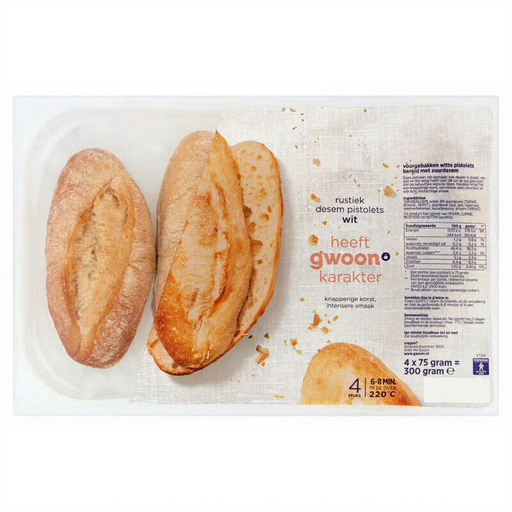 Image unavailable
g'woon White Rustic Pistolet, 4 rolls
For an Easter lunch where you’d like to serve white rolls labelled as rustic.
Four rolls per pack. Check the latest allergen information and preparation instructions before serving.
View at Joybuy
Frequently asked questions
How do I choose a roll with wholemeal ingredients or more fibre?
Read the ingredients and compare the fibre content per 100 g; the term multigrain doesn’t tell you how much wholemeal flour has been used. For example, PLUS lists 34% wholemeal wheat flour and 5,8 g of fibre per 100 g in its Korenlanders multigrain sourdough roll.
How can I tell if a roll contains iodised salt?
For a packaged roll, check the latest ingredients list for iodised salt or baker’s salt. For an unpackaged roll, ask which ingredients have been used if this matters for your choice.
Can I get allergen information for loose, freshly baked rolls?
Yes. The Netherlands Food and Consumer Product Safety Authority says sellers must provide information about 14 allergens for unpackaged foods, and must specify which cereals contain gluten. Ask before buying rolls for a guest with an allergy.
Can I serve regular and gluten-free rolls together?
Keep them separate if a guest needs to avoid gluten completely. Check the fillings too, and use separate utensils when preparing and serving the rolls to prevent a gluten-free roll from coming into contact with regular bread.


