
Catering buyers working to a tight bread budget
You want to compare packs on a like-for-like basis and work out how many rolls to plan for your expected number of guests.


A basic pack of part-baked rolls is a sensible choice if you want to keep an eye on your bread budget and have enough time and oven space. Fresh rolls save you baking on site; if guests need wholemeal or gluten-free bread, check the relevant products and their allergen information separately.
You want to compare packs on a like-for-like basis and work out how many rolls to plan for your expected number of guests.
If oven space, preparation time or the break itself is limited, your chosen preparation method needs to suit the number of rolls you want to serve at once.
You want to cater carefully for wholemeal preferences and allergens. To do that, you need clear ingredient and allergen information for each product.
First, work out how many rolls you need and whether you can bake them on site. Then compare the packs and arrange information for guests with specific dietary requirements before serving.
| What to consider | What to check | Who it matters to |
|---|---|---|
| Pack contents | Compare the net weight and number of rolls; assess loose rolls separately if their weight is unknown. | I want to match the order to the number of diners without treating packs with different contents as equivalent. Around 33% of consumers prioritise this kind of budget planning. |
| Baking and serving time | Check the preparation instructions and how many rolls fit in one batch. | During a short break, I need to be able to serve all the rolls on time. For around 27% of consumers, baking logistics are the main concern. |
| Bread options and allergens | Check the ingredients and allergens for each variety; keep any gluten-free option required separate. | If guests have different dietary requirements, I want to be able to say which product is intended for whom. Around 20% of consumers prioritise this product information. |
| Ready-to-serve rolls | Check with the shop that your chosen fresh rolls and quantities are available. | I want to serve bread without preparing it at the venue, so I need to plan my shopping accordingly. Having rolls ready to serve is the top priority for around 20% of consumers. |
A smaller pack won’t provide the same number of portions as a larger one. What’s more, fresh loose rolls don’t always have a listed weight.
Note the net weight and number of rolls in packaged products. If the weight of loose rolls is unknown, plan by quantity instead.
Preparation instructions for a single batch don’t tell you how many rolls you can bake with your equipment during a short break.
Try a full batch in advance using the oven you have available, then work out how many batches you can bake before each serving time.
This takes preparation time and needs to be factored into the schedule just before serving.
The multigrain rolls described by PLUS contain wheat, rye, barley and oats. A bread variety’s name is no substitute for checking the ingredients.
Check the label of a product specifically labelled gluten-free and organise serving so that products aren’t mixed up.
According to the Netherlands Food and Consumer Product Safety Authority, customers must be given information about 14 allergens for non-prepacked foods.
Before the event, record the up-to-date allergen information for each product you’ve chosen and make sure staff can check it when serving.
Dirk offers, among other things, white and multigrain part-baked rolls in 300 g packs.
PLUS offers white and multigrain part-baked rolls in 300 g packs, with nutritional information and preparation instructions for the varieties reviewed.
Albert Heijn offers fresh white and wholemeal rolls, as well as a separate part-baked variety specifically labelled gluten-free.
Lidl lists a white roll in its oven-fresh range and also offers part-baked bread.
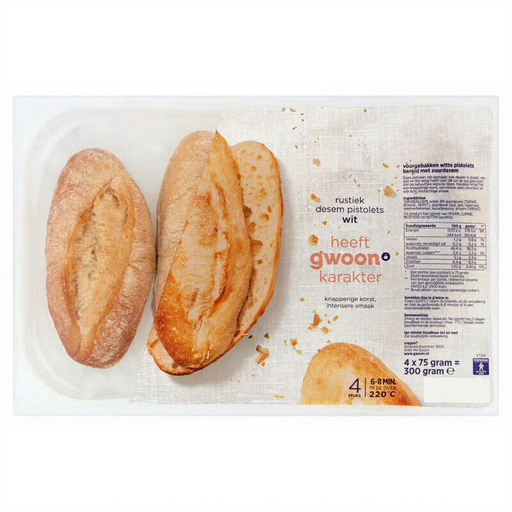
These white rolls are an option if you want to plan portions by quantity. For conference catering, also check how they need to be prepared and the latest information on the packaging.
 No image available
A pack of four makes it easier to plan by quantity. Check the current packaging for ingredients and allergens, and find out how to prepare these rolls before serving.
For packaged rolls, check both the net weight and the number of rolls so you can compare like with like and order the quantity you need. Plan for fresh loose rolls separately if their weight isn’t listed.
Part-baked rolls can work well for a short break if your equipment and schedule allow for enough batches. For the part-baked rolls reviewed, PLUS gives an oven time of 8–10 minutes at 220 °C; also check how many fit in your oven at once.
According to the Netherlands Food and Consumer Product Safety Authority, you must give customers information about 14 allergens for non-prepacked foods. Make sure you have the latest information for every product you’ve chosen and that it’s available when serving.
Multigrain doesn’t mean gluten-free: the PLUS multigrain rolls reviewed contain wheat, rye, barley and oats. If you need a gluten-free option, check a separate product specifically labelled gluten-free and its current packaging.
No. Check the ingredients for your chosen variety on the current label. The multigrain rolls described by PLUS list iodised salt, but that doesn’t tell you what’s in every other roll.