Choose a white bread roll if you want something simple to serve with coffee and cake; look specifically for the wholemeal label if the grain content matters more to you. Bake-at-home and frozen options require a little planning for preparation and storage. If you’re looking for a ‘medium sliced’ roll, check each product to see whether it comes pre-sliced, scored or unsliced.
Who is this choice relevant to?
Shoppers planning a coffee and cake break
They’re looking for a bread roll that goes with what they plan to serve alongside their coffee and cake. The choice between white, wholemeal and multigrain comes down to the taste and grain content they prefer, not just the roll’s appearance.
Shoppers who care about the grain content
They want to know whether a bread roll is genuinely wholemeal. According to the Netherlands Nutrition Centre, wholemeal bread is made from 100% wholemeal flour; a brown colour or the word ‘multigrain’ alone doesn’t confirm this.
Shoppers who need product information
They want to check the ingredients and allergens before buying, or find out whether baker’s salt has been used. If they’re buying an individual roll, they can ask the seller for this information.
What should you look for when choosing?
First decide whether grain content or the occasion matters more to you. Then check how the roll is prepared and read the product information for the one you have in mind.
| What to consider |
What to check |
Who it matters to |
| Flavour for the occasion |
Choose between white, brown, multigrain and wholemeal; don’t judge by colour alone. |
If you want to serve a simple white roll with cake, that preference will guide your choice. Around 25% of consumers put having it with coffee and cake first. |
| Grain content and fibre |
Look for the wholemeal label if you want a base of 100% wholemeal flour; compare fibre per 100 g or per serving on the label. |
If grain content matters more to you than having a white roll, the product description can help you decide. Wholemeal and fibre are the top priority for around 31% of consumers. |
| Preparation and storage |
Check whether the rolls are fresh, bake-at-home or frozen, and follow the baking and defrosting instructions. |
If you want to serve the rolls at a planned time, the preparation needs to fit your schedule. Around 25% of consumers say this is their primary need. |
| Label and ingredients |
Check the allergen information and ingredients; if buying individual rolls, ask about baker’s salt if necessary. |
If you need to know exactly what’s in the product before buying, you can’t rely on the product name alone. This information is the top priority for around 19% of consumers. |
Common assumptions
-
Assuming multigrain or a dark colour means wholemeal
According to the Netherlands Nutrition Centre, wholemeal bread is made from 100% wholemeal flour. The term ‘multigrain’ or a dark colour doesn’t confirm that it has this composition.
Look for the wholemeal label if that’s the grain content you want, and check the nutritional information if you want to compare fibre values.
-
Expecting every roll to contain iodised baker’s salt
The Netherlands Nutrition Centre says that bakers aren’t required to use baker’s salt. So the fact that a roll is a bread roll doesn’t tell you what type of salt it contains.
Read the ingredients list for a packaged product, or ask which salt has been used if you’re buying an individual roll.
-
Choosing a bake-at-home or frozen option without planning ahead
Preparation and instructions for after defrosting vary by product. For example, Jumbo says its white frozen rolls must be prepared and eaten within 24 hours of defrosting.
Before serving, check the oven and storage instructions on the packaging for your chosen variety.
-
Assuming ‘medium sliced’ means a particular way of cutting
The search term alone doesn’t tell you whether a roll will arrive pre-sliced, merely scored or unsliced. This matters in practice if you want to fill the rolls.
Check the packaging or product description for the actual cut, or ask in store.
Brands to compare
These brands offer different types of bread rolls to compare. Always check the current packaging for ingredients, how the rolls are cut and preparation instructions for your chosen variety.
Albert Heijn
For comparing white, wholemeal and multigrain options within one range.
- Albert Heijn lists separate bread roll varieties under each of these three descriptions.
- The variety name alone doesn’t tell you whether the rolls are pre-sliced, so check the product information.
Jumbo
For anyone considering frozen rolls for a planned serving time.
- Jumbo lists white and brown frozen rolls.
- Jumbo says its white variety must be prepared and eaten within 24 hours of defrosting; its brown variety must not be refrozen after defrosting.
Lidl
An option to compare if you’re looking for white rolls.
- Lidl has a product page for white rolls.
- Check the current label for the ingredients, allergens and cutting style that matter to you.
ALDI
An option to compare if you’re looking for an individual white roll.
- ALDI describes its roll as a white bread roll sold individually.
- If you’re buying an individual roll, ask about allergens if that information is important to your purchase.
PLUS
For comparing white and multigrain rolls, including bake-at-home options.
- PLUS lists white and multigrain rolls; its multigrain variety has a stated baking time of 8–10 minutes.
- Multigrain doesn’t automatically mean wholemeal. Check the product description and instructions for your chosen variety.
Dirk
For comparing white and rustic multigrain bake-at-home rolls.
- Dirk lists both varieties in packs of four.
- Check each pack for preparation instructions and whether the rolls are pre-sliced.
Bread rolls at Joybuy
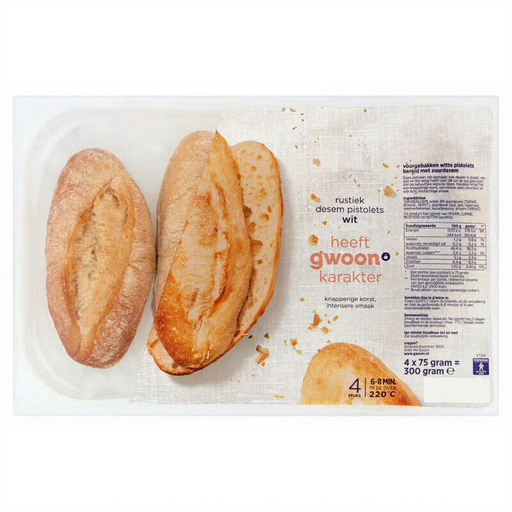
These white rolls are a good fit if you want something simple to serve with coffee and cake. Before buying, check that the way they’re cut suits your needs.
 No image available
g'woon White Rustic Bread Roll, 4 pieces
A white roll to consider if you want to serve something simple with coffee and cake.
The pack contains 4 rolls. Check whether they’re pre-sliced, scored or unsliced, and read the current allergen information if it’s important to your choice.
View at Joybuy
Frequently asked questions
Is a brown or multigrain roll the same as a wholemeal one?
No. According to the Netherlands Nutrition Centre, wholemeal bread is made from 100% wholemeal flour, while brown bread can contain a combination of wholemeal flour and white flour. The word ‘multigrain’ doesn’t in itself confirm that it’s wholemeal; check the product description if you’re specifically looking for wholemeal.
Does every bread roll contain iodised baker’s salt?
You can’t assume that. The Netherlands Nutrition Centre says that bakers aren’t required to use baker’s salt. Check the ingredients list for a packaged roll, or ask which salt has been used if you’re buying one individually.
Where can I find allergen information for an individual roll?
Ask the seller which allergens are present before you buy the roll. The Netherlands Food and Consumer Product Safety Authority says that sellers must also make allergen information available for unpackaged foods; for pre-packed products, this information is on the label.
How should I plan bake-at-home or frozen rolls for guests?
Follow the preparation and storage instructions for the exact variety you buy. PLUS states that its multigrain rolls take 8–10 minutes to bake; Jumbo says its white frozen rolls must be prepared and eaten within 24 hours of defrosting.


