Who are these choices relevant to?

If you want generously filled rolls

You want to cut open rolls and fill them with things like satay, vegetables and sauce. Choose a size that’s easy to fill, and allow time to slice the rolls open yourself unless the packaging says they’re pre-sliced.

If you want to serve warm rolls

You want to prepare the rolls just before eating. Check the instructions and make sure you have enough room in your oven or air fryer. For example, PLUS says its part-baked rolls tested take 8–10 minutes in the oven at 220 °C or 4 minutes in a preheated air fryer at 200 °C.

If you’re watching fibre or allergens

You’re comparing the nutritional information for white, wholemeal and multigrain rolls, or looking for a product with a specific allergen declaration. For a gluten-free diet, you’ll need a roll labelled gluten-free; also check the other allergens listed on the packaging you choose.

What should you look for when choosing?

Before your Asian night, decide what matters most in your filled rolls: the filling, when you’ll serve them, allergens or the type of grains. Then check the instructions and nutritional information for the product you choose.

What to consider What to check before buying Who it matters to
Bread to suit the filling Choose a type of bread that suits your filling, and check whether the rolls are pre-sliced if you want to fill them straight away. If I want the satay, vegetables and sauce to take centre stage, I need a roll that won’t overpower the filling. Around 33% of consumers give this combination of filling and bread top priority.
Preparation and timing Check the product-specific cooking time and temperature. For frozen rolls, also follow the defrosting instructions. If I want warm rolls just before serving, the cooking method needs to suit the oven or air fryer I have available. Around 27% of consumers put this convenience at serving time first.
Allergens and gluten-free options Check the current ingredients and allergen information, including any ‘may contain’ warnings. If you need a gluten-free option, choose a product explicitly labelled gluten-free. If a guest needs to avoid gluten or other allergens, I want to know what the roll I choose contains or may contain. This is the most important purchasing consideration for around 20% of consumers.
Fibre and grain type Compare fibre per 100 g and check whether the product is white, wholemeal or multigrain. Multigrain doesn’t automatically mean wholemeal. If I’m choosing more than just the filling, I also want to compare fibre content and the grains used. Around 20% of consumers put this grain profile first.

Common mistakes

  • Assuming ‘medium sliced’ means a roll is already cut open

    The search term doesn’t tell you whether the roll has actually been cut in half. This matters if you want to fill the rolls straight away.

    Check the current packaging for an explicit statement that the rolls are pre-sliced. If there isn’t one, allow time to cut them open yourself.

  • Treating white, multigrain and wholemeal as the same

    The grains used and nutritional values vary from product to product. PLUS lists 7 g of fibre per 100 g for its multigrain rolls tested, compared with 2.7 g per 100 g for its white version.

    Compare the nutritional information per 100 g on the packaging, then choose the type of bread that suits your filling and grain preferences.

  • Overlooking other allergens in gluten-free rolls

    Gluten-free doesn’t mean free from all allergens. Albert Heijn says its gluten-free part-baked rolls may contain egg, milk, soya, almonds and hazelnuts.

    For the product you choose, read both the ingredients and any ‘may contain’ warnings.

  • Assuming every roll contains iodised baker’s salt

    According to the Voedingscentrum, it isn’t compulsory to bake bread with baker’s salt. So, the fact that some rolls list iodised salt tells you nothing about another product.

    If this ingredient information matters to your choice, check the label on the roll you’re buying.

Brands to consider

Albert Heijn

Albert Heijn sells white and wholemeal rolls individually, as well as a separate gluten-free part-baked option.

  • The white and wholemeal rolls described each weigh 70 g; the wholemeal version is described as being made with 100% wholemeal flour.
  • A standard white or wholemeal roll isn’t interchangeable with the separate gluten-free option. Check for other allergens on that version too.

Jumbo

Jumbo offers white, multiseed and frozen rolls, among other options.

  • You can choose a product based on the type of bread and preparation method you want.
  • Frozen rolls have product-specific instructions to follow after defrosting. Jumbo says its white version should be prepared and eaten within 24 hours of defrosting.

Lidl

Lidl describes its white roll as a white wheat roll sold in store.

  • It’s an option to consider if you’re looking for a white roll to fill.
  • Check the packaging in store for the latest ingredients and allergen information.

ALDI

ALDI sells individual white rolls as part of its bakery range.

  • Buying rolls individually lets you choose the right number for your meal.
  • If you have questions about allergens, check the information for the specific part-baked product before choosing it for your guests.

PLUS

PLUS sells 300 g packs of white and multigrain part-baked rolls, as well as other types of rolls.

  • The multigrain version described lists 7 g of fibre per 100 g. Both part-baked versions described include oven and air fryer cooking instructions.
  • Check the current packaging for the ingredients, allergens and cooking instructions for the version you’re buying.

Dirk

Dirk sells packs of four white part-baked rolls and a rustic white part-baked version.

  • The pack of four white rolls described weighs 300 g in total.
  • If you have dietary requirements or allergies, read the latest ingredients and allergen information on the packaging.

Bread rolls at Joybuy

This is a white roll option for an Asian night with filled rolls. Check the packaging to see whether the rolls are pre-sliced and how to warm them, if needed.
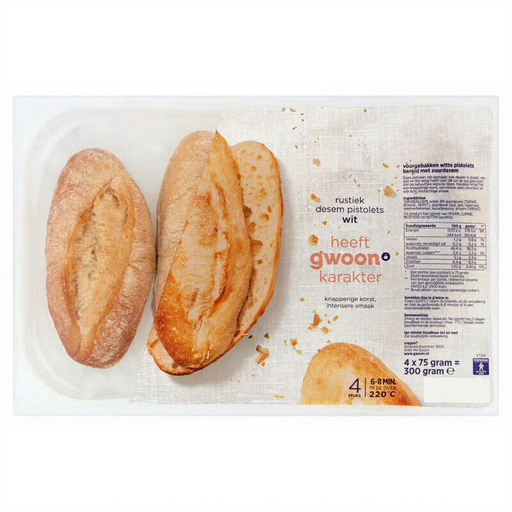
g'woon White Rustic Pistolet, pack of 4

g'woon White Rustic Pistolet, pack of 4

A white roll option if you want to make filled rolls for your Asian night.

Pack of 4. Before filling, check the packaging to see whether the rolls are already cut open and which cooking instructions apply.

Also check the latest allergen information; the product details list, among other things, cereals containing gluten, lupin, mustard, nuts and sesame.

View at Joybuy

Frequently asked questions

Are bread rolls for an Asian night usually cut in half?

Don’t assume so: ‘medium sliced’ isn’t a reliable indication that a roll has already been cut open. Check whether the packaging explicitly says the rolls are pre-sliced. If not, allow time to cut them open yourself.

Can you cook part-baked rolls in an air fryer?

Yes, if the instructions for your chosen product include air fryer cooking. PLUS says its white and multigrain part-baked rolls take 4 minutes in a preheated air fryer at 200 °C. For other products, follow the instructions on the packaging and make sure there’s enough room in the basket.

Can I serve standard rolls to someone who eats gluten-free?

Choose a product explicitly labelled gluten-free that meets your guest’s requirements, rather than a standard wheat roll. Check for other allergens too: Albert Heijn says its gluten-free rolls may contain egg, milk, soya, almonds and hazelnuts.

Do rolls always contain iodised baker’s salt?

No. According to the Voedingscentrum, it isn’t compulsory to bake bread with baker’s salt in the Netherlands. If you want to know which salt has been used, check the ingredients list for the specific roll.
