
Small households hosting an Asian-themed evening
You want to serve bread rolls alongside shared dishes, without buying more than your group needs. Individual rolls or a small pack make it easier to choose the right quantity.


For a small group, individual bread rolls or a pack that lets you choose how many to use are more practical than searching for a ‘half loaf’: a bread roll is a small roll, not half a loaf. Choose the type to suit what you’re serving alongside it, and check the nutritional information that matters to you. If you need a gluten-free option, check the label of the exact product. Before buying, also check for allergens and any baking instructions.
You want to serve bread rolls alongside shared dishes, without buying more than your group needs. Individual rolls or a small pack make it easier to choose the right quantity.
You’re looking for a bread roll with a suitable fibre content and don’t want to assume that ‘multigrain’ automatically means wholemeal. Compare the ingredients and nutritional information per 100 g instead.
You’re looking for a bread roll explicitly labelled as gluten-free. Check the current ingredients, allergen information and preparation instructions for the variant you choose.
Work out how many rolls you actually want to serve. Then compare the type of roll, how it needs to be prepared and the allergen information for the exact product.
| What to consider | What to check before buying | Who it matters to |
|---|---|---|
| Number of rolls | Compare rolls sold individually with packs of two or four, and count how many you want to serve. | If I’m serving rolls to one or two people, I don’t want lots left over unnecessarily. Getting the quantity right is the priority for around 36% of consumers. |
| Wholemeal and fibre | Read the ingredients and compare the fibre content per 100 g; ‘multigrain’ doesn’t automatically mean ‘wholemeal’. | If I’m keeping an eye on fibre, I want to know what the variant I choose actually contains. For around 29% of consumers, this nutritional information matters most. |
| Preparation | Check whether the roll is already baked or needs to be finished off at home, and follow the instructions for that variant. | I want to serve the rolls when the dishes are ready. That’s why the preparation method is the first thing around 21% of consumers consider. |
| Gluten-free and allergens | Check the current allergen information and, if you need a gluten-free option, choose a product specifically labelled as gluten-free. | If I need a gluten-free roll, I can’t rely on its colour or name. For around 14% of consumers, checking this product information comes first. |
According to the Netherlands Nutrition Centre, bread rolls are classed as small rolls. For a small group, the number of rolls you buy is the main thing that determines how many might be left over.
First, count how many people want a roll, then choose between individual rolls and a suitably sized pack.
The variants reviewed differ: Albert Heijn states that its wholemeal roll is made with 100% wholemeal flour, while PLUS states that its multigrain rolls contain 56% wholemeal wheat flour.
Compare the ingredients and fibre content per 100 g of the specific products you’re considering.
The colour of a roll, whether white or brown, doesn’t tell you which allergens it contains. You need product-specific information even for an unpackaged roll.
Read the label or ask for the latest allergen information before buying. If you’re looking for a gluten-free product, check that the specific variant is labelled as gluten-free.
Albert Heijn offers a white roll and a wholemeal roll, both sold individually; the two variants reviewed each weigh 70 g.
PLUS offers white and multigrain rolls to bake at home, as well as a separate gluten-free white variant.
Dirk lists a pack of four white 1 de Beste rolls to bake at home, with a total weight of 300 g.
ALDI offers a white roll sold individually.
Lidl offers brown wheat and rye rolls to bake at home.
This pack of four white rolls is a good fit if you want to serve four rolls with your meal or deliberately keep some for later.
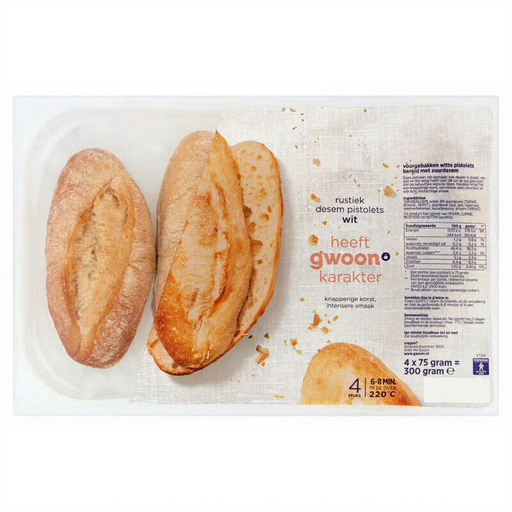 Image unavailable
A pack of four white rolls is a good option if that quantity suits your group. Check the pack for preparation instructions and allergens before serving.
No. A bread roll is a small roll, not literally half a loaf. According to the Netherlands Nutrition Centre, rolls fall into this category; for a small group, it’s better to choose based on the number of rolls in each pack.
No, don’t assume that. According to Brood.net Professionals, the use of iodised baker’s salt isn’t a legal requirement; Dutch food regulations allow iodine to be added via baker’s salt under certain conditions. Check the ingredients list of the roll you’re buying.
Before buying, ask which allergens are present in the specific roll. The Netherlands Food and Consumer Product Safety Authority states that sellers must also provide customers with allergen information for unpackaged foods.
No. Follow the instructions for the variant you’ve chosen. For the white and multigrain rolls reviewed, PLUS recommends baking in the oven at 220 °C for 8–10 minutes, but its gluten-free white rolls need 10 minutes at 180 °C.