What should you look for when choosing?
Mirrorless camera with interchangeable lens
A good fit if: you want to photograph both whole loaves and details of the crust or crumb, and may want to choose a different lens later.
Keep in mind: the mount and the lens included in your chosen kit determine what you can photograph straight away; a close-up lens isn’t necessarily included.
Camera with a fixed lens
A good fit if: you’d rather use one complete camera than change lenses.
Keep in mind: check in advance that the fixed lens’s zoom range and focusing distance suit your tabletop setup and the framing you want.
Existing camera with adjusted lighting
A good fit if: your current camera already gives you the framing you want, and it’s mainly the lighting or shadows that need attention.
Keep in mind: Sony Netherlands recommends using a large softbox angled towards the food for food photography, among other things. Even with adjusted lighting, your camera settings still matter.
Start with the framing you want and the lens you’ll need for it. Then check colour control and how the camera performs under your lights.
| What to consider |
What should you check? |
Who is this important for? |
| Colour under artificial light |
Check whether you can set the white balance manually and shoot in RAW. Assess test shots under the lights you use. |
I want the colour of the crust and crumb to look consistent across repeated shots; around 33% of consumers give colour consistency top priority. |
| Details in the crust and crumb |
Compare the minimum focusing distance and magnification of the specific lens. Also check whether a tripod will fit into your setup. |
If I want small details to fill the frame, I’ll focus on the lens and precise focusing; around 27% of consumers prioritise close-up details. |
| Complete, easy-to-use kit |
Check whether the deal includes a camera body or a suitable lens as well. See which accessories you’ll need for your setup. |
I want to get started without having to make lots of separate choices, and I’m looking for a camera that suits my setup; around 20% of consumers give the simplicity of a complete kit top priority. |
| Flickering lights |
Check the available shutter types and any anti-flicker features for the exact model. Take test shots under your own lights. |
If my lights cause banding or inconsistent exposure, I want to know which settings my camera supports; around 20% of consumers prioritise dealing with flickering light. |
Cameras at Joybuy
Below are Joybuy cameras suited to the topic, from compact models to a mirrorless camera. For each model, check that the listed features and included lens suit your lighting setup and the framing you want.
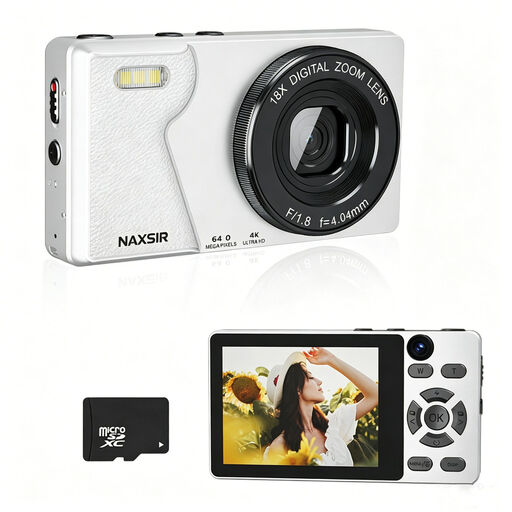 Image unavailable
NAXSIR 4K Ultra HD digital camera, 64 MP, 18x digital zoom
A compact camera for photography. Check whether its focusing distance and colour settings are suitable for bread details and your artificial lighting.
The product title lists 64 MP photo resolution, 18x digital zoom, autofocus and a 32 GB memory card.
View at Joybuy
 Image unavailable
KOMERY G7 5K digital camera, 80 MP, 18x zoom, white
The product title describes a portable camera for beginners. Check whether the lens can focus closely enough for the bread details you want to capture.
The title lists 5K, 80 MP UHD and 18x zoom.
View at Joybuy
 Image unavailable
DJI Osmo Action 5 Pro Adventure Combo, 4K
This is an action camera designed for travel and vlogging. Consider whether this type of camera suits a fixed tabletop setup and offers the framing you want for your bread photos.
The product title lists a 1/1.3-inch sensor, three batteries, stabilisation and two OLED touchscreens.
View at Joybuy
 Image unavailable
Songdian 4K pocket camera, 44 MP, 16x zoom, pink
A pocket camera for photography and video. Check whether its focusing distance and settings are suitable for your bread photos under artificial light.
The product title lists 4K, 44 MP and 16x zoom.
View at Joybuy
 Image unavailable
Sony Alpha A6100 with 16–50mm f/3.5–5.6 OSS II lens
The product title lists this mirrorless camera with a lens. Check whether its minimum focusing distance is suitable for the close-ups you want to take.
The product title lists a 16–50mm f/3.5–5.6 OSS II lens.
View at Joybuy
Frequently asked questions
Can I correct a yellow colour cast from artificial light later?
Shooting in RAW gives you the option to adjust the white balance later during editing. Check the colour while you’re taking photos too, so you can see how your lights affect the image.
How should I position artificial light for bread photography?
For soft studio lighting, Sony recommends angling a large softbox towards the food and, if needed, using a reflector to soften the shadows. The result also depends on your lights and setup.
What can I do if my lights cause banding in photos?
Sony recommends changing the shutter speed and describes anti-flicker and variable shutter features. Check which features the exact camera model supports in your chosen shooting mode and with your chosen shutter type, then test it under your own lights.
Do I need a macro lens for close-ups of bread?
It depends on how large you want the details to appear in the frame and how close the lens can focus. Compare the focusing distance and magnification of the specific lens. For example, Canon’s specified magnification of up to 1:2 applies to the separate RF 35mm F1.8 MACRO IS STM.
What if a camera I buy online isn’t suitable or turns out to be faulty?
In the Netherlands, online purchases made by consumers from a business generally come with a 14-day cooling-off period, subject to exceptions. If a product is faulty, statutory consumer rights apply, with no single fixed statutory time limit, and the seller is your point of contact. This is separate from any manufacturer’s warranty.


