
Baking for several lunchboxes
You want to bake enough bread for several lunches at a time. Compare the stated loaf sizes and consider how you’ll store any slices left over; Princess and Tefal list several loaf sizes for their models.


Start by choosing a loaf weight that suits the number of lunchboxes you fill, then check whether the machine has the basic or wholemeal programme you want and a useful timer. Inventum, Princess and Tefal list different loaf sizes for their models; a larger loaf may leave you with more bread to store. Let the bread cool before slicing it, and freeze any you won’t use straight away in portions, as advised by the Voedingscentrum.
You want to bake enough bread for several lunches at a time. Compare the stated loaf sizes and consider how you’ll store any slices left over; Princess and Tefal list several loaf sizes for their models.
You want to prepare the ingredients in advance and time the bake to fit your morning routine. Check whether the timer and delayed-start instructions work with the programme you want to use.
You usually want to pack wholemeal sandwiches. Check whether the model has a wholemeal programme and whether your recipe is suitable for that setting; Princess and Tefal list one for specific models.
First, choose a suitable loaf size, then look at the programmes and timer. The stated weight is a useful starting point when baking bread for lunchboxes, but the shape of the loaf and the thickness of your slices also affect how many sandwiches you’ll get.
| What to consider | What should you check? | Who is this most important for? |
|---|---|---|
| Loaf size | Compare the available loaf weights with the number of lunchboxes you need to fill. Inventum lists 650 and 800 g for the BM55, Princess 680–900 g for the 152009, and Tefal 500 g to 1 kg for the PF240E. Don’t estimate the number of slices from the weight alone. | If I’m baking for several lunchboxes at once, I want enough usable slices without having lots left over. Around 36% of consumers prioritise the number of slices per bake. |
| Timer and planning | Check the timer range and whether delayed start is allowed for the programme and recipe you’re using. Inventum and Princess list a timer of up to 13 hours for the models mentioned; Tefal lists up to 15 hours for the PF240E. | If I want to fit baking around my morning routine, the timer settings and instructions are important. Around 29% of consumers prioritise being able to plan when the bread is baked. |
| Wholemeal programme | Look for a dedicated wholemeal programme and follow a recipe designed for it. Princess lists one for the 152009 and Tefal for the PF240E; the Voedingscentrum recommends wholemeal or brown bread for school lunches. | If I usually pack wholemeal sandwiches, I want the programme to suit my recipe. Around 21% of consumers prioritise having wholemeal bread for lunch. |
| Care and ongoing costs | Check the cleaning instructions and ask about parts and warranty terms for the exact model. Inventum states that the BM55 baking pan must be washed by hand. | If I use the machine regularly, I want to know how much cleaning and maintenance it involves. Around 14% of consumers prioritise maintenance and ongoing costs. |
The stated baking weight doesn’t tell you how many sandwiches you’ll get from a loaf sliced to your preferred thickness. The loaf shape and recipe also make a difference.
Choose a loaf size first, then check that the shape and recipe will give you the slices you want to pack. If you like, freeze any leftover bread in portions.
A programme doesn’t determine the ingredients or nutritional value by itself. If you have coeliac disease, it’s also important to avoid contact with gluten through crumbs or utensils and equipment.
Check the ingredients and recipe. If you have coeliac disease, clean equipment carefully and avoid contact with gluten.
Any manufacturer’s warranty does not replace your statutory rights if a product fails to meet what you could reasonably expect from it. ACM ConsuWijzer advises contacting the seller about a faulty product.
Check the terms for the exact model and contact the seller if there’s a problem.
The BM55 is worth comparing if you’re looking for two stated loaf sizes and automatic basic programmes.
The 152009 is worth comparing if you’re looking for a larger stated loaf size and features including a wholemeal programme.
The PF240E is worth comparing if you want a choice of loaf sizes and programmes. The PF2101 is a separate model.
The SD-YR2550SXE is worth comparing if you’re looking for automatic ingredient dispensing and a choice of recipe settings.
These products are selected to help you compare loaf sizes, planning features and functions for baking bread for lunch. For each model, check that the version and settings suit your recipe and the amount you want to bake.
 No image available
Worth comparing if you’re weighing up different loaf sizes and a timer to suit your lunch plans.
The product name lists 12 programmes and a capacity of 1 L.
 No image available
Worth comparing if you’re considering larger batches for several lunchboxes.
The product name lists 1600 W, automatic programmes and a non-stick pan.
 No image available
Worth comparing if you want to factor several programmes and an adjustable timer into your decision.
The product name lists 700 W, 20 programmes, gluten-free options and a removable non-stick pan. A programme alone won’t prevent cross-contamination with gluten.
 No image available
Worth comparing if you’re planning a larger batch for several lunchboxes.
The product name lists 610 W and 12 programmes.
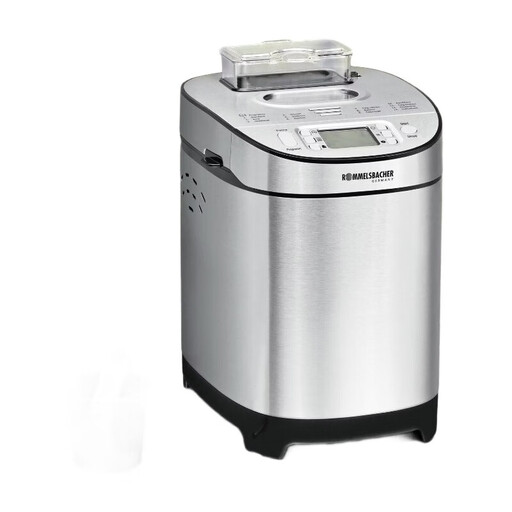 No image available
Worth comparing if you’re looking for a bread maker for planned lunch baking. Check that the settings suit your loaf size and recipe.
A gluten-free programme won’t prevent cross-contamination by itself. Check the ingredients and clean the baking pan, kneading paddle and any other equipment used carefully. If needed, discuss a gluten-free diet with a specialist dietitian.
After baking, leave the bread to cool on a wire rack, then slice it. You can freeze portions; the Voedingscentrum recommends storing bread in portions. For a school lunch, the Voedingscentrum recommends a well-sealed lunchbox and an insulated bag if you’re packing food that spoils quickly.
This is mainly relevant if homemade bread regularly replaces ordinary bread. The Voedingscentrum recommends using baker’s salt instead of table salt when baking your own bread; this is dietary advice, not a requirement for the bread maker.
As well as any manufacturer’s warranty, you’re entitled to a product that, under normal use, meets what you could reasonably expect from it. According to ACM ConsuWijzer, the seller is your point of contact if it doesn’t; there isn’t one fixed statutory warranty period for every appliance.
For electrical equipment covered by the rules and placed on the market in the Netherlands, the manufacturer must carry out a conformity assessment, affix a CE marking and draw up an EU declaration of conformity. The Dutch government sets out these obligations for manufacturers.