
Wholemeal baker with limited worktop space
You want to make wholemeal bread regularly and need to check that both the machine and the space needed to open the lid will fit on your worktop.


First, choose a machine that fits on your worktop and offers a loaf size suited to how much bread you use. Then check that the manual includes a suitable wholemeal programme and recipe. A compact model may make less bread per batch, while a larger loaf size gives you more portions. Also allow room to open the lid, clean the machine and replace any parts if needed.
You want to make wholemeal bread regularly and need to check that both the machine and the space needed to open the lid will fit on your worktop.
You want a loaf size that suits how much bread you use. Panasonic Nederland lists the SD-PN100 as making loaves of around 400 g; that small size may not suit every household.
As well as the programmes, check how to clean the machine and whether its parts can be replaced. Inventum lists a kneading blade and baking tin for model version BM55/01.
First measure the space available, including room for the lid. Then work out how much bread you use per batch, and check the recipes, cleaning instructions and parts.
| What to consider | What should you check? | Who is this most relevant to? |
|---|---|---|
| Wholemeal bread recipe | Check the recipe in the manual and the grain products it uses. A wholemeal programme alone does not determine which ingredients go into the loaf. | If I really want to bake wholemeal bread, I look at the ingredients, not just the programme name. Around 36% of consumers say the recipe and ingredients are their main consideration. |
| Fitting it on your worktop | Measure the width, depth and clearance above the machine, allowing enough room to open the lid. Compare these measurements with those for the exact model version. | With limited worktop space, I want to know whether the machine will fit in its permanent spot and whether I can open it there. Available space is the top priority for around 29% of consumers. |
| Loaf size for your household | Compare the stated loaf sizes with how much bread you use and store. The weight of a loaf is not the same as the weight of the flour. | If I’m baking for a small household, I don’t want to choose a loaf size larger than I need. A larger size may be more suitable if you have more people to feed. Around 21% of consumers focus mainly on how much bread each batch makes. |
| Cleaning and parts | Read the cleaning instructions and check replacement parts against the full model or version number. | I want to know how to clean the baking tin and kneading blade, and whether the parts fit my model version. Around 14% of consumers pay most attention to maintenance and replaceable parts. |
The programme name doesn’t tell you which ingredients the recipe uses. A recipe made with white flour isn’t based exclusively on wholemeal flour.
Read the full recipe for the specific model before choosing based on a programme name. Voedingscentrum defines wholemeal as being made from the entire grain.
The stated external dimensions don’t tell you how much clearance you need to open the lid where you plan to put the machine.
Measure the width, depth and clearance above the machine, and check the instructions for the exact model. Panasonic Nederland gives dimensions of approximately 255 × 307 × 290 mm for the SD-PN100, but these measurements alone won’t tell you whether it will fit in your space.
Inventum’s parts information specifically lists the baking tin for models including BM55/01 and BM60/01.
Check the machine’s full model or version number against the parts list before ordering a replacement.
Voedingscentrum recommends using bread-making salt rather than ordinary table salt when baking your own bread. Your choice of salt may matter if homemade bread is a regular source of bread in your diet.
Check which salt you use and follow Voedingscentrum’s advice for homemade bread.
The SD-PN100 is a mini model for anyone short on space who is happy with a loaf of around 400 g.
Inventum says the BM55 offers loaf sizes of 650 and 800 g.
Princess says model 152009 offers loaf sizes from 680 to 900 g and a wholemeal programme.
Tefal says the Pain & Délice PF240E offers three loaf sizes from 500 g to 1 kg and separate programmes for wholemeal bread.
The models shown are bread makers with different stated loaf sizes, programmes and features. For each exact model version, check that the manual includes a suitable recipe using wholemeal flour, and measure the space available.
 Image unavailable
The three stated loaf sizes give you a choice if you want to match the amount you bake each time to how much bread you use.
12 programmes; loaf sizes of 500, 750 and 1000 g; timer up to 15 hours; three adjustable crust settings.
 Image unavailable
The stated loaf weights go up to 1.5 kg, making this model worth comparing if you want to bake more bread per batch.
Loaf weights from 750 g to 1.5 kg; 16 automatic programmes; non-stick baking pan; 1600 W.
 Image unavailable
The three stated loaf sizes make it easy to compare the capacity with how much bread your household uses.
Three loaf sizes from 500 g to 1 kg; 20 automatic programmes; removable non-stick baking pan; 700 W. According to the product information, the baking pan is dishwasher-safe.
 Image unavailable
The product name describes a compact design. Measure the space available, including room for the lid, before choosing a model.
Maximum loaf size of 1 kg; 12 programmes; built-in display; delayed start; 610 W.
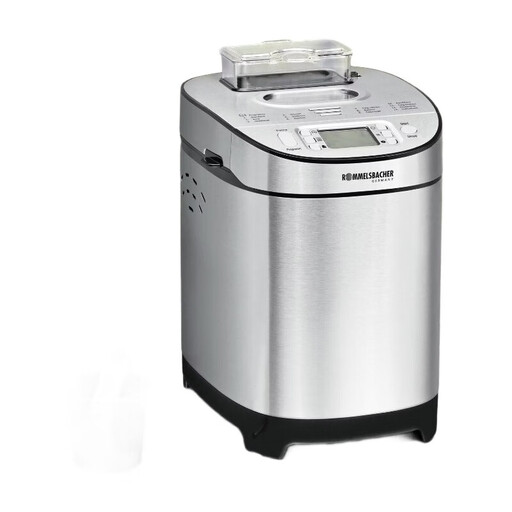 Image unavailable
The product description mentions wholemeal baking as a use. Check the recipe and ingredients for the model version you’re considering.
13 programmes; loaf sizes of 700 or 900 g; automatic ingredient dispenser.
No. Check the recipe and the grain products it uses too. Wholemeal means using the entire grain; a recipe made with white flour isn’t completely wholemeal just because you select a particular programme.
Measure the space for the machine and the clearance needed to open the lid. Follow the cleaning instructions for the exact model version, and don’t assume every baking tin is dishwasher-safe.
Voedingscentrum recommends using bread-making salt rather than ordinary table salt when baking your own bread. This advice is particularly relevant if homemade bread becomes a significant part of the bread you eat; using bread-making salt is not a legal requirement.
If a product is faulty, contact the seller. According to the Rijksoverheid, there is no fixed statutory guarantee period in the Netherlands. What you can expect depends, among other things, on the product, its price and normal use. If parts are worn, also check whether replacements are available for your exact model version.
Yes. According to the Nederlandse Voedsel- en Warenautoriteit, a bread maker placed on the Dutch market as an electrical consumer product must carry the required CE marking. For a specific product, check its marking and information. A CE marking is not, on its own, the result of an independent test.