What should you look for when choosing?
Start with the portion size you want. Then check whether the recipe time fits your workshop, and decide whether participants will watch the dough or work with it themselves.
This table is for consumers choosing a bread maker or dough-making solution for a baking workshop.
| What to consider |
What to look for |
Who is this important for? |
| A small loaf |
Compare the stated loaf weight and recipe for the exact model variant; the weight of the flour is not the same as the weight of the finished loaf. |
If I want to bake one small, complete loaf for each group, I check the loaf setting rather than just the machine’s external dimensions. Around 36% of consumers in this workshop context prioritise a small portion. |
| Will it fit into the session? |
Check the duration of the chosen programme and recipe in the manual. Allow time for cooling too, and don’t confuse a delayed start with a shorter baking time. |
If participants want to see the bread bake or taste it during the same session, the whole schedule needs to work. Around 29% of consumers prioritise the timing. |
| Kneading or shaping the dough yourself |
Check whether the model has a separate kneading or proving programme, and consider where and when the dough will be baked. |
If participants will be working with the dough themselves, I want the chosen programme to suit the activity. Around 21% of consumers prioritise hands-on participation. |
| Cleaning and reuse |
Read the cleaning instructions and check whether a suitable baking tin or kneading blade is available separately. |
If I’m running several groups one after another, I want to be able to clean and reuse the machine according to the instructions. Around 14% of consumers focus mainly on maintenance and spare parts. |
Products on Joybuy
This selection includes bread makers with stated loaf weights starting at 500 g, as well as a separate dough maker for kneading and resting. With the dough maker, you’ll need to arrange the baking separately.
 No image available
Tefal Pain Doré PF2101 bread maker
Could be a good fit if a 500 g loaf setting suits your workshop portion size.
12 programmes; 500 g, 750 g and 1000 g settings; timer up to 15 hours.
View on Joybuy
 No image available
Tefal PF250135 bread maker
The stated loaf settings start at 500 g. The transparent lid could be useful if participants want to watch the baking process.
20 programmes; three loaf sizes; timer up to 15 hours; removable non-stick pan.
View on Joybuy
 No image available
Tefal PF610138 bread maker
Better suited to a workshop where you want a larger loaf than to one focused on small portions.
16 programmes; stated loaf weights from 750 g to 1.5 kg; viewing window; 1600 W.
The smallest stated loaf size is 750 g.
View on Joybuy
 No image available
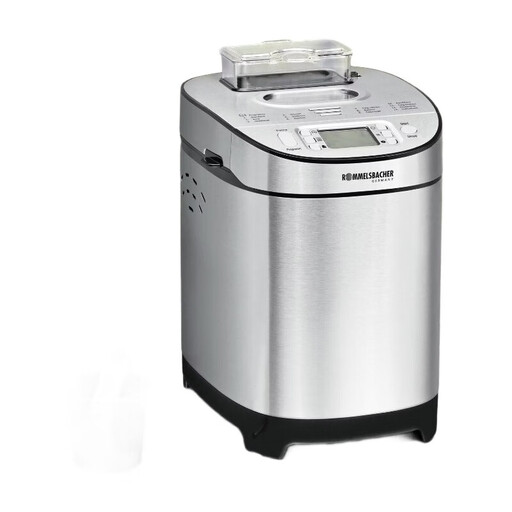
Rommelsbacher BA 550 bread maker
Could be suitable if a 700 g or 900 g loaf is right for your group’s portion size.
13 programmes; viewing window; timer up to 13 hours.
The stated loaf weights start at 700 g.
View on Joybuy
 No image available
Bear dough maker
Could suit a workshop where participants want to knead and rest the dough, with baking arranged separately.
Automatic kneading; resting function; maximum dough capacity 2.5 kg; capacity 5 L.
This is a dough maker, not a complete bread maker.
View on Joybuy
Frequently asked questions
Is a 500 g bag of bread mix suitable for a 500 g loaf setting?
Not necessarily. Include the other ingredients in your calculation and follow the recipe and measurements for your chosen model. For example, Rommelsbacher states that 500 g of mix plus 350 ml of water corresponds to a 900 g setting on the BA 550; this isn’t a recipe for another model.
How do I prepare a bread maker safely for a workshop?
Follow the manual for the exact model. For the BM55, Inventum specifies, among other things, a stable, level surface and a power supply that matches the rating plate; the exterior can get hot. Only remove the kneading blade and hot baking tin as instructed for that model.
Is a gluten-free programme enough for a participant with coeliac disease?
No. According to the Voedingscentrum, even a bread crumb can cause symptoms. Check the ingredients and prevent cross-contamination; a gluten-free programme alone doesn’t confirm that a machine previously used for wheat bread is suitable for that participant.
What warranty applies if I buy the machine for a workshop?
If you buy as a consumer in the Netherlands, you’re covered by the statutory guarantee: the seller must resolve problems with a faulty product under the applicable conditions. There’s no fixed statutory guarantee period in the Netherlands. If you buy the machine for a workshop business, don’t assume these consumer rights automatically apply; check the terms of sale.
Is CE marking compulsory for an electric bread maker?
According to the Netherlands Food and Consumer Product Safety Authority, CE marking is compulsory for electrical products. The marking is the manufacturer’s declaration that the product meets the applicable product requirements; it isn’t proof of independent testing.


