
Baking one small loaf to sell
You want to decide the portion size in advance. So compare the smallest loaf size specified by the manufacturer for the particular model and programme, rather than looking only at the maximum capacity.


For one small loaf, choose a machine with a documented 500 g loaf size, such as the Princess 152007, DOMO B3978 or Tefal Pain & Délice PF240E. A 500 g setting doesn’t guarantee that the baked loaf will weigh exactly that much. Then compare the duration of your chosen programme and the delay-start function: according to Princess, the 152007’s basic programme for 500–750 g takes around 2 hours and 15–20 minutes. Prepare and store the bread hygienically, and make sure you have reliable information about its ingredients and allergens for buyers.
You want to decide the portion size in advance. So compare the smallest loaf size specified by the manufacturer for the particular model and programme, rather than looking only at the maximum capacity.
You want the bread to be ready on time, with enough time left for it to cool and be transported. The programme duration and any timer can help you plan when to bake.
You also need to think about hygienic preparation and reliable information about ingredients and allergens. The Netherlands Food and Consumer Product Safety Authority (NVWA) stresses that food at events must be prepared, stored and sold safely and hygienically.
Start with the smallest loaf size that suits your recipe. Then check the duration of the right programme, allow time for cooling and transport, and consider what you need to do to offer the bread responsibly.
| What to consider | What should you check? | Who should pay particular attention? |
|---|---|---|
| Small portion | Check the smallest loaf size for the specific model and programme. According to their manufacturers, the Princess 152007, DOMO B3978 and Tefal PF240E offer a setting from 500 g. | If I need one small loaf, I want to know which size my recipe and programme can handle; around 33% of consumers prioritise portion size. |
| Deadline | Compare the programme duration and timer for the model and programme you’ve chosen. For the 152007, Princess states that the basic programme for 500–750 g takes around 2 hours and 15–20 minutes. Allow time for cooling and transport too. | With a set start time for the sale, I want to work backwards from when the bread will be served; around 25% of consumers prioritise having it ready on time. |
| Preparation and ingredient information | Keep your preparation area clean, keep a record of the recipe and ingredients used, and agree with the school how buyers will be given allergen information. The NVWA’s guidance on food safety and allergens makes clear that the exact information requirements depend on the circumstances, including who is offering the food and whether it is prepacked. | If I’m baking for others, I want to work safely and answer questions about ingredients reliably; around 25% of consumers value this most. |
| Use and care afterwards | Compare the programmes you plan to use after the school bake sale and follow the care instructions for the model. Inventum says the BM55 baking tin should be washed by hand; Tefal has a parts finder for specific models. | If I want to keep using the machine afterwards, I consider how easy it is to clean and whether suitable parts are available; around 17% of consumers prioritise future use and maintenance. |
The maximum capacity doesn’t tell you whether you can choose a smaller loaf size. For example, Inventum lists loaf sizes of 650 and 800 g for the BM55, while several other models reviewed have a setting from 500 g.
Check the smallest size available for the exact model and programme you want to use.
A delay-start function lets you schedule when a programme begins, but it doesn’t shorten the programme. Remember to allow time for cooling and transport too.
Work backwards from when you need the bread and check how long your chosen programme takes.
A programme name doesn’t prove that a recipe, its ingredients or the preparation method is suitable for someone with an allergy. The materials used and the preparation process matter too.
Check the recipe and ingredients separately, prepare the food carefully and don’t make unverified claims about allergy safety.
The Princess 152007 could be worth considering if you’re looking for a small loaf size and a way to schedule your baking in advance.
According to DOMO, the B3978 lets you choose loaf sizes of 500, 750 and 1000 g, as well as offering a customisable programme.
Tefal Netherlands lists three loaf sizes for the Pain & Délice PF240E, from 500 g to 1 kg.
The Inventum BM55 is an option if 650 g is suitable for your small loaf to sell.
The Rommelsbacher BA 550 could be a good fit if a freely programmable programme or automatic addition of ingredients is important to you.
These Joybuy bread makers are options to compare for making a small loaf and planning when to bake. Check that the loaf size and programme for each version suit your recipe.
 Image unavailable
Check that the smallest loaf size and programme available on this version suit your recipe for one small portion to sell.
The product name lists a capacity of 1 L and 12 programmes.
 Image unavailable
Compare this version’s settings with your recipe and check which programme uses the loaf size you want.
The product name lists 700 W and 20 programmes.
 Image unavailable
A timer can be useful for planning; check that the loaf size you need is available for your recipe.
The product name lists 610 W.
 Image unavailable
Before choosing this version, check that its smallest available loaf size is suitable for one small portion to sell.
The product name lists 1600 W.
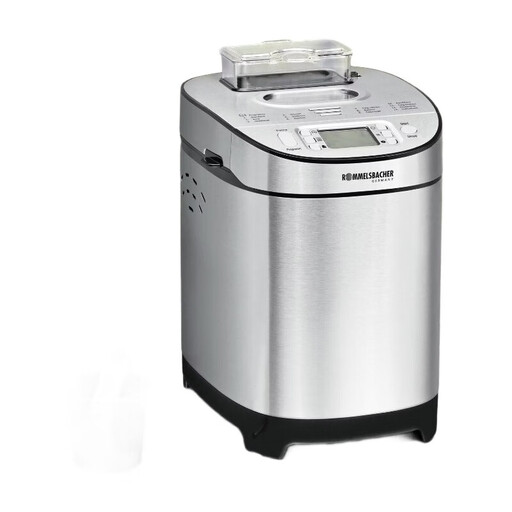 Image unavailable
Consider this model if its standard loaf sizes suit your plans; Rommelsbacher lists 700 and 900 g, with no standard 500 g setting.
The manufacturer also lists a freely programmable programme. Assess separately whether an adapted recipe will suit your preferred portion size.
No. A loaf-size setting doesn’t guarantee the exact weight of the baked loaf. Use it to choose a suitable programme and recipe, and bear in mind that the final result may vary.
Check how long your chosen programme takes and allow time for cooling and transport too. According to Princess, the 152007’s basic programme for 500–750 g takes around 2 hours and 15–20 minutes; a delay-start function doesn’t change the programme duration.
Follow the instructions for your specific model. Inventum says to wash the BM55 baking tin by hand with a little washing-up liquid and advises against sharp ingredients because of the non-stick coating. Don’t automatically apply this advice to other models.
The NVWA says food at events must be prepared, stored and sold safely and hygienically, including by private individuals. The NVWA says a food safety plan is required when someone prepares and sells food several times a year; this doesn’t mean a plan is automatically required for a one-off sale. Agree with the school how everything will be managed.
The NVWA states that businesses and organisations offering food are legally required to provide information about allergens present. For non-prepacked food, this can be provided in certain circumstances, for example on a card or verbally; if information is given verbally, it must be clear that customers can ask for it. Agree with the school who will provide the information, and pass on accurate details of the ingredients used.