If you mainly want to demonstrate the complete baking process, choose a machine that kneads, proves and bakes the bread. If participants are going to shape a long sandwich loaf themselves, a dough programme paired with a separate oven and suitable tin is a better option. Match the loaf size and shape to your group, and allow time for both the programme and cooling before promising a slicing session.
Who is a bread maker suitable for in a workshop?
Workshop leader working to a tight schedule
Want to make the baking process visible and plan the finished result. Check how long the selected programme takes and allow time for the bread to cool. The Netherlands Nutrition Centre recommends cooling baked bread on a wire rack.
Leader of a hands-on dough class
Want participants to shape and bake the bread themselves. A separate dough or kneading programme may be suitable, provided you also have an appropriate tin and oven. Princess and Panasonic describe models with separate kneading or proving functions.
Baker leading a larger workshop group
Want to make enough bread for the group or demonstrate several loaves at once. Compare the recipe capacity and the tins supplied: Inventum states that the BM125 can make one loaf weighing 900 or 1200 g, or two loaves weighing 450 g each.
What should you look for when choosing a bread maker?
Bake the whole loaf in the machine
Choose this if: you want the machine to knead, prove and bake the bread, and can leave it to cool afterwards.
Bear in mind: the programme length and loaf shape; participants won't shape the dough themselves during the automatic cycle.
Make the dough and bake it separately
Choose this if: participants need to shape the loaf themselves and you have a suitable tin and oven.
Bear in mind: the extra steps, supervision and available oven space; a dough programme won't bake the loaf for you.
| What to consider |
What to look for |
Who is this most important for? |
| Programme and timing |
Check how long the specific bread programme takes and allow extra time for the loaf to cool. |
If I want to slice bread during a workshop, the programme needs to finish on time and the loaf needs time to cool. Around 31% of consumers prioritise workshop timings. |
| Loaf size and tin |
Match the recipe weight and shape to the number of slices you want and the size of your group. |
If I'm making bread for participants, I want a suitable size and slices that are easy to use. The machine's capacity alone doesn't guarantee the shape I want. Around 25% of consumers focus mainly on loaf size. |
| Shaping the loaf yourself |
Check whether the exact model has separate dough, kneading or proving settings. You'll also need a suitable tin and oven. |
If participants are going to shape a sandwich loaf themselves, I want that step to remain part of the lesson. Around 19% of consumers put this learning objective first. |
| Cleaning and parts |
Read the cleaning instructions and check that any replacement part you need is compatible with the exact model variant. |
If I'm using the machine for regular workshops, I want to know how to clean the bread pan and which parts belong to the model. Around 13% of consumers prioritise maintenance. |
| Safety and food contact |
Check the CE marking and product information for the specific appliance and any parts that come into contact with food. |
If I'm using the machine in a workshop, I want to be able to check the product information and food-contact documentation. Around 12% of consumers put these checks first. |
The Netherlands Food and Consumer Product Safety Authority (NVWA) states that CE marking is compulsory for electrical products covered by the relevant rules. The marking is a declaration by the manufacturer, not an independent quality mark. Bread pans and other parts intended to come into contact with food must also meet the applicable requirements for food-contact materials. Check the information for the specific product on offer.
Common pitfalls when choosing a bread maker for workshops
-
Assuming a delayed start means a shorter baking programme
A timer changes when the programme starts, but doesn't tell you how long it takes. The bread also needs to cool after baking before you slice it.
Check the programme length for the exact model and work backwards from the time you want to serve the slices.
-
Assuming the loaf weight guarantees the sandwich slices you want
The stated loaf weight doesn't tell you what shape the bread will be or how many even slices you can cut.
Compare the tin and recipe with the result you have in mind. If participants are shaping a long loaf themselves, look for a dough programme and use a suitable separate tin.
-
Assuming a gluten-free programme makes the whole workshop gluten-free
The Netherlands Nutrition Centre notes that bread crumbs can be a concern for someone with coeliac disease. A programme won't prevent cross-contamination from ingredients or equipment.
Discuss dietary requirements in advance and choose ingredients, a bread pan, utensils and a cutting area that suit the necessary precautions.
Depending on the participant and the precautions required, you may need separate equipment or equipment that has been thoroughly cleaned.
Relevant bread maker brands to consider
Inventum
The BM55 and BM125 are worth considering if the machine needs to bake the whole loaf; capacity varies by model.
- Inventum says the BM55 can make loaves weighing 650 or 800 g. The BM125 is designed for one loaf weighing 900 or 1200 g, or two loaves weighing 450 g each.
- Inventum lists two bread pans for the BM125; don't assume the BM55 offers the same option. Inventum recommends washing the BM55 bread pan by hand.
Princess
The 152009 is worth considering if you want separate kneading or proving as well as fully automatic baking.
- Princess lists a capacity of 680–900 g for the 152009, along with separate kneading and proving functions.
- These functions don't guarantee that a particular workshop recipe or a long sandwich loaf will work without a separate tin.
Tefal
The Pain Doré PF210138 is worth a look if you want to compare automatic bread and dough programmes.
- Tefal lists automatic programmes for bread and dough. The model information also shows a removable pan, along with the matching housing and kneading parts.
- Check the full variant code and the programme you need; the model information doesn't prove that its schedule will suit your workshop.
Panasonic
The SD-R2530 is worth considering for lessons where kneading and proving are set separately.
- Panasonic lists manual kneading and proving settings, plus a nut and raisin dispenser, for the SD-R2530.
- The Dutch product page showed the SD-R2530 and SD-R2530KXE as unavailable; this doesn't automatically tell you whether other Panasonic models are available.
Bread makers on Joybuy for baking a whole loaf
This selection focuses on bread makers that bake the whole loaf. Compare the stated loaf weights, programmes and controls with your workshop recipe and schedule.
 No image available
Tefal Pain Doré PF2101
Could be a good fit if you want to demonstrate a complete baking programme during your workshop.
The product information lists loaf weights of 500, 750 and 1000 g, 12 baking programmes, three crust settings, a timer of up to 15 hours and a keep-warm function. Follow the instructions on children and supervision.
Joybuy
 No image available
Tefal PF610138
Could be a good fit if you want to compare a larger stated loaf weight with your recipe and group size.
The product information lists loaf weights from 750 g to 1.5 kg and 16 automatic programmes for bread and dough. The bread pan and appliance get hot during use; follow the instructions and place the machine on a stable, heat-resistant surface.
Joybuy
 No image available
Tefal PF250135
Could be a good fit if you want to compare several automatic programmes and a removable bread pan for your recipe.
The product information lists 20 automatic programmes, three loaf sizes, a timer of up to 15 hours and a 1-hour keep-warm function. The description includes instructions on children and supervision.
Joybuy
 No image available
Tefal PF251835
Could be a good fit if you're looking for bread and dough programmes and a stated loaf weight of up to 1 kg suits your recipe.
The product information lists programmes for baking bread and preparing dough, plus a delayed-start timer. Use the machine indoors on a stable, heat-resistant surface, and let hot parts cool before cleaning them.
Joybuy
 No image available
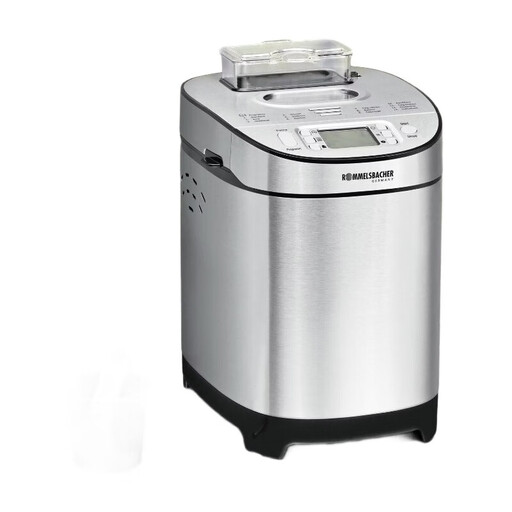
Rommelsbacher BA 550
Could be a good fit if you want to match the stated loaf sizes to the amount of bread your workshop needs.
The product information lists loaf sizes of 700 and 900 g, three browning levels, a timer of up to 13 hours and a keep-warm function of up to 60 minutes.
Joybuy
Frequently asked questions about using a bread maker in a workshop
Can I slice the bread into neat sandwiches straight after baking?
Allow time for it to cool first. The Netherlands Nutrition Centre recommends cooling bread on a wire rack after baking. Whether this fits into your workshop depends on the programme length and your schedule.
Where should I put the machine, and how do I clean it?
Follow the instructions for the exact model. The Inventum BM55 manual says to use it indoors on a firm, level surface and warns against placing it near heat sources or flammable objects. Inventum recommends washing the BM55 bread pan by hand.
Who should I contact if it develops a fault, and do I need extra cover?
If a product is faulty, contact the seller about your statutory guarantee rights. The Dutch government states that there is no fixed statutory guarantee period in the Netherlands. Compare the terms of any additional cover with the rights you already have.
Is CE marking compulsory for an electric bread maker in the Netherlands?
CE marking is compulsory for electrical products covered by the relevant rules. The NVWA explains that the marking is a declaration by the manufacturer, not proof that an independent body has tested every individual appliance. Check the marking and product information for the specific model on offer.
Is a gluten-free programme enough if a participant has coeliac disease?
No. A programme alone won't prevent gluten in ingredients or cross-contamination from equipment and crumbs. Discuss dietary requirements in advance and choose ingredients and working practices accordingly.


