
Baking for a larger group
You want to work out in advance how many loaves and batches you’ll need. Compare the stated loaf sizes and estimate portions based on how thick you slice your bread; Inventum and DOMO publish weights for specific models.


First work out how much bread you want to serve and how many batches you’ll need: a larger stated loaf size may mean fewer batches, but it won’t tell you how many portions you’ll get. Then choose between a raisin dispenser and adding the raisins yourself when prompted; if you plan to use the delay timer, check whether your recipe requires you to be there at any point. Inventum, DOMO and Panasonic describe features of specific models, not guaranteed yields or baking results for your recipe.
You want to work out in advance how many loaves and batches you’ll need. Compare the stated loaf sizes and estimate portions based on how thick you slice your bread; Inventum and DOMO publish weights for specific models.
You want to prepare raisin bread without having to wait by the machine for an add-in signal during kneading. A dispenser is a useful model feature in this case; Panasonic lists one for the SD-YR2550.
You’re planning your baking around a morning coffee gathering and want to know whether the delay timer and the add-in stage suit your recipe. Princess and Tefal list timers for specific models; also check the instructions for your recipe.
First work out how much bread you need and whether you can be there during kneading. Then make sure the timer suits your recipe and the time you want to serve the bread.
| What to consider | What should you check? | Who is this important for? |
|---|---|---|
| Enough bread per batch | Compare the stated loaf weight and any double baking tin; work out the portions from a test loaf yourself. Inventum and DOMO list weights for their models, not a set number of slices. | If I’m baking for a group, I want to know how many batches I’ll need for my portions. That’s why around 28% of consumers prioritise making enough bread per batch. |
| Adding raisins | Check whether the exact model has a raisin dispenser or requires you to add the raisins yourself when prompted, and whether the feature works with your chosen programme. Panasonic and Inventum describe different methods. | I want to add raisins without having to be there during kneading. That’s why around 22% of consumers prioritise automatic dispensing. |
| A set serving time | Check the timer and whether your recipe requires you to intervene part-way through. Princess lists a maximum of 13 hours for article 01.152009.01.001; Tefal lists a maximum of 15 hours for the PF240E38. | If the morning coffee gathering has a set start time, I want to be able to plan the baking in advance. That’s a priority for around 22% of consumers. |
| Cleaning and reuse | Check the cleaning instructions and which parts are included with the exact model. Inventum says to hand-wash the baking tin for the BM55; DOMO lists specific parts for the B3977. | If I’m baking repeatedly, I want to know how to clean the baking tin and which parts fit the machine. Around 17% of consumers place the greatest importance on care and reuse. |
| Dietary needs and cross-contamination | Check the ingredients and avoid contact with gluten crumbs on the baking tin, utensils and work surface. The Voedingscentrum stresses that a gluten-free programme alone does not prevent cross-contamination. | If a guest has a dietary requirement, I want to check the ingredients and the risk of cross-contamination carefully. Around 11% of consumers give dietary safety the highest priority. |
The stated weight won’t tell you how many slices you’ll get from your recipe. The thickness of your slices also affects how many portions you can serve.
If possible, bake a test loaf first and plan the number of batches based on the portions you cut from it.
A timer and a raisin dispenser are two different features. For certain programmes on the Inventum BM55, the manufacturer says to add extra ingredients yourself when an audible signal sounds; Panasonic lists a dispenser for the SD-YR2550.
Check the manual for the exact model and your chosen programme before using the delay timer.
A programme name doesn’t mean the ingredients, baking tin or work surface are free from gluten contact.
Check the ingredients and prepare them and the bread carefully to avoid cross-contamination, as the Voedingscentrum advises.
The BM55 is specified for 650 and 800-gram loaves; according to Inventum, the BM125 can bake one large loaf weighing 900 or 1200 grams, or two small loaves weighing 450 grams each.
DOMO specifies loaf sizes of 1000, 1250 and 1500 grams for the B3977.
Panasonic lists a raisin and nut dispenser and a yeast dispenser for the SD-YR2550.
For article 01.152009.01.001, Princess lists a sweet-bread programme, loaf sizes from 680 to 900 grams and a timer of up to 13 hours.
For the Pain & Délice PF240E38, Tefal lists loaf sizes from 500 grams to 1 kilogram, a sweet-bread programme and a timer of up to 15 hours.
These Joybuy product picks are suited to planning loaf sizes, a set serving time and when to add raisins.
 No image available
Worth considering if you want to match different loaf sizes to your serving plans.
 No image available
An option to compare if you’re planning a larger batch for a group.
 No image available
Worth comparing if you’d rather have the raisins added automatically than add them yourself during kneading.
 No image available
Worth considering if you want to plan your baking in advance for a set serving time.
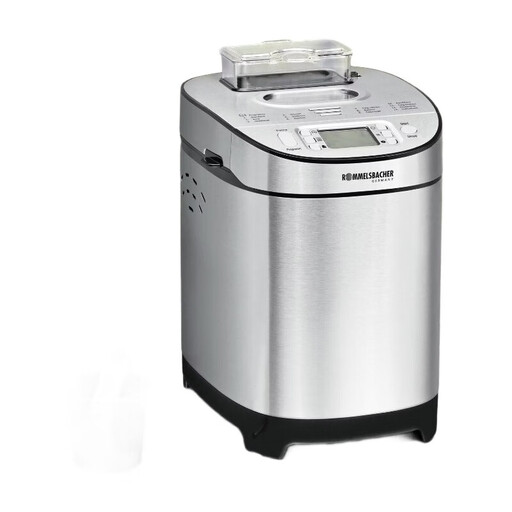 No image available
An option to compare if you want to time your baking around a set serving time.
Compare the stated loaf size with the number of slices from your test loaf and the number of guests. Inventum specifies that the BM125 can make one large loaf weighing 900 or 1200 grams, or two small loaves weighing 450 grams each; DOMO lists sizes up to 1500 grams for the B3977. These weights don’t indicate a set number of slices.
That depends on the model, programme and recipe you choose. Panasonic lists an automatic raisin dispenser for the SD-YR2550; for certain BM55 programmes, Inventum says to add the raisins yourself when an audible signal sounds. Check the manual before using the delay timer.
The Voedingscentrum advises keeping opened raisin bread in a kitchen cupboard for 4–7 days or in the freezer for 1–3 months; after that, its quality may deteriorate. Also check the bread for a stale smell or mould.
Follow the manual for the exact model and allow hot parts to cool first. For the BM55, Inventum instructs you to hand-wash the baking tin with a little washing-up liquid; don’t assume these instructions apply to every model.
For consumer purchases in the Netherlands, statutory rights apply alongside any manufacturer’s warranty. According to ACM ConsuWijzer, the seller must offer an appropriate solution if the product breaks sooner than you could reasonably expect under normal use. Online purchases also usually come with a 14-day cooling-off period from delivery; check which exceptions and return conditions apply.
No, not on its own. The Voedingscentrum points out that cross-contamination from gluten crumbs may be an issue. Check all the ingredients and avoid contact through the baking tin, utensils and work surface; discuss with your guest whether the preparation meets their dietary needs.