
Teachers who want participants to shape the dough themselves
You want the machine to do the kneading and first prove, while filling, rolling and baking remain part of the workshop. Panasonic describes this approach in a cinnamon roll recipe.


For a workshop where participants shape their own cinnamon rolls, choose a bread maker with a dough programme that kneads and proves the dough without baking it. Then check that the recipe quantities are suitable for the machine and plan time for the programme, shaping, final proving, baking and cleaning. A stated loaf weight does not automatically indicate the maximum amount of cinnamon roll dough the machine can handle.
You want the machine to do the kneading and first prove, while filling, rolling and baking remain part of the workshop. Panasonic describes this approach in a cinnamon roll recipe.
You want to match recipe quantities and consecutive batches to the number of participants and the time available. The stated loaf sizes for models such as the Inventum BM55 and DOMO B3974 are not set limits for dough quantities.
You want to know when the dough will be ready and how much time to allow for handling and cleaning between sessions. Dough programmes, manual settings and care instructions vary by model.
Start with the dough setting and the instructions for your recipe. Then match the batch size and programme duration to your workshop schedule.
| What to consider | What should you check? | Most important for |
|---|---|---|
| Dough programme | Check the manual to see whether the setting kneads and proves the dough without a baking phase, and whether it suits your recipe. | If I want to give participants dough they can fill and shape themselves, I look for a suitable dough setting. Around 36% of consumers say a suitable dough programme is their top priority. |
| Batch size | Compare the ingredients for each group with the recipe and manual; don’t work out the permitted dough quantity from the loaf weight alone. | If I’m catering for several groups, I want to know how much dough I can make per batch and whether there will be any waiting time. Around 29% of consumers prioritise the amount of dough per group. |
| Workshop timing | Check the programme duration for the exact model and allow time for shaping, final proving and baking too. | If the dough needs to be ready at a set time, I want to fit the machine cycle around the rest of the schedule. Around 21% of consumers give predictable timing top priority. |
| Cleaning between sessions | Read the cleaning instructions and check whether the bread pan and kneading blade will be ready for the next group after a batch. | If I use the machine repeatedly during a workshop, I want to allow enough time for cleaning. Around 14% of consumers prioritise maintenance between sessions. |
Stated loaf sizes are not a proven limit for cinnamon roll dough with a different composition, such as dough made with butter and egg.
Before deciding how many machines or groups you’ll need, compare the ingredients per batch with the recipe and the instructions for the specific model.
A timer changes when the machine starts; it doesn’t shorten the cycle. The dough still needs to be filled and shaped, left to prove again and baked in an oven.
Build a schedule around the programme duration for your chosen model and the steps in the recipe. A trial batch can help you fine-tune the timings.
Inventum specifies that the bread pan for the Inventum BM55 should be washed by hand. A non-stick coating doesn’t override this instruction.
Follow the care instructions for the exact model and, if you need replacement parts, check which bread pan or kneading blade is compatible.
The B3974 lists separate dough and kneading settings, with loaf sizes of 750 or 1000 g.
Panasonic lists manual kneading and proving settings for the SD-R2530. A Panasonic cinnamon roll recipe uses a basic bread dough programme as its starting point.
Inventum says the BM55 has 12 programmes and loaf sizes of 650 and 800 g. Its manual describes a dough programme that doesn’t bake the dough in the machine.
Princess lists 15 programmes and loaf sizes from 680 to 900 g for the 152009.
Tefal lists a yeast dough programme and loaf sizes from 500 g to 1 kg for the Pain & Délice PF240E.
Bread makers to compare for the dough-making part of a cinnamon roll workshop. Check whether the features and recipe instructions listed for each model suit the way you plan to work.
 No image available
Before choosing this model for a workshop, compare its dough setting and recipe instructions.
The product name lists 12 programmes and a capacity of 1 L; this capacity is not a set maximum for cinnamon roll dough.
 No image available
The product information mentions dough preparation; check which dough settings and recipes are intended for your workshop.
The product name lists 1600 W and a white finish.
 No image available
The product information mentions dough preparation; check that the listed features suit your workshop recipe and batch size.
The product name lists 700 W, 20 programmes, gluten-free options and a removable non-stick bread pan.
 No image available
The product information mentions dough preparation; check the dough setting and instructions for your recipe before planning your batches.
The product name lists 610 W, 12 programmes and a compact design. The description says it is for indoor household use only.
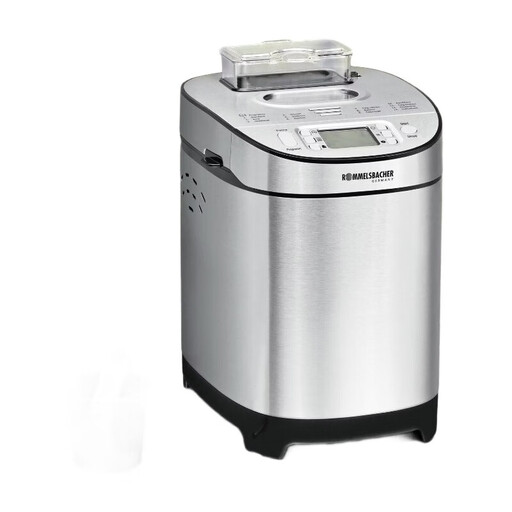 No image available
Check the dough-making features and the instructions for your recipe to see whether this model suits your workshop.
Not in the method described in the Panasonic recipe we consulted. After the basic bread dough programme, you take the dough out of the machine, fill and roll it, leave the rolls to prove again, then bake them on a baking tray in an oven. The recipe’s timings and temperature won’t automatically apply to other dough variations.
No, not without checking the instructions for your specific dough recipe. The loaf sizes listed by DOMO and Inventum do not, on their own, set a maximum for dough with a different composition.
Follow the cleaning instructions for the exact model. Inventum specifies that the BM55 bread pan should be washed by hand. Before making the next batch, also check that the bread pan and kneading blade are correctly fitted.
For a consumer purchase in the Netherlands, the seller is responsible for providing a solution. According to the Dutch government, there is no fixed statutory two-year warranty period; what you can expect depends, among other things, on the product and the purchase information. Check separately which terms apply if the machine is bought or used for business purposes.
If you sell food or drink to customers as a business, the Netherlands Food and Consumer Product Safety Authority says you must follow food safety rules and tell customers about allergens in food you prepare or sell. Whether these business rules apply to a particular workshop depends on how it is run.