
Vandaag of morgen in huis

Kwaliteit gegarandeerd

Welkomstaanbiedingen ontgrendelen: GRATIS bezorging | Tot 80% korting | Gratis 30 dagen JoyPlus-proefperiode
Download de app
Baking your own bread sounds simple: add the ingredients, choose a programme and wait. Yet many consumers buy a bread maker that barely gets used after a few weeks. Often, the problem is not the bread itself, but an unsuitable capacity, unclear programmes or an appliance that is difficult to clean.
This practical buying guide explains what to look for in a bread maker, which features really make a difference and which type suits your everyday needs.
A long list of programmes may sound appealing, but not every programme will be relevant to your household. First check whether the machine has programmes you will actually use, such as white bread, wholemeal bread, dough, cake or jam. Also check whether the manual provides clear quantities and baking times.
With a bread maker with programmes, the name of a function is not enough. Check exactly what the programme does and which ingredients it requires.
A small loaf size can be convenient for one or two people, but for a family it may mean having to bake more often. A large model, on the other hand, takes up more space and can be impractical if you usually eat small loaves.
Pay attention to the difference between the minimum and maximum weight. A machine that only handles large loaves well offers less flexibility for smaller households.
A delayed start is useful if you prepare the ingredients in the evening for the following morning. However, check that the ingredients you choose are suitable for delayed baking. Fresh milk, eggs and other perishable ingredients require extra care and must be used according to the instructions.
A bread maker with a timer makes planning easier, but it does not replace accurately measuring and adding the ingredients.
For a household of one or two people, a model with a loaf weight starting at around 500 grams may be sufficient. Families may benefit more from a machine that can handle 1 to 1.5 kilograms. An adjustable weight setting is useful if you want to make different-sized loaves.
Also check the appliance’s dimensions. An automatic bread maker should stand on a stable, heat-resistant surface while in use. Measure beforehand to make sure there is enough space on your worktop and that you can store the appliance after use.
Do not just look at the number of programmes. Consider the combination of functions:
According to Tefal’s product description, the Pain Doré PF2101 has twelve programmes, three browning levels, loaf weights of 500, 750 and 1000 grams, and a timer of up to 15 hours. According to information from Tefal itself, the model also includes programmes for low-salt and gluten-free baking. When baking gluten-free bread, always check the ingredients list, cross-contamination information and instructions on the packaging. A dedicated programme is not a general guarantee that the finished product will be gluten-free.
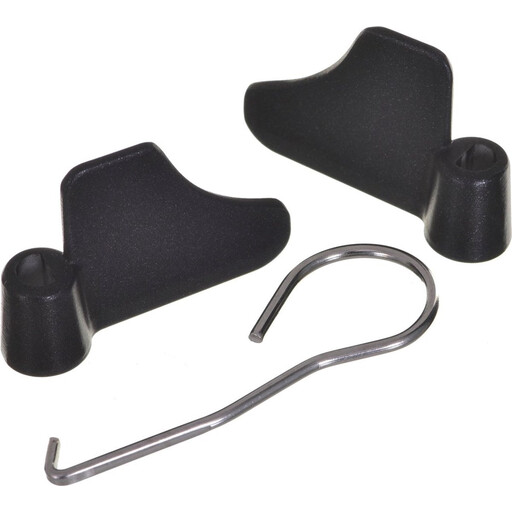
A removable baking pan with a non-stick coating is generally easier to clean than a fixed component. Do not use sharp objects to remove baked-on residue, as this can damage the coating. Also check whether the kneading paddle and baking pan can be removed easily.
For an appliance that will be used frequently, pay attention to its components, warranty conditions and the availability of replacements. The product description for the Tefal PF2101 states that the product is designed to be repairable and that parts should be available for a long period, according to the manufacturer. This is manufacturer-provided information, so check the current terms when purchasing.
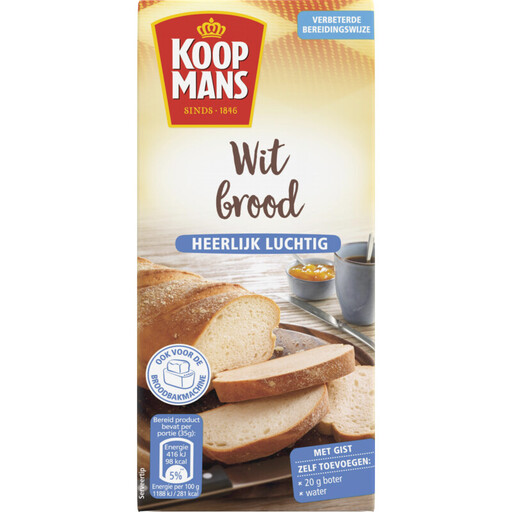
Why it suits this profile: If you want to try baking bread at home, you do not need to weigh out separate quantities of flour, yeast and salt straight away. According to the product description, you only need to add water to this mix; it is suitable for use in an oven or bread maker.
The fixed composition reduces the risk of using the wrong proportions when baking for the first time. However, the mix contains wheat and gluten, so always check the label.
450 grams of mix; suitable for use in an oven or bread maker; only water needs to be added according to the product description.
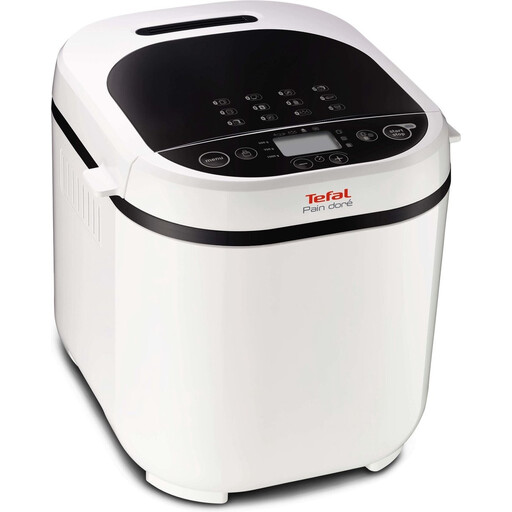
Why it suits this profile: This model offers several adjustment options without claiming a maximum capacity intended for large households. It is well suited to users who value variety and planning.
The adjustable weights of 500, 750 and 1000 grams help prevent you from repeatedly baking a loaf that is too large or too small.
12 programmes; timer of up to 15 hours according to the product description; three browning levels; 720 watts of power.
Why it suits this profile: This model is aimed at households that want to make larger loaves and prepare a range of different recipes. According to the product details, its maximum loaf capacity is 1.5 kilograms.
The capacity of 750 grams to 1.5 kilograms provides more room for families. However, check that the size fits on your worktop.
16 automatic programmes; 1600 watts; non-stick coating; viewing window and delayed start according to the product description.
Anyone who bakes their own bread will often find that a fresh loaf is still soft when it needs to be sliced. Using an ordinary knife can then result in uneven slices or tearing. A bread slicer can be useful if you regularly bake your own bread.
According to the product details, the Fritel Bread Slicer SL 3070 has a serrated stainless-steel blade, an adjustable slicing thickness of 0 to 15 millimetres and a blade diameter of 17 centimetres. The appliance is foldable and has a removable crumb tray. Always use the food pusher, place the slicer on a stable, dry surface and unplug it before removing or cleaning the blade.
The costs include ingredients, electricity and any accessories you may need to buy. Power consumption depends on the wattage, programme duration and number of baking cycles. A higher wattage does not automatically mean a higher cost per loaf, as baking time and programme settings also play a part.
A white bread mix can make preparation easier. Using individual ingredients often gives you more freedom, but requires more precise measuring. So do not compare only the price of an appliance. Also consider how much bread you actually bake and which ingredients you use.
We have put together a complete, up-to-date list of products that fully meet these strict selection criteria and the applicable European safety regulations.
Not always. Recipes designed for an oven may use different quantities, proving times or baking temperatures. Start by following the recipe in the bread maker’s manual and only adjust quantities gradually.
Its lifespan depends on use, maintenance and components such as the kneading paddle and baking pan. Clean the machine according to the manual, avoid overloading it and do not use metal utensils with the baking pan. Keep your proof of purchase and check the statutory warranty terms.
That depends on the purchase price, ingredients, energy consumption and how often you use the machine. Baking your own bread mainly gives you more control over the size, ingredients and baking time. Before buying, make a simple calculation based on the number of loaves you normally bake per week.
