
Vandaag of morgen in huis

Kwaliteit gegarandeerd

Welkomstaanbiedingen ontgrendelen: GRATIS bezorging | Tot 80% korting | Gratis 30 dagen JoyPlus-proefperiode
Download de app
A good bread knife cuts through a crisp crust without squashing the soft crumb. Choosing one is not always as straightforward as it seems, though. Product pages use terms such as “extra sharp”, “professional” and “durable”, while important details can sometimes be less clearly stated.
So keep an eye out for these three common pitfalls:
For many households, a 23 cm bread knife is a practical middle ground. It can handle both a compact farmhouse loaf and a larger sliced loaf. A 20 cm blade is easier to manoeuvre and takes up less space, but may not reach as far when cutting taller loaves.
A serrated knife uses saw-like teeth to grip the crust. This usually means you need to apply less pressure than you would with a smooth kitchen knife. Pay attention to the shape of the serrations:
A sharp bread knife isn’t just about the first cut. The shape, hardness and finish of the blade also affect how long it remains comfortable to use.
Stainless steel is commonly used for bread knives. It stands up to normal moisture and needs little maintenance with daily use. However, the exact type of steel makes a difference. For example, Wüsthof lists X50CrMoV15 steel and a hardness of 58 HRC for some Classic models.
The brand’s claim that a knife is “20% sharper” thanks to laser-guided sharpening should be read as information based on Wüsthof’s own research or product communications. It isn’t a general measurement standard for all bread knives.
Damascus steel can have a striking appearance and particular material properties. That doesn’t automatically make every Damascus knife more practical for every user. Also consider the weight, handle, serration shape and care instructions.
A lightweight plastic handle can be comfortable if you regularly slice bread. A metal handle feels different and may look particularly sturdy, but it won’t be equally comfortable for everyone. Check whether the knife is suitable for both left- and right-handed use, and whether the join between the handle and blade is smooth.
Dishwasher guidance varies considerably:
Rinse the knife after use, dry it straight away and store it out of children’s reach. Use a stable, non-slip chopping board for bread. Sharpening a serrated knife is trickier than sharpening a smooth kitchen knife, so follow the manufacturer’s care advice.
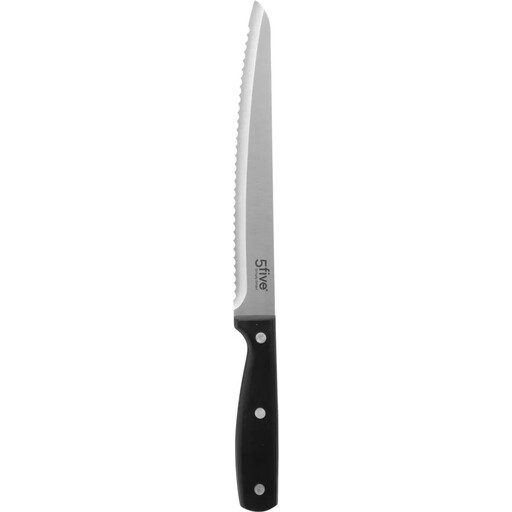
Why it suits this profile: This model has an overall length of 33 cm, a stainless steel blade and a plastic handle. Its specifications are easy to understand if you’re looking for a straightforward bread knife for everyday use.
The length is clearly stated and the product is listed as dishwasher-safe. Do check that you have enough room in your kitchen for a 33 cm knife.
Stainless steel blade, plastic handle and stated dishwasher-safe design.
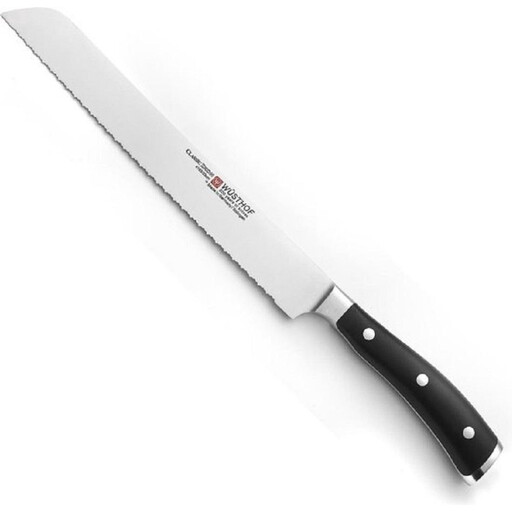
Why it suits this profile: The stated 23 cm blade length, double-serrated edge and ergonomic handle make it suitable for frequent bread slicing, as well as cutting cake and soft or hard foods.
The product information lists the blade length, X50CrMoV15 steel and hand washing as the recommended care method. So you’ll know in advance that this isn’t the choice for you if you want a dishwasher-safe knife.
23 cm blade, double-serrated edge, suitable for left- and right-handed use, and a half bolster for control.
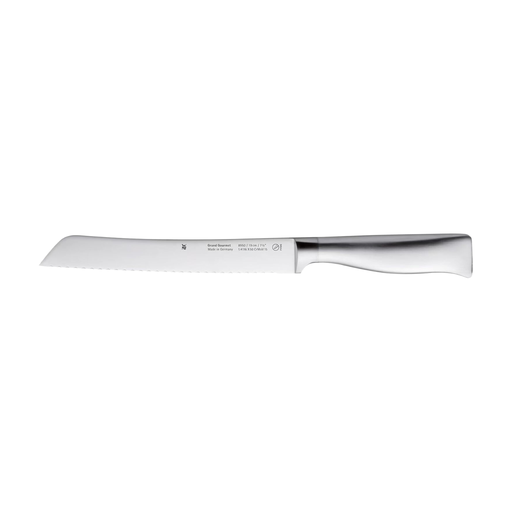
Why it suits this profile: The long, double-serrated edge is designed for large loaves, hard crusts and soft rolls. The product information specifies a stainless steel construction and hand washing.
The length and care instructions are clearly stated. Hand washing means you won’t mistake dishwasher-safe claims for a guarantee that the edge will stay in good condition.
32 cm overall product length, double-serrated edge and Cromargan 18/10 handle, according to the product description.
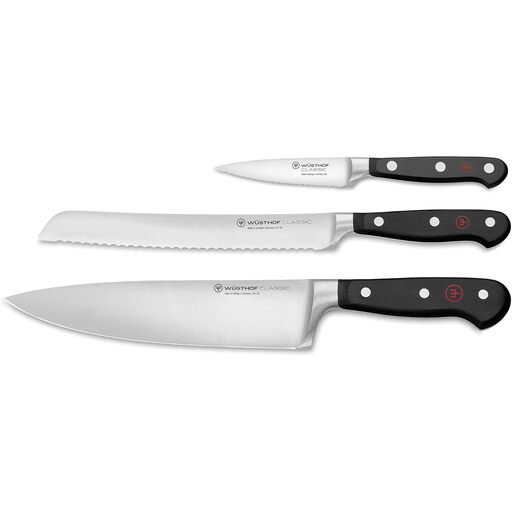
Why it suits this profile: The set combines a chef’s knife, bread knife and paring knife. It’s a good fit for households that prepare vegetables, fruit and other ingredients every day, as well as slicing bread.
You won’t be buying several individual knives without a clear purpose for each. Do check the care instructions, as the set is listed as dishwasher-safe.
Three knives, plastic handles and stainless steel blades, according to the product information.
We’ve put together a complete, up-to-date list of products that meet these strict selection criteria and the current European safety requirements.
A 23 cm blade is a useful length for many household loaves. A longer blade may be more comfortable for very wide or tall loaves. Also check the knife’s overall length to make sure it will fit in your knife block or kitchen drawer.
It depends on the model. Some 5five knives are listed as dishwasher-safe. Various Wüsthof Classic models and the WMF Grand Gourmet recommend hand washing. Always check the specific product information and dry the knife after cleaning.
There’s no set lifespan. Frequent cutting on a hard surface, contact with other knives and dishwasher use can damage the serrations more quickly. Use a suitable chopping board, store the knife safely and follow the brand’s care advice.
