
Vandaag of morgen in huis

Kwaliteit gegarandeerd

Welkomstaanbiedingen ontgrendelen: GRATIS bezorging | Tot 80% korting | Gratis 30 dagen JoyPlus-proefperiode
Download de app
A bread knife should cut through a crusty crust without squashing the soft bread underneath. Yet choosing one doesn’t always go smoothly. A knife may be too short for large loaves, its handle may feel slippery or its serrated edge may be difficult to maintain. For home bakers, keen cooks and professional kitchens, the most important factors are blade length, tooth shape, materials and cleaning.
Terms such as “extra sharp” or “professional bread knife” don’t automatically tell you how a knife performs in practice. It’s better to check:
Wüsthof states that some models are sharpened using laser guidance and that their sharpness is 20% greater than that of average knives. This is a brand claim, not a universal measurement standard. So check the specific details too, such as X50CrMoV15 steel, a 20 or 23 cm blade and a double-sided serrated edge.
A 20 cm bread knife is practical for smaller loaves, soft rolls and cakes. For sourdough loaves, large crusty loaves and long baguettes, a 23 cm bread knife offers more cutting length. A longer bread knife gives you room to saw in one smooth, even motion, but it also takes up more space in a kitchen drawer or knife block.
Remember that the product’s overall length isn’t the same as its blade length. For example, a knife with a 23 cm blade may be over 32 cm long in total.
A dishwasher is convenient, but heat, moisture and contact with other cutlery can put strain on the blade and handle. Hand washing with mild washing-up liquid is recommended for many forged or finely finished knives. Other models are listed as dishwasher-safe in their product specifications.
Always follow the care instructions for the specific model. A stainless-steel bread knife isn’t automatically suitable for the dishwasher.
A serrated bread knife works differently from a smooth-edged chef’s knife. Its teeth grip the crust and saw through the bread, so you don’t need to apply as much pressure. This is particularly useful for a bread knife for crusty loaves.
Consider the tooth shape:
A serrated bread knife generally shouldn’t be sharpened with a standard honing steel. When the teeth become blunt, you’ll need a specialist sharpening service or a suitable sharpening tool.
Stainless steel is practical for everyday use because it resists corrosion with normal care. Some models use X50CrMoV15 steel; others are made from standard stainless steel or Damascus steel.
A hardness of 58 HRC, as listed for one of the Wüsthof models, is a verifiable technical specification. Greater hardness can help the edge stay sharp for longer, but it doesn’t remove the need for careful use and maintenance. Don’t cut on glass, metal or other hard surfaces.
A plastic or ABS handle is lightweight and easy to clean. A metal handle may offer a different balance and appearance. Check whether the handle is suitable for both left- and right-handed use, and whether the join between the handle and blade is smooth.
For intensive use, a secure grip, good balance and safe storage are important. For example, store a long bread knife in a knife block or on a magnetic strip, out of children’s reach.
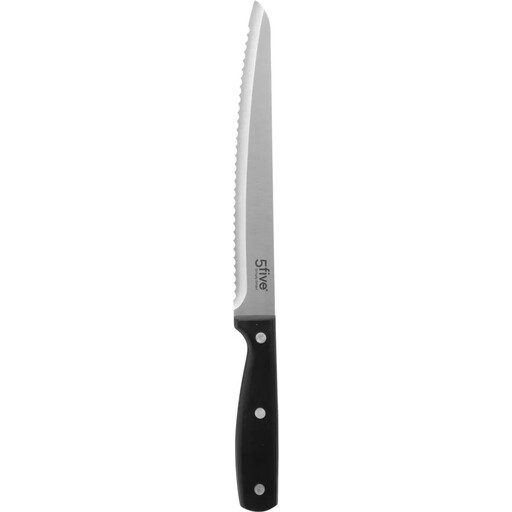
Why it suits this profile: At 33 cm long, it has plenty of reach for larger loaves and, according to the product specifications, it’s dishwasher-safe. That makes it a practical choice for everyday use without complicated care.
Its stated length means the blade won’t be too short for larger loaves. Check that the full 33 cm length will fit in your kitchen drawer or knife block.
Stainless-steel blade, ABS handle, 33 cm length and a product description stating that it’s dishwasher-safe.
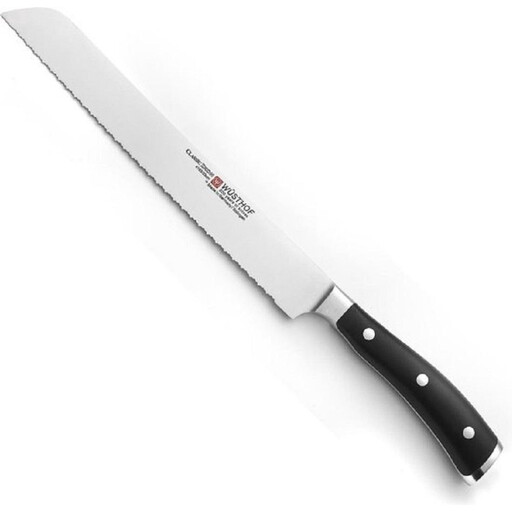
Why it suits this profile: This model combines a 23 cm blade with a double-sided serrated edge, a curved handle and a half bolster. It’s a good choice if you bake often or cut large loaves.
The product information specifies the type of serrated edge and the exact blade length. It also advises against using a dishwasher, so you’ll know how to care for it from the outset.
23 cm blade, double-sided serrated edge, X50CrMoV15 steel according to the product description, and suitable for both left- and right-handed use.
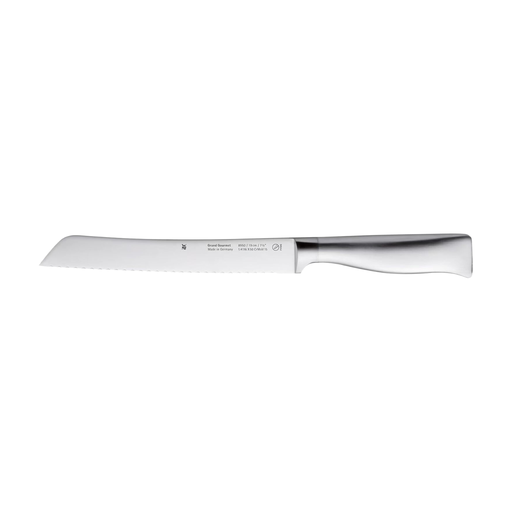
Why it suits this profile: This long version is designed for bread, soft rolls and fruit. Its all-metal Cromargan handle and stated double serrated edge make it well suited to intensive kitchen work.
The product information clearly states that it must be hand washed. That leaves no uncertainty about dishwasher use for a model with a metal finish.
32 cm overall length, double-sided serrated edge according to the product description, stainless-steel construction and forged handle.
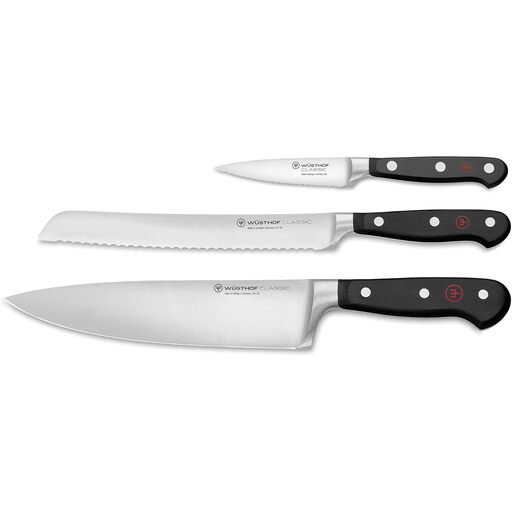
Why it suits this profile: If you need a chef’s knife and a paring knife as well as a bread knife, this set gives you three knives that are useful for everyday food preparation.
Rather than buying just a bread knife, you can check in advance exactly which knives are included: a chef’s knife, bread knife and paring knife.
Three knives, stainless-steel blades, plastic handles and, according to the product information, dishwasher-safe.
We’ve put together a complete, up-to-date list of products that meet these strict selection criteria and the applicable European safety regulations.
Yes. According to the product descriptions, various models can also be used for cake, fruit and vegetables with a tough skin. Some are also listed as suitable for crusty roasts. Use the knife only for food, and check after use that the blade hasn’t come into contact with a hard surface.
A 20 cm bread knife is easy to handle for smaller loaves and in kitchens with limited worktop space. A 23 cm bread knife gives you more reach for large loaves and tough crusts. Measure your storage space first, and check the overall product length, not just the blade length.
Wash the knife according to the product instructions, dry it straight away and store it safely. Hand washing is recommended for many stainless-steel and forged models. A serrated edge doesn’t need sharpening after every use; have the knife sharpened when sawing starts to require noticeably more pressure. Use a stable, non-slip surface when cutting.
