For your teenager’s school lunch, choose wholemeal bread if they enjoy eating it. According to the Netherlands Nutrition Centre, wholemeal bread contains more fibre than white bread. If the taste or texture is a sticking point, try finely milled wholemeal bread first, or alternate between white and wholemeal. Check the latest ingredients and allergen information for each loaf, and look for baker’s salt if that matters to your choice.
Who is this choice relevant to?
Parents of fussy bread eaters
You’re looking for bread to pack for school, while also seeing whether your teenager can get used to wholemeal. The Netherlands Nutrition Centre points out that wholemeal tastes different from white bread, and that it can take time to get used to.
Parents keeping an eye on fibre
You want to compare breads for lunch by their wholemeal labelling, ingredients and fibre per 100 g, rather than judging by colour alone.
Parents who need to check allergens
Before packing lunch, you need to check the packaging and any arrangements the school has in place. Bread made with wheat, rye or barley may contain gluten. If your child has a known allergy or other medical dietary requirement, take extra care when choosing a product.
What should you look for when choosing?
First, work out which bread your teenager will actually eat. Then compare the wholemeal labelling, fibre per 100 g and ingredients of the breads that could work.
Finely milled wholemeal bread
When: If your teenager is willing to eat wholemeal bread, a finer texture could be a good place to start.
The trade-off: Wholemeal can taste different from the familiar white loaf, even when it has a fine texture.
Alternating between white and wholemeal
When: If switching straight away doesn’t work, you can gradually alternate between the two types of bread in their school lunch.
The trade-off: Alternating isn’t the same as choosing wholemeal bread exclusively.
Brown bread
When: Brown bread is another option if your teenager wants to choose between white and wholemeal.
The trade-off: A brown colour doesn’t mean the bread is wholemeal.
White bread
When: White bread can be a temporary option if your teenager isn’t ready to eat the other types yet.
The trade-off: According to the Netherlands Nutrition Centre, white bread contains less fibre than wholemeal bread.
| What to consider |
What to check when buying |
Who it matters to |
| Taste and texture |
Compare a finely milled wholemeal loaf with the white bread your teenager is used to. If needed, try a smaller amount first. |
If lunch would otherwise come home uneaten, I want a manageable transition. Around 40% of consumers put taste and texture first when it comes to acceptance. |
| Wholemeal and fibre |
Look for the wholemeal label and compare fibre per 100 g. If you’re interested in baker’s salt, check the ingredients list too. |
For bread my teenager will eat every day, I like to compare the wholemeal labelling and nutritional information. For around 50% of consumers, this is the main consideration. |
| Allergens and school arrangements |
Read the latest allergen information and any cross-contamination warnings. Check the school’s arrangements too. |
If a pupil needs to avoid certain ingredients, I want to know which bread is suitable before packing it. For around 10% of consumers, this check is the top priority. |
Common mistakes
-
Mistaking brown or multigrain bread for wholemeal
A dark colour, seeds or several types of grain don’t prove that all the grain in the bread comes from wholemeal flour.
Look for the wholemeal label if that’s what you want. According to the Netherlands Food and Consumer Product Safety Authority, a product can only carry this label if all the grain ingredient is wholemeal flour.
-
Choosing a large, coarse loaf without trying the taste
Wholemeal tastes different from white bread. For a fussy teenager, a sudden switch could mean their lunch goes uneaten.
Try a smaller amount of finely milled wholemeal bread first, or gradually alternate between white and wholemeal.
Bread that comes home uneaten and is then thrown away can contribute to food waste.
-
Relying on the product name when checking for allergies
The name doesn’t tell you which allergens or possible cross-contamination warnings are listed on the latest packaging.
Read the packaging before packing lunch, and take the school’s or class’s arrangements into account.
-
Assuming every loaf contains baker’s salt
The Netherlands Nutrition Centre mentions bread made with baker’s salt in connection with iodine, but that doesn’t tell you what’s in a loaf you’re still deciding whether to buy.
Check the ingredients list for baker’s salt if it’s relevant to your purchase.
Bread brands compared
Jumbo
Jumbo Fijn Volkoren Half is worth considering if you’d like to try a smaller amount of finely milled wholemeal bread.
- Jumbo lists 7,6 g of fibre per 100 g for this particular bread.
- Check the packaging for the latest ingredients and allergen information.
Albert Heijn
AH Vloerbrood volkoren heel is a wholemeal option you can compare with other breads at product level.
- Albert Heijn’s product information lists more than 6 g of fibre per 100 g for this bread.
- Refer to the latest packaging for ingredients and allergen information.
ALDI
ALDI lists both white and finely milled wholemeal bread in its range, so you can consider both for a gradual switch.
- According to ALDI, its wholemeal breads are made with 100% wholemeal flour.
- Check the product name and packaging for each loaf. The range description doesn’t tell you what’s available at a particular store.
Lidl
Lidl lists white, brown, multigrain and wholemeal bread in its range.
- According to Lidl, its packaged breads have a fibre meter you can use to compare the stated fibre per 100 g.
- The fibre meter doesn’t replace the wholemeal label or allergen information.
PLUS Korenlanders
According to PLUS, Korenlanders Boeren tijger volkoren is also available as a half loaf.
- PLUS lists 6,4 g of fibre per 100 g for this particular product.
- Check the latest ingredients and allergen information for both the tiger-patterned crust and the bread itself.
Bakker van der Akker
Dirk lists a wholemeal batard under Bakker van der Akker, for anyone looking to try a different shape of bread.
- The product name identifies this batard as wholemeal.
- When buying, check the product information for ingredients, allergens and nutritional values.
A white-bread stopgap on Joybuy
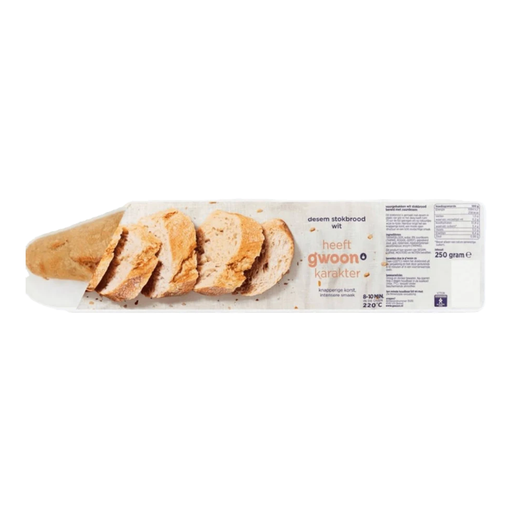
This white baguette is only suitable for the temporary white-bread option for a school lunch. It isn’t wholemeal bread or a mix of white and wholemeal.
 No image available
G'woon White Rustic Baguette, 250 g
A white baguette for anyone choosing white bread for their school lunch for now. Before packing it, check the latest packaging for ingredients, allergens and any cross-contamination warnings.
View on Joybuy
Frequently asked questions
Is brown bread automatically wholemeal?
No. According to the Netherlands Food and Consumer Product Safety Authority, a product can only be labelled wholemeal if all the grain ingredient is wholemeal flour. So don’t judge by the brown colour alone.
How can I help a fussy teenager get used to wholemeal bread?
You could try finely milled wholemeal bread, or gradually alternate between white and wholemeal. The Netherlands Nutrition Centre points out that wholemeal tastes different from white, so see which bread your teenager will actually eat.
What should I check about allergens for a school lunch?
Read the latest packaging for listed allergens and any cross-contamination warnings. If your child has a known allergy or other medical dietary requirement, check the school’s or class’s arrangements before packing the bread too.
When should I look for baker’s salt on the label?
Check the ingredients list for baker’s salt if iodine from bread matters to your choice. The Netherlands Nutrition Centre links iodine in bread specifically to bread baked with baker’s salt, so don’t assume every loaf has the same ingredients.


