
Vandaag of morgen in huis

Kwaliteit gegarandeerd

Welkomstaanbiedingen ontgrendelen: GRATIS bezorging | Tot 80% korting | Gratis 30 dagen JoyPlus-proefperiode
Download de app
Every mechanic and serious DIYer knows the frustration: that one bolt or nut that's just out of reach of your standard tools. Hidden behind an engine component, deep inside a machine, or tight against a brake line. A normal open-end or socket wrench won't fit, and your work grinds to a halt. It's for these exact situations that a specialist box-end wrench set is indispensable.
This article isn't a collection of marketing talk, but a practical guide. As a Joybuy Product Recommendation Officer, I'll help you make the right choice by focusing on what really matters: specifications and intended use. We'll look at different types of box-end wrenches designed to make your work in awkward angles and tight spaces easier.
Before we look at specific products, here are a few key points to help you choose a set that suits your projects.
Not every box-end wrench is a simple, straight bar. The shape is crucial for reaching hard-to-access fasteners.
The durability of your tools depends directly on the material used. For an automotive wrench set intended for heavy-duty use, chrome vanadium steel (Cr-V) is a common and reliable choice. This material is strong, wear-resistant, and well-protected against rust by a chrome layer. A mirror polish finish not only looks good but also makes the tools easier to clean.
Most quality box-end wrenches feature a 12-point (or double-hex) profile in the head. This design has two advantages:
Also, make sure you choose a set with metric tools, the standard measurement for virtually all European vehicles and machinery.
Based on the criteria above, we have selected a few popular choices that solve specific problems for mechanics and technicians.
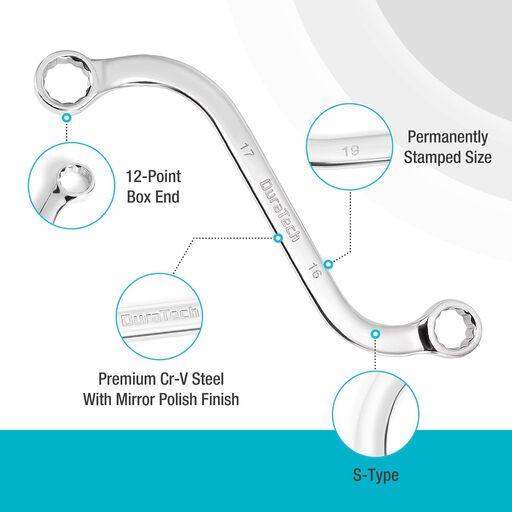
Why It Stands Out: The S-shape is specifically designed to manoeuvre around obstacles, making this set a lifesaver for work on engine blocks or complex machinery.
Advantages:
Who Is This For?: Automotive mechanics and technicians who regularly work in engine bays or other environments where lines and components block access to bolts.
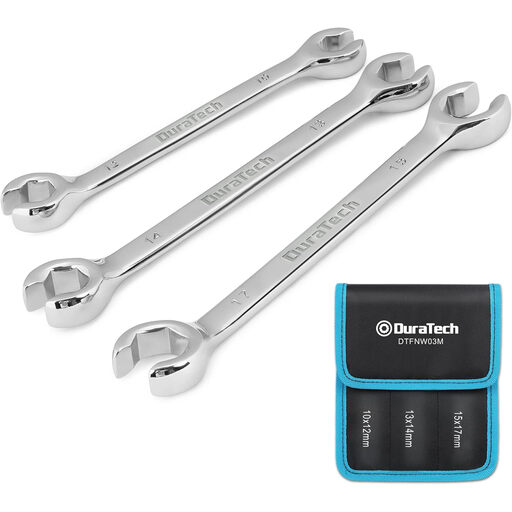
Why It Stands Out: This is a classic flare nut wrench set, essential for work on brake, fuel, and air conditioning systems. The opening allows the wrench to slide over a line.
Advantages:
Who Is This For?: Anyone who works on vehicle line systems. A must-have for safely loosening and tightening flare nuts without damaging them.

Why It Stands Out: The deep, 75-degree offset heads provide maximum clearance for your hands and make it possible to reach deep-set or recessed bolts.
Advantages:
Who Is This For?: The all-around mechanic or serious DIYer who needs a complete and versatile set to tackle almost any challenge in tight spaces.
Can't find exactly what you need here? No problem. For a broader overview of specialist hand tools, you can browse our range of box-end wrenches and related tools.
A 6-point (hex) box-end wrench fits perfectly onto a hexagonal bolt head and offers maximum contact surface. A 12-point (double-hex) box-end wrench, as the name suggests, has 12 points. This allows you to place the wrench on the bolt head in more positions, making it easier to turn in small increments in a tight space. For most applications, a 12-point wrench offers the best balance of flexibility and grip.
Standard straight wrenches work fine when you have direct access to a nut or bolt. An S-shaped wrench or an offset wrench is designed to reach around an obstruction. Think of a pipe, an alternator, or another component blocking the path to the bolt. The shape gives you the necessary clearance to still place the wrench on the bolt and apply force.
A brake line wrench, also called a line wrench or flare nut wrench, looks like a normal box-end wrench but has a small cutout in the ring. This opening is essential for sliding the wrench over a fixed line (like a brake or fuel line). The wrench then surrounds the flare nut on the line on almost all sides, providing much more grip than an open-end wrench and preventing the soft metal nut from getting damaged.
