
Artist with a delicate, bound sketchbook
You want to digitise pages without flattening the binding unnecessarily. Book thickness, page curvature and the drawing materials you use all affect your choice.


Choose an overhead scanner if you want to scan bound or delicate pages without pressing them against a flatbed; a flatbed scanner is an option if your work can safely lie flat. Then check that the scan size and supported book thickness suit your sketchbook, and use a test scan to see how it captures faint lines and paper colour. In a shared studio, the space needed for the setup and how users store their files also matter.
You want to digitise pages without flattening the binding unnecessarily. Book thickness, page curvature and the drawing materials you use all affect your choice.
You want to assess faint pencil lines, paper colour and subtle tonal transitions. A test scan using different techniques helps you compare the result with the original.
You need a setup that suits the page size and available space, with output files that studio users can find after scanning.
Choose this option: if you want to capture pages without pressing a bound sketchbook against a flatbed. CZUR describes its ET series as a book-scanning option with book flattening.
Keep in mind: check the supported book thickness and take a test scan. An A3 label or megapixel count alone tells you nothing about how pencil lines and paper colour will appear.
Choose this option: if studio users regularly scan larger, flat loose pages and a foldable setup would be useful. IRIS and CZUR describe models as A3 solutions.
Keep in mind: CZUR positions the Shine 800 A3 Pro for flat pages. Don’t assume it can replace a book scanner with flattening unless you’ve tested it first.
Choose this option: if your work fits within A4 and can safely lie flat on the glass. The Epson Perfection V39II and Canon CanoScan LiDE 400 are A4 flatbed models.
Keep in mind: a larger page won’t fit entirely on an A4 flatbed. For a bound book, also consider whether it can safely lie flat.
Choose this option: if you can lay a large bound page flat and need the book’s edge to sit close to the scanning edge. Plustek describes the OpticBook A300 Plus as having a book-edge design.
Keep in mind: the original still touches the glass. Plustek’s claim about reducing spine shadow doesn’t guarantee the same result with your sketchbook.
| What to consider | What should you check? | Who is this important for? |
|---|---|---|
| Bound pages | Check the supported book thickness and whether the model offers book flattening or overhead scanning. | I don’t want to flatten a bound book unnecessarily, so I take the binding and page curvature into account. Around 33% of consumers prioritise preserving the binding. |
| Subtle image details | Take a test scan of both faint pencil lines and coloured work, then compare it with the original. | I want to assess paper colour and fine lines, not just compare resolution figures. Around 27% of consumers prioritise subtle image details. |
| Page size | Measure the page with the margin you need, and check whether the stated size applies to loose sheets or also suits your scanning method. | I want to capture a larger page in one go, so I check that it fits entirely within the scanning area. Around 20% of consumers prioritise page size. |
| Shared use | Check the space needed during use, the computer and software required, and the output files you need. | I want to share the scanner with others and find scans easily. Around 20% of consumers place particular importance on a practical shared scanning station. |
CZUR distinguishes between its ET book-scanning option with flattening and the Shine 800 A3 Pro for flat pages. So the scan size alone doesn’t tell you whether a bound book will fit the setup.
Measure both the page and the book thickness, and check the requirements for the exact model.
A page outside the usable range may mean rescanning or extra editing.
A stated dpi or megapixel figure alone doesn’t tell you how faint lines and paper colour will appear. A Dutch digitisation service points out that strong automatic contrast enhancement can remove subtle details.
Compare a test scan with the original, including both faint pencil lines and colour.
The book-edge design of the Plustek OpticBook A300 Plus doesn’t prevent the original from touching the glass.
Assess the binding and drawing materials separately. If the work mustn’t touch the glass, choose a suitable contactless option.
CZUR describes its ET models as a book-scanning option with flattening, and the Shine 800 A3 Pro as a solution for flat loose pages.
The IRIScan Desk 6 Pro is an A3 document camera. IRIS lists JPG and PDF output for this model.
Plustek positions the OpticBook A300 Plus as an A3 book-edge flatbed scanner for bound pages.
The Perfection V39II is an A4 flatbed scanner for photos and documents.
The CanoScan LiDE 400 is an A4 flatbed scanner with a USB-C connection and a Z-lid.
These picks suit shared studio work: an A4 feed-through option for thin booklets and an A3 document camera for flat loose pages. They represent different scanning methods, so check that each model suits your original work.
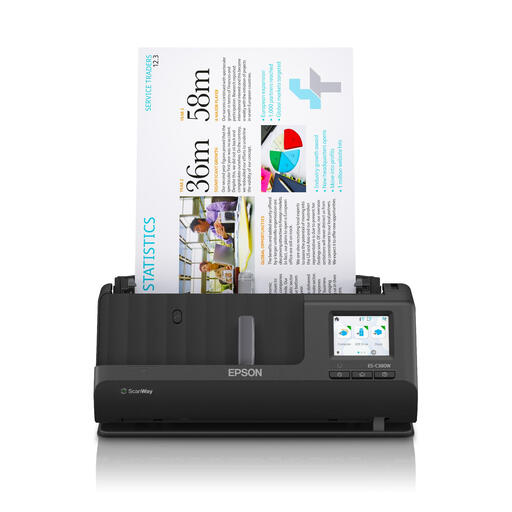 No image available
Could suit a shared scanning station for thin booklets, provided the straight-through feed is suitable for the work in question.
Specifications: A4; 600 × 600 dpi; straight-through feed for booklets up to 5 mm thick; network use for multiple users.
The 5 mm limit is key. Check that your booklet can be fed through without forcing it.
 No image available
Suited to a shared workspace where users want to capture flat loose pages up to A3 and fold the camera away after use.
Specifications: up to A3 size for flat sheets; foldable design; 8 MP CMOS sensor.
This option is designed for flat loose pages. It isn’t the same as a book scanner with flattening for bound sketchbooks.
Start with a test scan using the materials you work with, then compare faint pencil lines, paper colour and any texture with the original. If there’s loose pigment, consider whether contact with a flatbed is safe, and don’t force a bound page flat.
Before buying, check the space required and the computer and software needed for your chosen model. Also agree how files will be named, stored and cleared out, so users can find their scans and files aren’t accidentally left on a shared computer.
If you buy as a consumer and a product is faulty, you may be entitled to a free repair or replacement, or in some circumstances a refund. The Dutch government states that there is no fixed statutory guarantee period in the Netherlands. Check whether the studio’s purchase is a consumer or business purchase; the information above relates to consumer rights.
In the Netherlands, artists automatically hold copyright in their drawings. The Dutch government distinguishes between making a copy for personal use and distributing or publishing someone else’s protected work. Get permission or establish another applicable legal basis before sharing scans like these. The Dutch Data Protection Authority notes that identifiable people in images may be personal data, so privacy rules may also apply, depending on how the images are used.