Who are these speakers for?

The jazz listener at their desk

You listen at close range and want to hear vocals, piano and instruments in a useful stereo image. So look beyond the model name and consider the dimensions and placement too. Genelec points out that similar reflections on the left and right help create an accurate stereo image.

The computer listener without an amplifier

You want to connect a pair of speakers directly to a computer. Check the inputs on the exact active model: Edifier lists analogue inputs for the MR4, for example, while Audioengine specifies USB-C audio for the A2+ Gen 3.

The hi-fi owner with an amplifier

You want to add passive speakers to an existing system. Compare the speakers’ load with your amplifier’s specifications, and measure the available space too. ELAC lists a nominal impedance of 6 Ω for the DB53.

What should you look for?

Compact active desktop speakers

A good fit if: you listen at close range and want to connect a computer without a separate amplifier. Check that the model’s input is compatible with your computer.

The trade-off: the amplifier and speakers come as one system, so they’re less easy to replace separately. With a compact cabinet, it’s also worth having realistic expectations about bass response.

Active system with more source options

A good fit if: you want to connect another audio source as well as a computer. Edifier lists optical, coaxial, dual RCA and Bluetooth inputs for the R1280DB; KEF lists USB-C and network playback for the LSX II LT.

The trade-off: connections vary between models. Check that your computer and other sources have the right outputs.

Passive speakers with a separate amplifier

A good fit if: you already own an amplifier or want to choose your speakers and amplification separately. Compare the electrical specifications of both devices.

The trade-off: the amplifier and cables are part of the setup. ELAC lists a nominal impedance of 6 Ω and a recommended amplifier power of 20–120 W for the DB53.

What to consider What should you check? Who is this important for?
Placement and stereo image Measure the width and depth; check that you can angle both speakers towards your usual listening position. If I listen at close range, I want to position both speakers to suit the space and as symmetrically as possible. Around 33% of consumers prioritise placement on the desk above all else.
Connecting without an amplifier Compare your computer’s output with the exact USB, analogue or digital input on the model. If I want to listen from my computer without a separate amplifier, I’m looking for an active system with a compatible input. Around 25% of consumers prioritise direct connection.
Compatibility with an amplifier Compare the nominal impedance and recommended amplifier power; also check whether the system is sold as a pair or as individual speakers. If I already own an amplifier, I want to know whether the passive speakers are compatible. Around 25% of consumers choose mainly on the basis of the amplifier they already have.
Desired bass response Check the measurement conditions for the frequency range, and consider them alongside the cabinet size and placement. Check for a subwoofer output using the full model name. If the double bass is important in my jazz recordings, I want to take bass response into account without relying on a single quoted frequency. Around 17% of consumers prioritise fuller bass.

Common buying mistakes

  • Choosing based only on frequency range or wattage

    A frequency limit depends on how it’s measured, and the room affects the perceived bass balance. Power figures for different active models don’t tell you directly how a live jazz recording will sound at your desk.

    Check the measurement conditions, compare cabinet dimensions and think about placement. If you’re considering a subwoofer output, check it against the full model name.

  • Treating a passive speaker as a complete stereo system

    Passive speakers need a compatible amplifier. Also check whether the offer includes a pair or a single speaker, so you get the right setup for your needs.

    Compare the electrical specifications with your amplifier and check how many speakers are included before you decide.

  • Assuming similar model numbers mean the same version

    A small difference in a model name can indicate different connection options. Specifications for one version don’t automatically apply to a related model.

    Check the full model name and the connections on the exact version you want to buy.

Brands to consider

Edifier

Edifier offers active models to suit different connection needs, including the MR4 for analogue desktop sources and the R1280DB for optical and coaxial sources, among others.

  • According to Edifier, the MR4 has two RCA/AUX inputs and a headphone output on the front. Edifier lists Bluetooth, optical, coaxial and dual RCA inputs for the R1280DB.
  • These are model specifications, not the result of an independent listening test. Check the full model name: the R1280DB is not the same model as the R1280DBs.

Audioengine

According to Audioengine, the active A2+ Gen 3 is a compact desktop option with USB-C audio, analogue inputs and Bluetooth.

  • Audioengine also lists an RCA output for adding a subwoofer.
  • The connections and dimensions apply to the Gen 3 and don’t necessarily apply to earlier A2+ versions.

KEF

According to the Dutch product page, the active LSX II LT combines computer playback via USB-C with network playback.

  • KEF lists USB-C, network features and a subwoofer output for this model.
  • Check whether you’ll use the extra features and whether the setup will fit the available space on your desk.

DALI

According to DALI, the passive KUPID can be placed on a shelf or mounted using the supplied wall bracket.

  • These placement options may be useful if you have limited desk space.
  • You’ll also need to choose a compatible amplifier for passive speakers. Check whether the offer is for one speaker or a pair.

ELAC

The passive Debut 3.0 DB53 is designed for a stereo system assembled from separate components.

  • ELAC lists a front-firing port, a nominal impedance of 6 Ω and a cabinet depth of 267 mm.
  • A front-firing port doesn’t eliminate the effect of the room and speaker placement. Check your amplifier and available depth too.

Speakers at Joybuy

This selection includes compact active desktop speakers for computer use and passive bookshelf speakers for use with a separate amplifier.
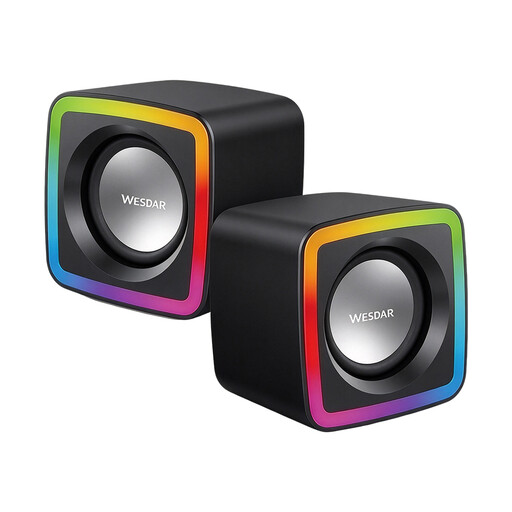
Compact RGB gaming speakers in a stereo set for PC and desk

Compact RGB gaming speakers in a stereo set for PC and desk

A stereo set for computer and desktop use, as stated in the product title.

The description lists Bluetooth 5.3, USB and 3.5mm AUX.

View on Joybuy
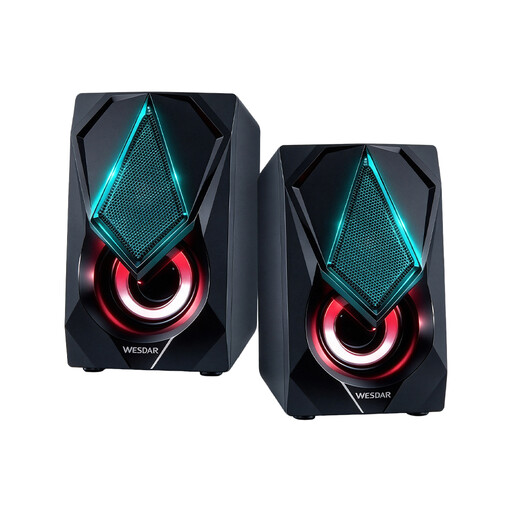
Compact stereo desktop speakers with coloured LED lighting

Compact stereo desktop speakers with coloured LED lighting

A compact stereo set for a workspace; the description mentions music and workspaces.

The stated dimensions are approximately 120 × 72 × 88 mm per speaker.

View on Joybuy
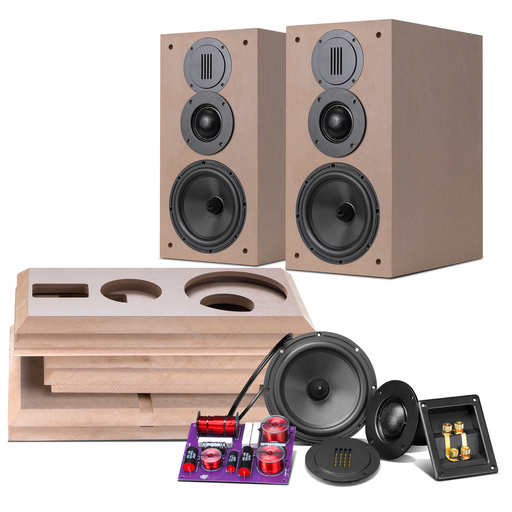
HiVi-Swans DIY3.1 passive 6.5-inch bookshelf speakers, pair

HiVi-Swans DIY3.1 passive bookshelf speakers, 6.5-inch, pair

A pair of passive bookshelf speakers for use with a separate amplifier.

The product title specifies a 6.5-inch version and a pair of speakers. A separate amplifier is required.

View on Joybuy
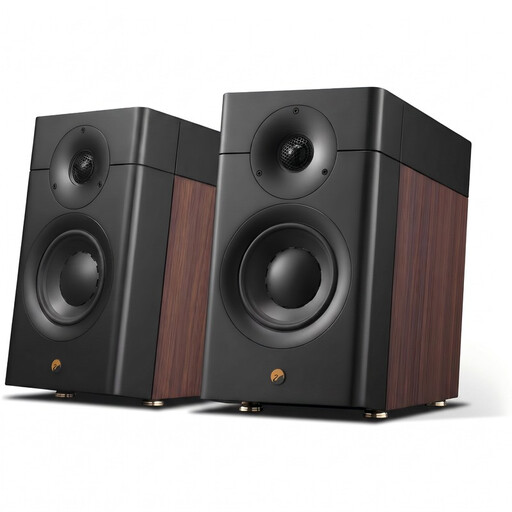
HiVi-Swans D3.1MKII passive 6.5-inch bookshelf speakers, pair

HiVi-Swans D3.1MKII passive bookshelf speakers, 6.5-inch, pair

A pair of passive bookshelf speakers for a workspace or home studio with a separate amplifier.

The product title specifies a 6.5-inch version and a pair of speakers. A separate amplifier is required for use.

View on Joybuy
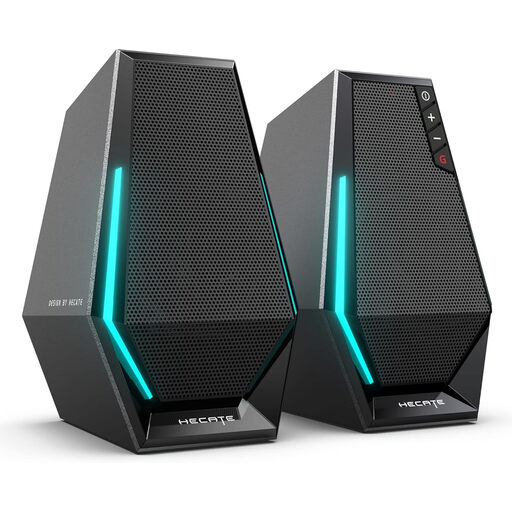
Edifier G1500 computer speakers with RGB, Bluetooth 5.3, USB and 3.5mm AUX

Edifier G1500 computer speakers with RGB

Computer speakers for computer and desktop use; the description specifies stereo playback.

The description lists Bluetooth 5.3, USB and 3.5mm AUX.

View on Joybuy

Frequently asked questions

How should I position two speakers on my desk?

Angle both speakers towards your usual listening position and try to place them as symmetrically as possible. Genelec describes an equilateral triangle as a starting point for monitor placement and notes that desks, walls and the room affect the sound you hear. This doesn’t guarantee the same result with every model.

Can I connect passive bookshelf speakers directly to my laptop?

Passive speakers need a compatible amplifier. Before buying, check the speaker load and the amplifier’s specifications. If you want to connect directly to a computer, an active system with a compatible input is the simpler option.

Am I always entitled to just a two-year warranty in the Netherlands?

No. According to the Dutch government, the expected lifespan depends, among other things, on the product and what you’ve been told about it. If there’s a problem, the seller must provide a solution; a manufacturer’s warranty is in addition to this.

Can I return a pair of speakers bought online?

For many applicable distance purchases, the Dutch government says you have a 14-day cooling-off period, although exceptions apply. Before buying, check the seller’s information and the terms and conditions that apply to your order.

Does a speaker sold in the Netherlands need a CE marking?

That depends on the applicable EU rules for the exact product. The European Commission lists electrical and electronic equipment as a category for which specific rules may require a CE marking. Don’t assume that the term ‘bookshelf speaker’ means the same rules apply to a passive cabinet and an active or wireless system.
